On this page
Interests and Annuities is Chapter 13 of CBSE's Applied Mathematics XI student support material (second edition, April 2026). It covers simple and compound interest, the effective rate, and the future and present value of annuities.
How many marks is Interests and Annuities in Class 11 Applied Maths?
The CBSE 2026-27 Applied Mathematics (241) curriculum gives Unit VI, Basics of Financial Mathematics, 15 marks out of an 80-mark theory paper, with 20 marks for internal assessment. Those 15 marks are shared with Tax and Utility Bills, so CBSE prints no separate figure for this chapter.
The curriculum's content for this chapter:
interest rates: nominal, effective and real rates compared
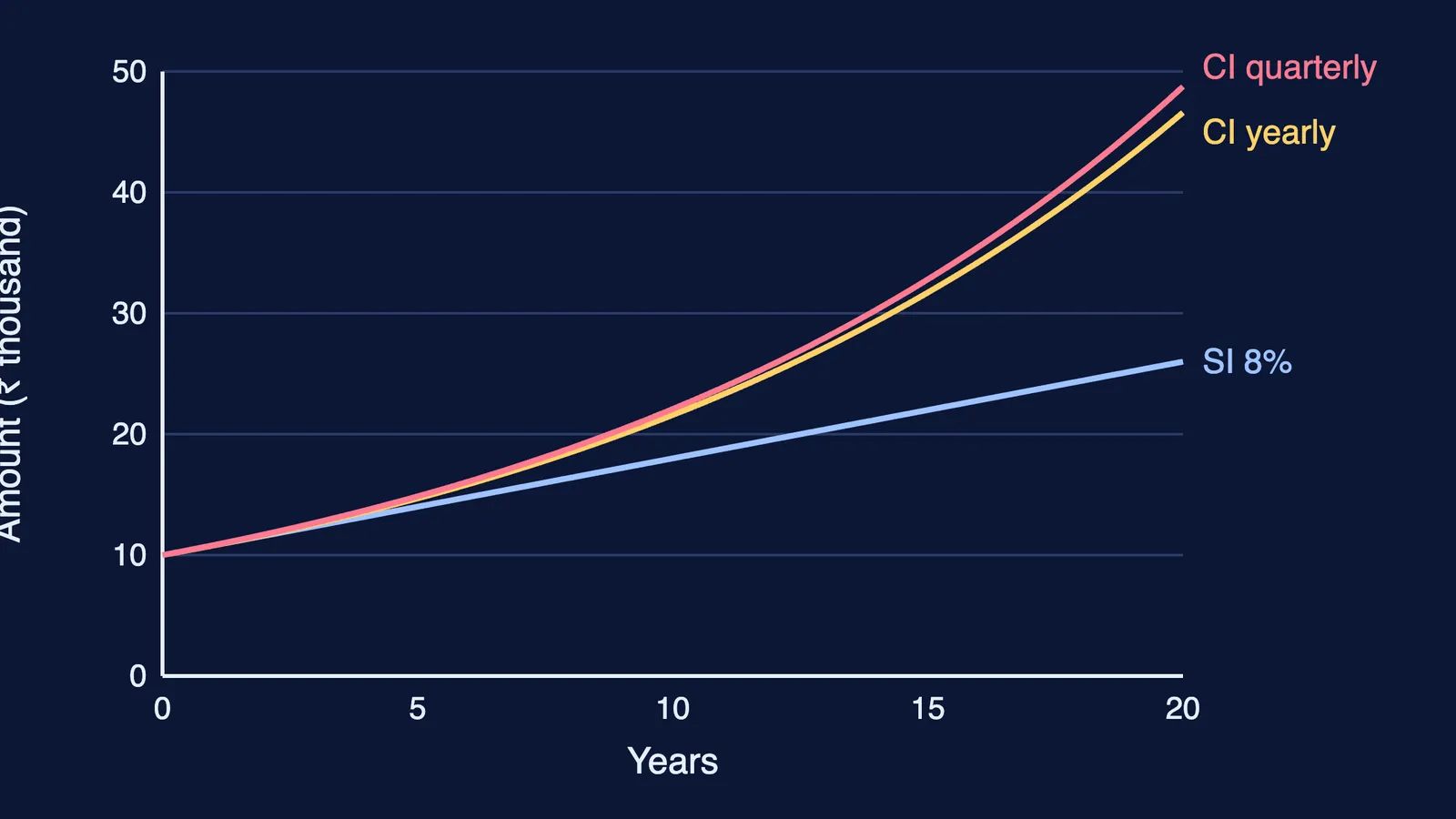
simple and compound interest in practical problems
the effective rate of interest
the meaning of immediate (ordinary) annuity, annuity due and deferred annuity
future and present value of an ordinary annuity and an annuity due, "up to 3 period"
Deferred annuities are asked as a meaning, and the book gives no formula for them. The real interest rate appears only in words, linked to inflation. Continuous compounding is mentioned as a limit, without a formula.
Which formulas do you need?
P is the principal, i the rate per period (decimal), n the number of periods and R the payment per period.
Simple interest: I = P × i × n
Compound amount: A = P(1 + i)ⁿ, and CI = A − P
Effective annual rate with nominal rate i compounded n times a year: (1 + i/n)ⁿ − 1
Future value, ordinary annuity: FV = R × [(1 + i)ⁿ − 1] / i
Present value, ordinary annuity: PV = R × [1 − (1 + i)⁻ⁿ] / i
Annuity due: multiply either value by (1 + i), since every payment is one period earlier
An ordinary annuity pays at the end of each period; an annuity due pays at the start. The annuity sums are geometric series, which is why the Class 11 Applied Maths guide to sequences and series is worth revising first.
Worked example: which rate, and what is an annuity worth?
All figures here are illustrative, for practice only, and are not financial advice.
Part 1. Three deposits are on offer: A pays 8.8% a year compounded quarterly, B pays 9% compounded half-yearly and C pays 9.15% compounded once a year. Which earns most?
A: (1 + 0.088/4)⁴ − 1 = 1.022⁴ − 1 ≈ 9.095%
B: (1 + 0.09/2)² − 1 = 1.045² − 1 = 9.2025%
C: compounded yearly, so the effective rate is 9.15%
B wins, though A compounds most often and C has the highest headline rate: compare effective rates, not headline rates.
Part 2. Kavya saves ₹25,000 a year for 3 years at 7% a year compounded annually. Here 1.07³ = 1.225043.
Ordinary annuity, future value: 25,000 × 0.225043 / 0.07 = 25,000 × 3.2149 = ₹80,372.50.
Check by hand: the first payment grows for 2 years, the second for 1, the third not at all. 28,622.50 + 26,750 + 25,000 = ₹80,372.50.
Annuity due, future value: 80,372.50 × 1.07 ≈ ₹85,998.58.
Ordinary annuity, present value: 25,000 × (1 − 1/1.225043) / 0.07 ≈ 25,000 × 2.624316 ≈ ₹65,607.90.
Annuity due, present value: 65,607.90 × 1.07 ≈ ₹70,200.45.
A neat check: PV × 1.07³ should equal FV, and 65,607.90 × 1.225043 ≈ ₹80,372.50. For longer streams and the GP derivation, see our explainer on annuity and perpetuity present value.
Practice questions
These are our own questions, and the mark values are our suggestion, not CBSE's.
(1 mark) Find the effective annual rate for 7% a year compounded quarterly.
(2 marks) On ₹12,000 for 3 years at 6% a year, how much more does annual compounding earn than simple interest?
(3 marks) Find the present value of ₹6,000 paid at the start of each quarter for 3 quarters at 8% a year compounded quarterly.
(4 marks) A loan of ₹50,000 is repaid in 3 equal payments at the end of each year at 8% a year compounded annually. Find each payment, and show that the balance is zero after the third.
Answers: 1. 1.0175⁴ − 1 ≈ 7.186%. 2. SI = ₹2,160, CI = 12,000 × (1.06³ − 1) ≈ ₹2,292.19; difference ₹132.19. 3. i = 0.02: 6,000 + 6,000/1.02 + 6,000/1.02² ≈ ₹17,649.37. 4. R = 50,000 × 0.08 / (1 − 1.08⁻³) ≈ ₹19,401.68; the balances run ₹34,598.32, then ₹17,964.51, then about zero.
How should you revise this chapter?
Write all six formulas from memory, then check them against the book.
For every problem, first write P or R, i and n per period, and whether payments fall at the start or end.
Rebuild the curriculum's suggested practical: a spreadsheet comparing simple and compound interest year by year.
Stuck on a step? Fermi's AI tutor teaches, explains and works through problems alongside the student.