On this page
Matrices and Determinants is the whole of Unit II, Algebra, in Class 12 Applied Mathematics (241). Here is the 2026-27 syllabus, how the sample paper marks it, and a shop-bill problem solved with Cramer's rule.
What does the 2026-27 syllabus include, and how many marks?
In the CBSE Applied Mathematics curriculum for 2026-27, Unit II Algebra carries 10 of the 80 theory marks in Class 12. In Class 12 that unit contains only this chapter, so the 10 marks belong to matrices and determinants.
Its six topics:
Matrices, types and order, with data in matrix form.
Equality, transpose, and symmetric and skew-symmetric matrices.
Addition, subtraction, scalar multiplication and matrix multiplication.
Determinants, singular and non-singular matrices, and |AB| = |A||B|.
Inverse by cofactors, with (AB)⁻¹ = B⁻¹A⁻¹, (A⁻¹)⁻¹ = A and (A′)⁻¹ = (A⁻¹)′.
Up to three non-homogeneous equations, solved by Cramer's rule or the inverse of the coefficient matrix, including real-life problems you set up yourself.
The prescribed text is Chapter 2 of CBSE's Applied Mathematics Class XII support material (first edition, July 2021). The chapter PDF also has properties of determinants, area of a triangle, inverse by elementary row operations, a row-reduction method and the Leontief input-output model. The 2026-27 curriculum names none of these, so treat them as background.
How is it different from core Maths matrices?
Both subjects give Algebra 10 marks in Class 12. The core Mathematics (041) curriculum names one method for solving systems: the inverse of a matrix, for two or three variables with a unique solution. It also lists area of a triangle and consistency of systems by examples. The Applied Maths curriculum names Cramer's rule as well, and asks you to turn real-life problems into equations. For the core version, see our Matrices and determinants Class 12 board guide. Still choosing a subject? Read who should take CBSE Applied Mathematics.
How does the sample paper mark this chapter?
The 2026-27 Applied Maths sample paper has matrices in a 1-mark MCQ, a 1-mark assertion-reason question, a 3-mark question on a 2×2 matrix and its inverse, and a 5-mark question with an internal choice: Cramer's rule for a factory, or decoding a message with an inverse matrix.
In the marking scheme, the 5-mark Cramer's rule answer gives 1½ marks for writing the three equations, ½ each for Δ, Δx, Δy and Δz, ½ for the values, and 1 for the final statement in words. Setting up the equations outweighs any single determinant.
The assertion-reason answer turns on a common slip: |kA| = kⁿ|A| for a matrix of order n, not k|A|.
How do you solve a business problem with Cramer's rule?
A stationery shop prices pens at ₹x, notebooks at ₹y and files at ₹z (our numbers). Three bills:
1 pen, 2 notebooks, 1 file: ₹120
3 pens, 1 notebook, 2 files: ₹135
2 pens, 1 notebook, 3 files: ₹145
Equations: x + 2y + z = 120, 3x + y + 2z = 135, 2x + y + 3z = 145.
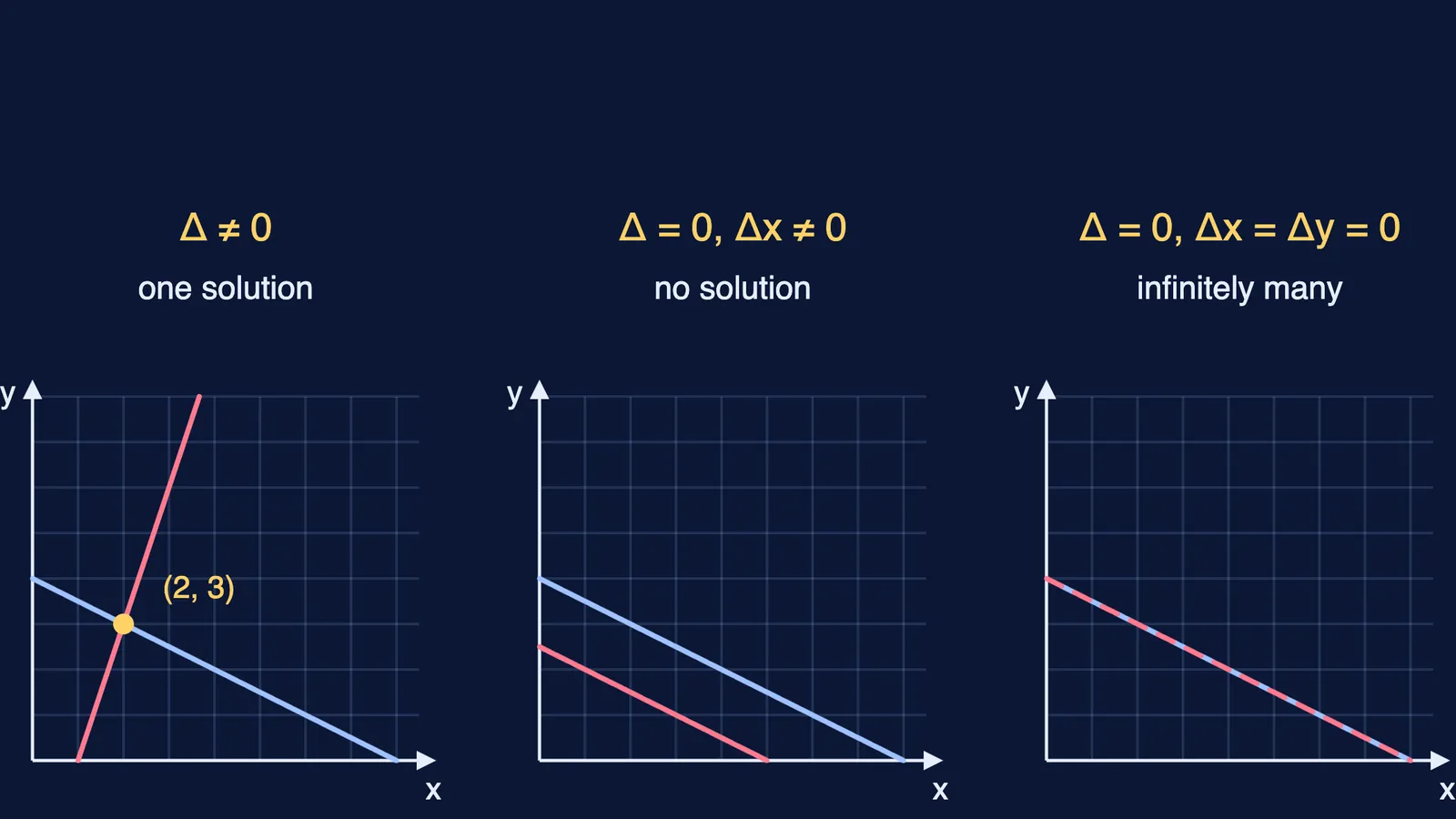
Δ, from the coefficients: 1(3 − 2) − 2(9 − 4) + 1(3 − 2) = 1 − 10 + 1 = −8. Δ ≠ 0, so there is exactly one solution.
Δx, with the first column replaced by 120, 135, 145: 120(1) − 2(405 − 290) + 1(135 − 145) = −120.
Δy, second column replaced: 1(405 − 290) − 120(9 − 4) + 1(435 − 270) = −320.
Δz, third column replaced: 1(145 − 135) − 2(435 − 270) + 120(3 − 2) = −200.
x = −120/−8 = 15, y = −320/−8 = 40, z = −200/−8 = 25.
So a pen costs ₹15, a notebook ₹40 and a file ₹25. Check: 15 + 80 + 25 = 120, 45 + 40 + 50 = 135, 30 + 40 + 75 = 145.
The inverse method agrees: adj A has rows (1, −5, 3), (−5, 1, 1), (1, 3, −5), A(adj A) = −8I, and X = (adj A)B/(−8) = (15, 40, 25).
Practice questions
Mark values follow the 2026-27 sample paper's 1-, 3- and 5-mark question types. For more drills, see our step-by-step guide to Cramer's rule with three unknowns.
Quick check (1 mark): A is a 3×3 matrix with |A| = 5. Find |3A| and |adj A|. (Answers: 135 and 25.)
Short answer (3 marks): At a canteen, 3 teas and 2 samosas cost ₹110, and 2 teas and 5 samosas cost ₹165. Use Cramer's rule to find each price. (Answer: Δ = 11, tea ₹20, samosa ₹25.)
Long answer (5 marks): A family puts ₹x, ₹y and ₹z thousand into three schemes, with x + y + z = 11, x − y + 2z = 12 and 3x + y − z = 9. Solve by the inverse of the coefficient matrix. (Answer: |A| = 10; x = 4, y = 2, z = 5.)
Stuck on a cofactor sign? The Fermi Problem Library has worked problems with a step-by-step solver that explains the reasoning rather than printing an answer.