On this page
Circle and Parabola is the last chapter of the CBSE Applied Mathematics XI student support material (second edition, April 2026). It treats both curves as a locus, and its applications are business ones such as delivery zones.
How many marks is Circle and Parabola in Class 11 applied maths?
The CBSE 2026-27 Applied Mathematics (241) curriculum gives Unit VII, Coordinate Geometry, 05 of 80 theory marks. Straight Lines shares that unit, so this chapter has no separate figure.
How is it different from conic sections in core maths?
Core Mathematics (041) also covers the ellipse and hyperbola, per the CBSE 2026-27 Mathematics curriculum. Applied Mathematics drops both. If you also take core maths, our conic sections Class 11 guide covers the wider chapter.
What are the four forms of a circle's equation?
A circle is every point at distance r (the radius) from a fixed centre, per the support material.
Standard form, centre at the origin: x² + y² = r².
Central form, centre (h, k): (x − h)² + (y − k)² = r².
Diameter form, ends (x₁, y₁) and (x₂, y₂): (x − x₁)(x − x₂) + (y − y₁)(y − y₂) = 0.
General form: x² + y² + 2gx + 2fy + c = 0, with centre (−g, −f) and radius √(g² + f² − c).
It is a real circle only when g² + f² − c > 0; zero gives a point circle, and a negative value gives no real points.
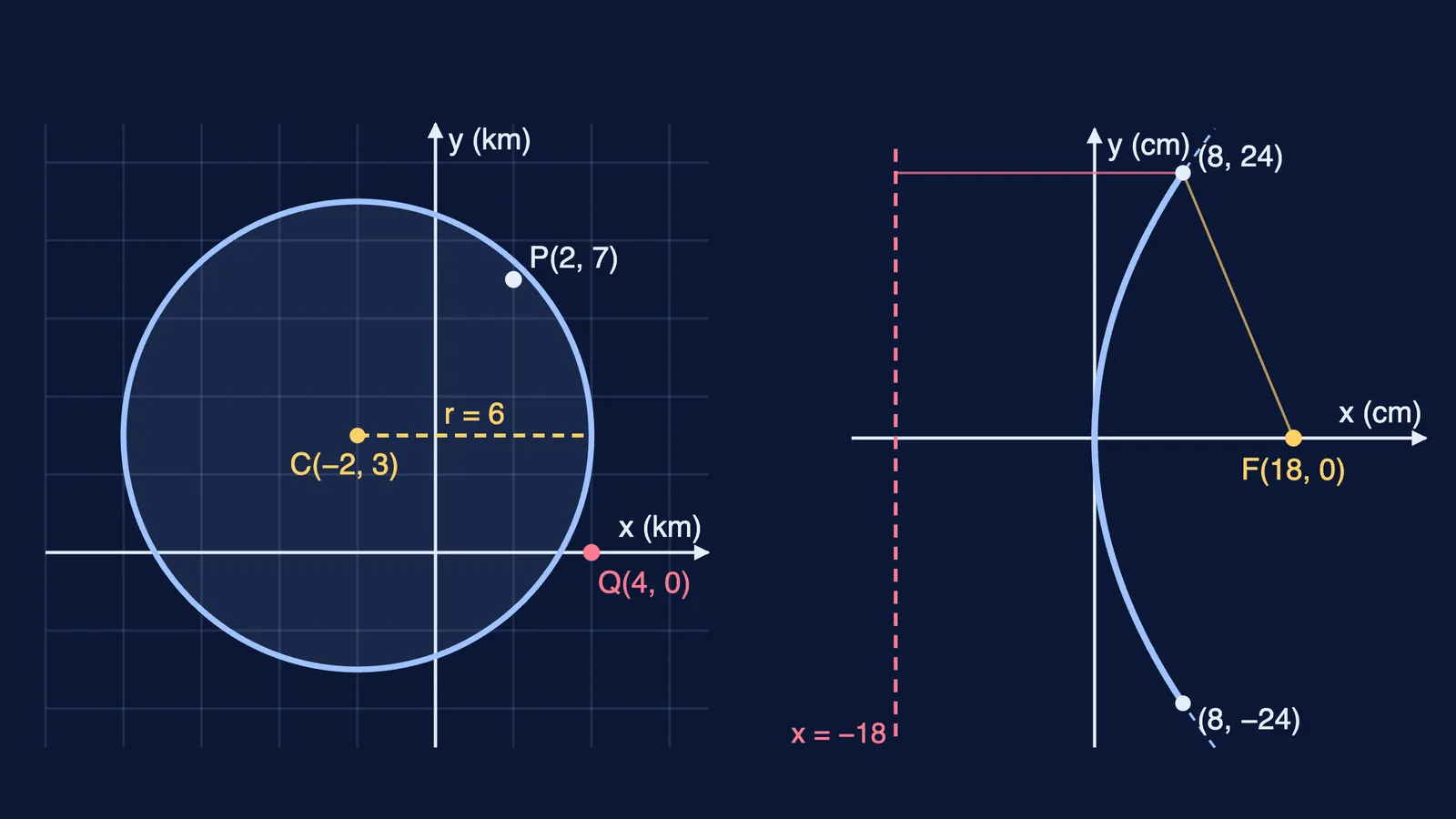
Worked example 1. A pharmacy at C(−2, 3) on a km grid delivers up to 6 km. Central form: (x + 2)² + (y − 3)² = 36. Expanding gives x² + y² + 4x − 6y − 23 = 0.
Check: g = 2, f = −3, c = −23 give r = √(4 + 9 + 23) = 6.
Is P(2, 7) covered? 4 + 49 + 8 − 42 − 23 = −4. Negative means inside (squared distance 32 < 36). Q(4, 0) gives +9, so Q is outside.
Worked example 2. A plot's diameter runs from A(1, −2) to B(7, 6): (x − 1)(x − 7) + (y + 2)(y − 6) = 0, so x² + y² − 8x − 4y − 5 = 0. Check: r = √(16 + 4 + 5) = 5, half of AB = √(36 + 64) = 10.
What are the parabola's focus, directrix and latus rectum?
A parabola is every point equally far from a fixed line (the directrix) and a fixed point off it (the focus), per the support material. With the vertex at the origin:
y² = 4ax: opens right, focus (a, 0), directrix x = −a.
y² = −4ax: opens left, focus (−a, 0), directrix x = a.
x² = 4ay: opens up, focus (0, a), directrix y = −a.
x² = −4ay: opens down, focus (0, −a), directrix y = a.
Here a > 0, and the latus rectum (the focal chord perpendicular to the axis) is 4a long.
Worked example 3. A dish is 48 cm across and 8 cm deep. Put the vertex at the origin with the x-axis as the line of symmetry; then the rim passes through (8, 24). Then 24² = 4a × 8, so 576 = 32a and a = 18. The equation is y² = 72x, the focus is (18, 0), the directrix is x = −18, and the latus rectum is 72 cm.
Check: (8, 24) is √(10² + 24²) = 26 cm from the focus and 8 + 18 = 26 cm from the directrix.
Ignoring air resistance, a projectile's path is a parabola, per NCERT Physics Class 11, Motion in a Plane. For dishes, see the reflection property of the parabola.
What questions should you practise?
We wrote these questions. The mark labels are our suggestion, not CBSE's; your school's paper may differ.
(1 mark) Find the centre and radius of x² + y² − 10x + 8y + 5 = 0. Answer: (5, −4), radius 6.
(2 marks) Does x² + y² + 6x − 2y + 15 = 0 represent a circle? Answer: no, since g² + f² − c = 9 + 1 − 15 = −5.
(2 marks) Find the parabola with focus (0, 2.5) and directrix y = −2.5, and its latus rectum. Answer: x² = 10y; 10.
(3 marks) Find the circle on the diameter joining (−3, 1) and (5, 7). Answer: x² + y² − 2x − 8y − 8 = 0, centre (1, 4), radius 5.
(4 marks, case-based) A fountain jet peaks at the origin and falls 2 m over 8 m horizontally. Taking x² = −4ay, find a, the equation and the drop at x = 4 m. Answer: a = 8, x² = −32y, 0.5 m.
Not sure which form a question wants? Fermi's AI tutor works out what you already know and builds a plan for the session. For how this elective fits your subjects, see our CBSE Applied Mathematics overview.