On this page
Linear Programming is Unit VIII of the CBSE Class XII Applied Mathematics (241) curriculum for 2026-27, carrying 08 of the 80 theory marks (CBSE Applied Mathematics curriculum 2026-27). Work from Chapter 8 of the CBSE Applied Mathematics XII support material.
What does the 2026-27 syllabus cover?
The curriculum lists the terminology (decision variables, constraints, objective function, optimisation, non-negative constraints), formulating an LPP with up to three non-trivial constraints, types such as manufacturing and diet problems, the corner-point method, bounded and unbounded regions, and optimal feasible solutions.
The support material chapter also shows transportation problems and the iso-profit method; the curriculum names neither, so treat them as extra practice.
How is it different from core Maths linear programming?
Core Mathematics (041) gives Linear Programming 05 marks and lists the terminology and graphical method, with up to three non-trivial constraints (CBSE Mathematics curriculum 2026-27). Applied Maths gives it 08 and adds formulating named problem types. The graph work is the same, so our core Class 12 linear programming guide covers the method.
In the Applied Maths sample paper 2026-27, the chapter appears as a 1-mark MCQ, a 2-mark question on writing constraints from a graph, and a 5-mark profit word problem. In the marking scheme for that 5-mark question, ½ mark goes to the profit per unit and 1½ to writing the LPP, then 2 to the graph and 1 to the corner-point table.
How do you formulate an LPP from a business problem?
Name the decision variables with units ("x desks per week").
Use net figures in the objective: profit per unit = selling price minus cost.
Write one inequality per limited resource; "at most" gives ≤, "at least" gives ≥.
Add x ≥ 0, y ≥ 0.
More drill: our guide to formulating LPP word problems.
Worked example: a furniture workshop
Our own problem: a workshop makes desks and shelves. A desk sells for ₹2,600 using ₹1,700 of material; a shelf sells for ₹1,400 using ₹700. Weekly, cutting takes 3 hours per desk and 1 per shelf, with 27 hours available; storage holds at most 13 items; finishing takes 1 hour per desk and 4 per shelf, with 40 hours available. Find the most profitable weekly plan.
Formulate. Let x desks and y shelves be made per week. Profit per desk = 2,600 − 1,700 = ₹900; per shelf = 1,400 − 700 = ₹700.
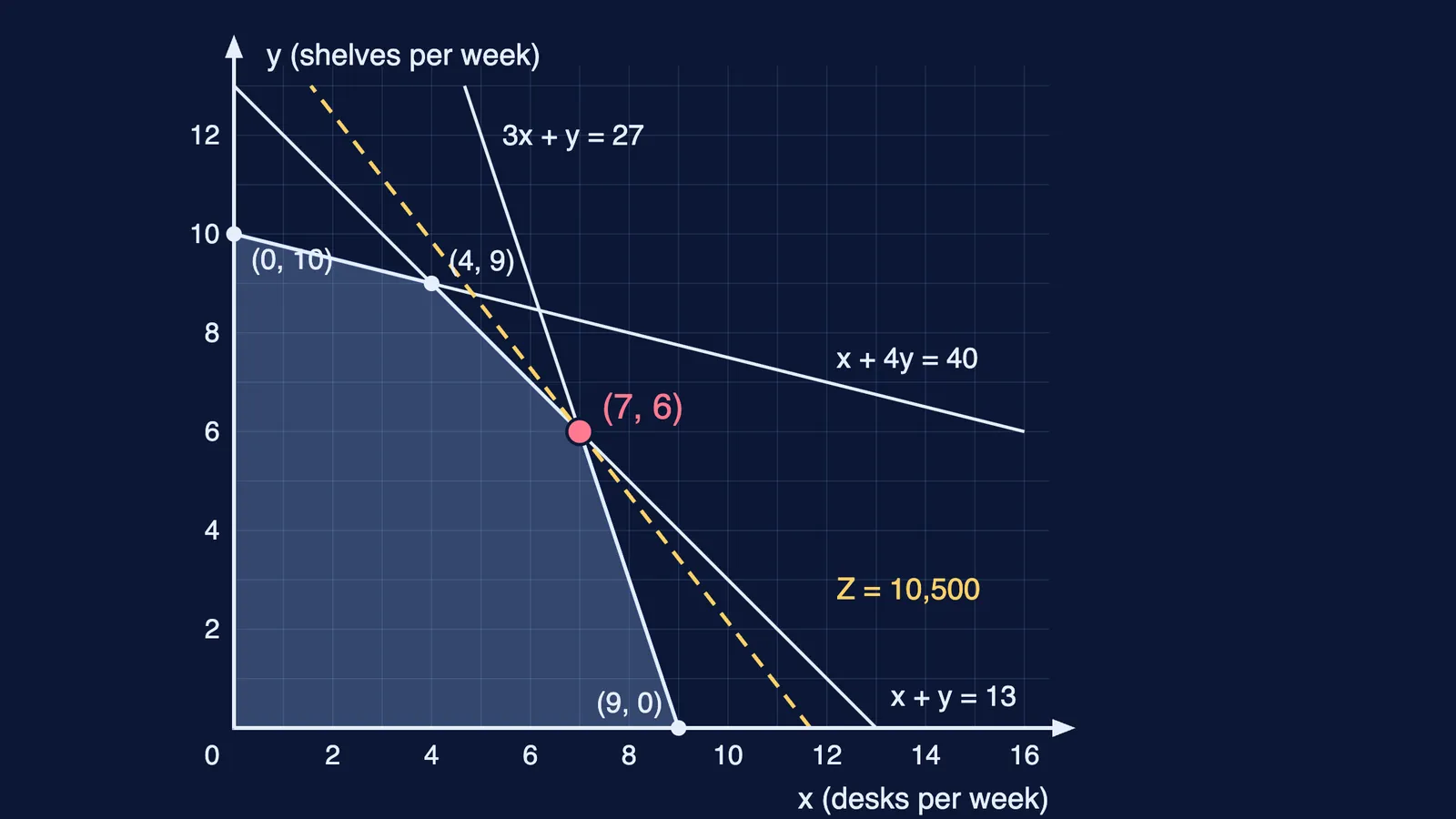
Maximise Z = 900x + 700y subject to 3x + y ≤ 27, x + y ≤ 13, x + 4y ≤ 40, x ≥ 0, y ≥ 0.
Graph. Plot each boundary line from its intercepts. The origin satisfies all three constraints, so shade towards it; the region is bounded.
Corners. O(0, 0), (9, 0) and (0, 10) are intercepts. Solving 3x + y = 27 with x + y = 13 gives 2x = 14, so x = 7 and y = 6. Solving x + y = 13 with x + 4y = 40 gives 3y = 27, so y = 9 and x = 4.
O(0, 0): Z = 0
(9, 0): Z = 8,100
(7, 6): Z = 10,500
(4, 9): Z = 9,900
(0, 10): Z = 7,000
Maximum weekly profit: ₹10,500, from 7 desks and 6 shelves. Check: cutting uses all 27 hours and storage all 13 places, while 9 finishing hours are spare. We checked every corner by hand and in Python.
What about minimisation and unbounded regions?
Diet problems minimise cost under "at least" constraints, so the region is often unbounded. The smallest corner value m is the minimum only if the open half plane ax + by < m has no point in common with the region; the support material sets out this check. See our open half-plane test for unbounded regions.
Practice questions
Our own questions, labelled with the 2026-27 sample paper's question types.
(MCQ, 1 mark) Which describes the feasible region of x ≤ 4, y ≤ 4, x + y ≥ 10, x ≥ 0, y ≥ 0? (A) empty (B) unbounded (C) a triangle (D) a quadrilateral
(VSA, 2 marks) Feed P costs ₹40 per kg and gives 3 units of protein and 1 unit of fibre per kg. Feed Q costs ₹25 per kg and gives 1 unit of protein and 2 units of fibre per kg. A mix needs at least 11 units of protein and 12 units of fibre. Formulate the LPP to minimise cost.
(LA, 5 marks) Solve question 2 graphically.
Answers. 1: (A), since x + y ≤ 4 + 4 = 8. 2: Minimise Z = 40x + 25y subject to 3x + y ≥ 11, x + 2y ≥ 12, x ≥ 0, y ≥ 0. 3: The corners (0, 11), (2, 5) and (12, 0) give Z = 275, 205 and 480. The region is unbounded, but 40x + 25y < 205 never meets it, so the minimum cost is ₹205, from 2 kg of P and 5 kg of Q.
Not sure where to start? Fermi's AI tutor works out what you already know and builds a plan for the session.