On this page
Probability Distributions is Unit IV of CBSE Class 12 Applied Mathematics (241). It turns your Class 11 probability into models of real counts and measurements.
What is in Probability Distributions for 2026-27?
The CBSE Applied Mathematics curriculum for 2026-27 gives Unit IV, Probability Distributions, 10 of the 80 theory marks. The unit is one chapter, so all 10 marks belong to it. It lists random variables (discrete and continuous), expectation, variance and SD, and the binomial, Poisson and normal distributions, with the standard normal variate Z = (x − μ)/σ.
CBSE's Student Support Material, Chapter 4 is the reference text. Its section 4.7.3 on the Z-test is not in the 2026-27 list (Unit V tests only the one-sample t-test), so skip it.
In the 2026-27 sample paper, this unit gets five 1-mark questions, one 2-mark Poisson question and one 3-mark normal question. Calculators are not allowed, so values like e⁻² and z-table areas are given.
That list is from the core 2026-27 curriculum; our Class 12 Probability board guide covers the Bayes side.
How do you find the expectation and variance of a random variable?
Expectation is E(X) = Σ x·P(x). Variance is Var(X) = E(X²) − [E(X)]², and the SD is its square root.
Example 1. A shop's daily returns X take values 0, 1, 2, 3 with probabilities 0.3, 0.4, 0.2, 0.1 (sum 1).
E(X) = 0(0.3) + 1(0.4) + 2(0.2) + 3(0.1) = 1.1
E(X²) = 0 + 0.4 + 0.8 + 0.9 = 2.1
Var(X) = 2.1 − 1.21 = 0.89, so SD ≈ 0.943
When do you use binomial, Poisson or normal?
Binomial: n independent trials, each success or failure with the same p.
Poisson: counts in a fixed time, length or area at a constant average rate λ.
Normal: a continuous measurement, such as height or lifetime, symmetric about its mean.
Example 2 (binomial). 10% of bulbs from a line are faulty. In a sample of 8, P(exactly 1 faulty) = 8 × 0.1 × 0.9⁷. With 0.9⁷ = 0.4783, that is 0.8 × 0.4783 ≈ 0.3826. The mean is np = 0.8, the variance npq = 0.72 and SD ≈ 0.849. Why np? See binomial mean np and variance npq.
Example 3 (Poisson). A helpline gets 3 calls per 10 minutes on average, so λ = 3. Using e⁻³ = 0.0498, P(no call) = 0.0498 and P(2 calls) = (3²/2!) × 0.0498 = 4.5 × 0.0498 ≈ 0.2241.
How do you use the z-table in a normal distribution question?
The support material notes that about 68.27%, 95.45% and 99.73% of a normal distribution lie within 1, 2 and 3 SDs of the mean (Chapter 4).
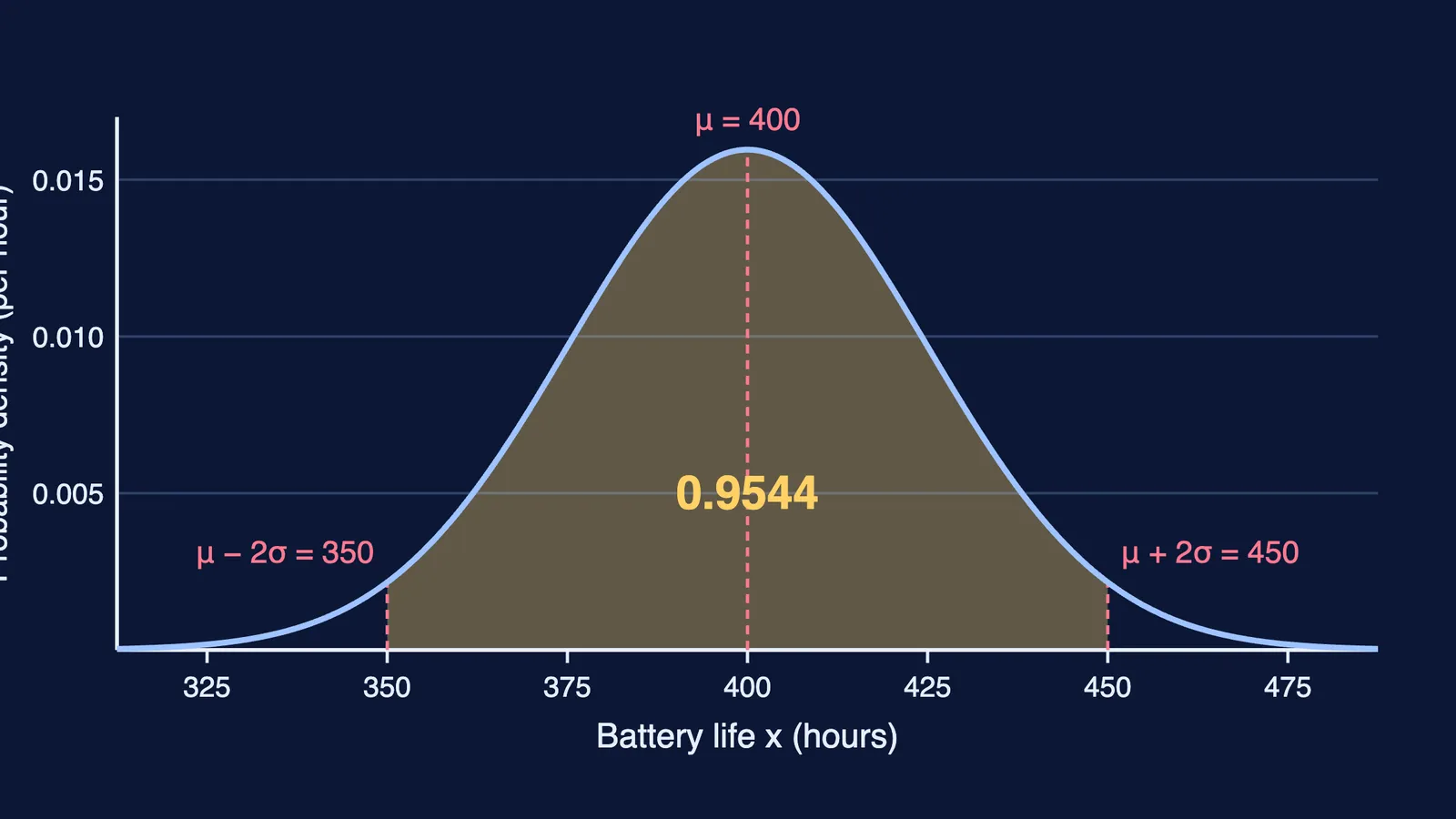
Example 4. Battery life is normal with μ = 400 hours and σ = 25 hours. Of 1,200 batteries, how many last 350-450 hours, and how many under 375? Use P(0 ≤ Z ≤ 1) = 0.3413 and P(0 ≤ Z ≤ 2) = 0.4772.
Convert: Z = (350 − 400)/25 = −2 and Z = (450 − 400)/25 = 2.
P(−2 < Z < 2) = 2 × 0.4772 = 0.9544, so 1,200 × 0.9544 ≈ 1,145 batteries.
For 375 hours, Z = −1. P(Z < −1) = 0.5 − 0.3413 = 0.1587, so 1,200 × 0.1587 ≈ 190 batteries.
Sketch and shade the curve first; a common slip is adding 0.5 where you should subtract it.
Practice questions in the sample-paper format
Mark labels follow the 2026-27 sample paper's question types; the questions are ours.
MCQ (1 mark). A binomial variable has mean 6 and variance 4.2. Find n and p. *Answer: q = 0.7, p = 0.3, n = 20.*
Assertion-reason (1 mark). A: The variance of a binomial distribution can exceed its mean. R: Variance = mean × q, and 0 < q < 1. *Answer: A is false, R is true.*
VSA (2 marks). A website logs 4 failed logins per hour on average. Find P(at most 1 failed login in 15 minutes). Use e⁻¹ = 0.3679. *Answer: λ = 1, so P = 2e⁻¹ ≈ 0.7358.*
SA (3 marks). The heights of 500 students are normal with mean 160 cm and SD 8 cm. How many are taller than 172 cm? Use P(0 ≤ Z ≤ 1.5) = 0.4332. *Answer: Z = 1.5, P = 0.0668, so about 33 students.*
How should you revise this unit?
Do one session each on expectation tables, choosing the distribution, and z-table questions with a sketch. The nCr work in binomial questions builds on Class 11 Applied Maths combinatorics.
Not sure where to start? Fermi's AI tutor works out what you already know, builds a plan for the session, and teaches through it.