On this page
Numbers, Quantification and Numerical Applications is Unit I of CBSE Class 12 Applied Mathematics (241). It is the first chapter of CBSE's Class 12 Applied Mathematics support material.
What does Numbers and Quantification cover in Class 12 Applied Maths?
The CBSE Applied Mathematics curriculum for 2026-27 lists modulo arithmetic, congruence modulo and equivalence classes, alligation and mixture, three numerical problem types (boats and streams, pipes and cisterns, races and games), and numerical inequalities.
What is cut: the 2021 support material also has arithmetic functions, partnership and scheduling. None is in the 2026-27 list, so skip them.
Marks: Unit I carries 11 of the 80 theory marks in the 2026-27 curriculum. The chapter is the whole unit.
How it differs from core Maths: core Mathematics (041) treats equivalence relations abstractly in Class 12 and linear inequalities in Class 11. Applied Maths uses congruence for clocks and calendars and inequalities for numerical comparisons. For Class 11, see our Numbers and Quantification Class 11 applied maths guide.
How do modulo and congruence work?
a mod m is the remainder when a is divided by m, always between 0 and m − 1, even for negative a.
Worked example. −45 = 8 × (−6) + 3, so −45 mod 8 = 3, not −5. 100 days after a Friday is a Sunday, since 100 mod 7 = 2.
Congruence. a ≡ b (mod m) when m divides a − b. Is 87 ≡ 52 (mod 7)? Yes: 87 − 52 = 35 = 7 × 5. Both leave remainder 3.
Equivalence class. [3] mod 7 is every integer leaving remainder 3; below 40 its positive members are 3, 10, 17, 24, 31 and 38. Mod 7 has exactly seven classes, [0] to [6].
How do you use the rule of alligation?
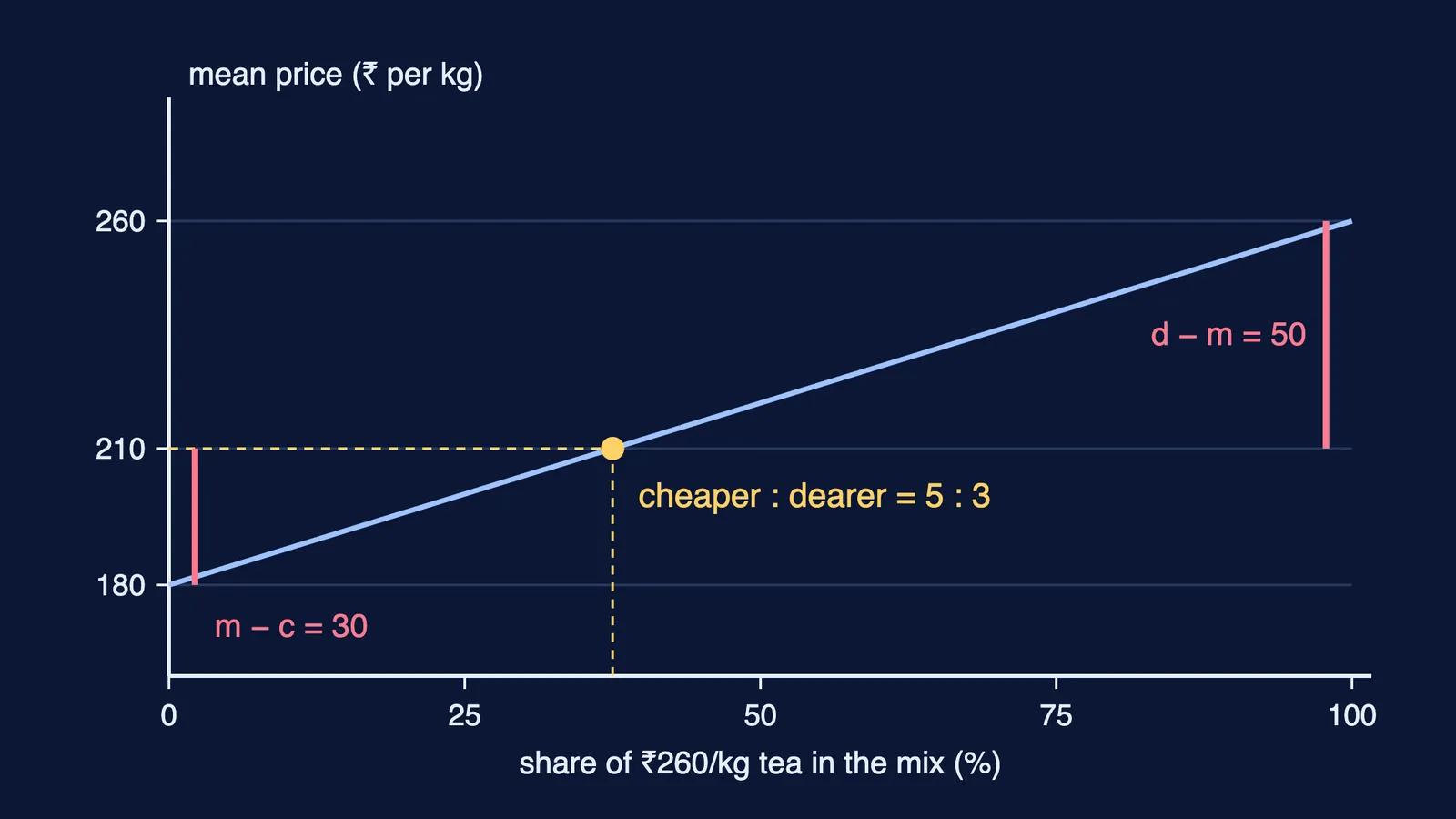
Mix a cheaper ingredient at price c with a dearer one at d to get mean price m, and cheaper : dearer = (d − m) : (m − c).
Worked example. Tea at ₹180 per kg is mixed with tea at ₹260 per kg to cost ₹210 per kg. Ratio = (260 − 210) : (210 − 180) = 50 : 30 = 5 : 3. For 40 kg, take 25 kg and 15 kg.
How do you solve boats, pipes and races problems?
Boats and streams. With boat speed x in still water and stream speed y, downstream is x + y and upstream x − y. A boat does 33 km downstream in 1.5 h (22 km/h) and 24 km upstream in 2 h (12 km/h). Boat = (22 + 12) ÷ 2 = 17 km/h; stream = (22 − 12) ÷ 2 = 5 km/h. More in upstream and downstream equations.
Pipes and cisterns. Work in tanks per hour: pipes A and B fill a tank in 7 h and 14 h, and C empties it in 21 h. Net rate = 1/7 + 1/14 − 1/21 = (6 + 3 − 2)/42 = 1/6, so the tank fills in 6 hours. Leaks follow the same net rate method.
Races. "A beats B by x metres" means B is x metres short when A finishes. In an 800 m race A beats B by 80 m and B beats C by 50 m. While B runs 720 m, C runs 720 × 750/800 = 675 m, so A beats C by 125 m, not 130 m.
What are numerical inequalities in Applied Maths?
Two real numbers joined by <, >, ≤ or ≥ form a numerical inequality. Adding or subtracting the same number on both sides, or multiplying both by a positive number, keeps the direction. A negative multiplier reverses it: 4 < 9, but −2 × 4 = −8 > −18 = −2 × 9.
Practice questions for Numbers and Quantification
The CBSE 2026-27 sample paper tests this unit with 1-mark MCQs, 2-mark questions on modulo and boats, and a 4-mark pipes case study. Our questions follow those types.
(1 mark) Find −29 mod 6.
(1 mark) Coffee at ₹450 per kg is blended with coffee at ₹600 per kg to cost ₹500 per kg. Find cheaper : dearer.
(2 marks) Show that 95 ≡ 35 (mod 12).
(2 marks) A boat goes 15 km/h downstream and 9 km/h upstream. Find the boat and stream speeds.
(1 mark) Solve −2x + 5 > 17 for real x.
(2 marks) In a 500 m race, A gives B a 50 m start and still wins by 20 m. Find the ratio of their speeds.
Answers: 1) 1, since −29 = 6 × (−5) + 1. 2) (600 − 500) : (500 − 450) = 2 : 1. 3) 95 − 35 = 60 = 12 × 5; both leave remainder 11. 4) 12 km/h and 3 km/h. 5) −2x > 12, so x < −6. 6) B runs 430 m while A runs 500 m, so A : B = 50 : 43.
Not sure which rule a word problem needs? Fermi's AI tutor works out what you already know, builds a plan for the session, and teaches through it.