

On this page
Every boat-and-stream problem comes down to two speeds and distance = speed × time, written carefully.
What are upstream and downstream speeds?
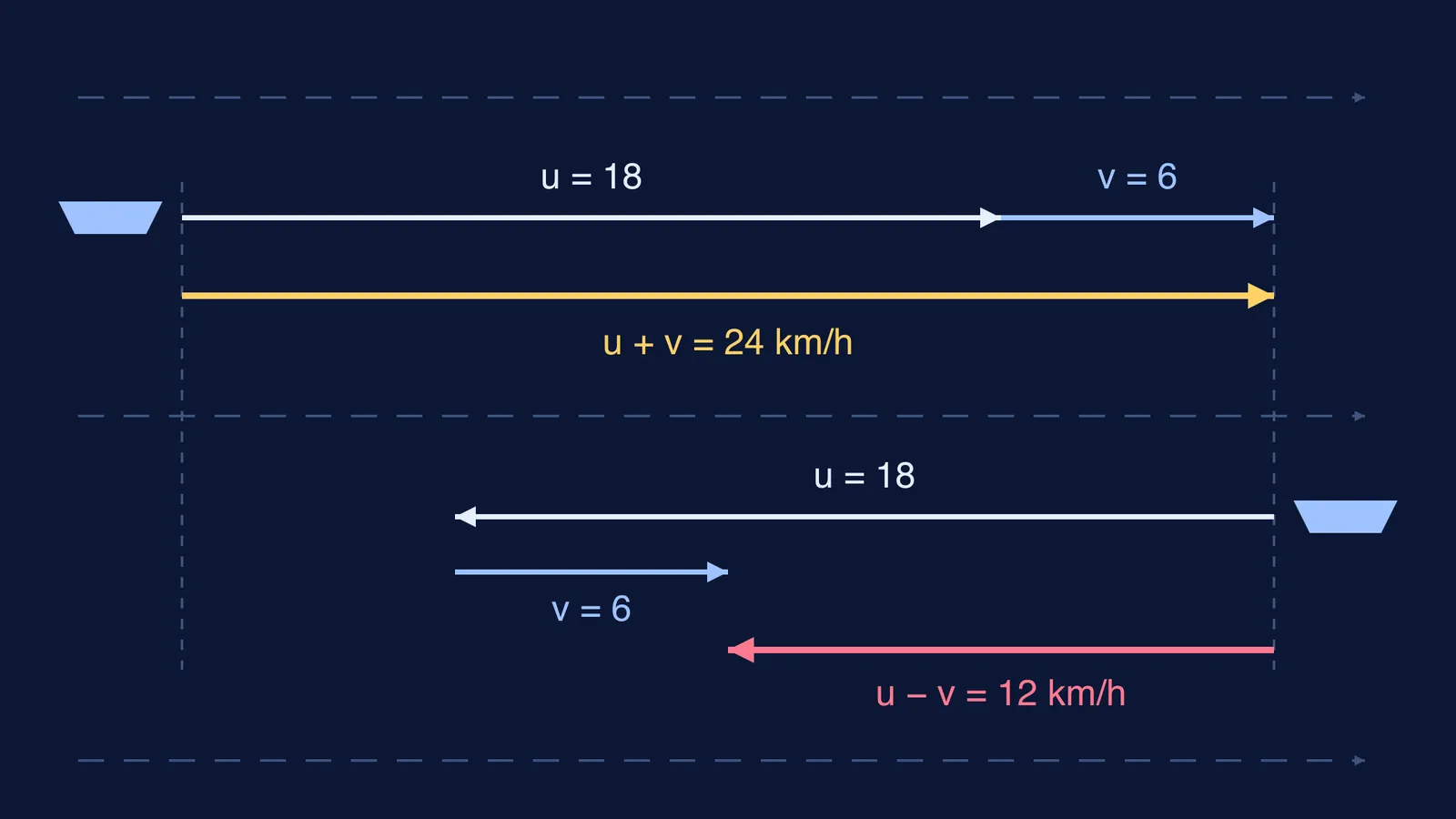
Call the boat's speed in still water u km/h and the stream's speed v km/h. Going downstream, the water carries the boat, so the speeds add: u + v. Going upstream, the current takes speed away: u − v. So:
Speed in still water: u = (downstream speed + upstream speed) ÷ 2
Speed of the stream: v = (downstream speed − upstream speed) ÷ 2
Example: 24 km downstream in 2 hours and 16 km upstream in 2 hours means speeds of 12 and 8 km/h, so u = 10 km/h and v = 2 km/h. When the boat points across the current instead, see our river boat crossing simulation, shortest time vs shortest path.
How do you build the equation from time or distance?
A distance and a time for each leg: speed = distance ÷ time gives u + v and u − v directly. Add and subtract.
Two different trips, each with a total time: write time = distance ÷ speed for every leg. Put a = 1/(u − v) and b = 1/(u + v), and each trip becomes a linear equation in a and b.
One trip with a time difference ("takes 1 hour more"): upstream time − downstream time = the difference. This gives a quadratic.
The NCERT Class 10 chapter on pairs of linear equations notes in its summary that several situations lead to "two equations that are not linear to start with", which "we alter" so that they reduce to a pair of linear equations (NCERT Class 10 Mathematics, Chapter 3). If turning words into symbols is the hard part for you, see how to form equations from word problems in Class 10.
How do you solve a two-trip boat problem?
A boat goes 30 km upstream and 44 km downstream in 10 hours. It goes 40 km upstream and 55 km downstream in 13 hours. Find u and v.
Let a = 1/(u − v) and b = 1/(u + v). Then 30a + 44b = 10 and 40a + 55b = 13.
Multiply the first equation by 4 and the second by 3: 120a + 176b = 40 and 120a + 165b = 39.
Subtract: 11b = 1, so b = 1/11. Then 30a = 10 − 4 = 6, so a = 1/5.
So u − v = 5 and u + v = 11, which gives u = 8 km/h and v = 3 km/h.
Check: 30/5 + 44/11 = 6 + 4 = 10 hours, and 40/5 + 55/11 = 8 + 5 = 13 hours.
How does the boat problem become a quadratic in Class 10?
With a time difference, x lands in two denominators, and clearing them gives a quadratic. CBSE set this as the internal-choice option of Q32, a 5-mark question, in its Class 10 Mathematics (Basic) sample question paper for 2022-23: "A motor boat whose speed is 18 km/h in still water takes 1 hour more to go 24 km upstream than to return downstream to the same spot. Find the speed of the stream."
Let the stream's speed be x km/h. Upstream speed = 18 − x and downstream speed = 18 + x.
Upstream time − downstream time = 1, so 24/(18 − x) − 24/(18 + x) = 1.
Multiply both sides by (18 − x)(18 + x) = 324 − x²: 24(18 + x) − 24(18 − x) = 324 − x².
The left side simplifies to 48x, so x² + 48x − 324 = 0.
Factorise: (x + 54)(x − 6) = 0, so x = 6 or x = −54.
A speed cannot be negative, so reject −54. The stream flows at 6 km/h.
Check: 24 km upstream at 12 km/h takes 2 hours; downstream at 24 km/h it takes 1 hour.
The current NCERT quadratics chapter has the same structure with a train: Exercise 4.1 describes a train that would take 3 hours longer over 480 km at 8 km/h less (NCERT Class 10 Mathematics, Chapter 4).
Which mistakes cost marks in boat and stream problems?
Subtracting times the wrong way round: slower (upstream) time − faster time = difference.
Writing 24/18 − x when you mean 24/(18 − x).
Keeping the negative root, or rejecting it without saying why.
Mixing minutes with km/h.
Averaging the two speeds for a round trip. In the CBSE problem the boat covers 48 km in 3 hours, so its average is 16 km/h, not 18. Here is why round-trip average speed is not the average of the two speeds.
If you get stuck at the set-up rather than the algebra, the Fermi Problem Library has worked problems with a step-by-step solver that explains the reasoning rather than printing an answer. If relative speed itself feels shaky, the Fermi Concept Library gives each concept in physics and mathematics its own lesson.


