

On this page
Why is the round trip average speed not 50 km/h?
Picture a classic commute: you drive 40 km/h to an exam hall, and with lighter traffic returning, you drive 60 km/h along the exact same route. Ask students to name the average speed for the round trip, and most instinctively answer 50 km/h. While 50 is the arithmetic mean of 40 and 60, in physics it is incorrect. As physics educator Juan Miguel Campanario noted in *The Physics Teacher*, this scenario is a classic counterintuitive problem where everyday arithmetic intuition clashes with physical definitions.
Average speed is not an unweighted mean of numbers. Under the kinematics definitions in OpenStax University Physics, average speed equals total path length divided by total elapsed time. Because traveling at 60 km/h takes less time than crawling at 40 km/h, the two speeds do not share the clock equally.
In a landmark study in the *American Journal of Physics*, researcher P. C. Peters found that 60% of honors physics students defaulted to simple arithmetic averaging on round-trip questions, with only 40% solving it correctly. The mistake persists because learners treat 'average' as an algebraic routine rather than a ratio of accumulated quantities.
How do you calculate the average speed for a round trip?
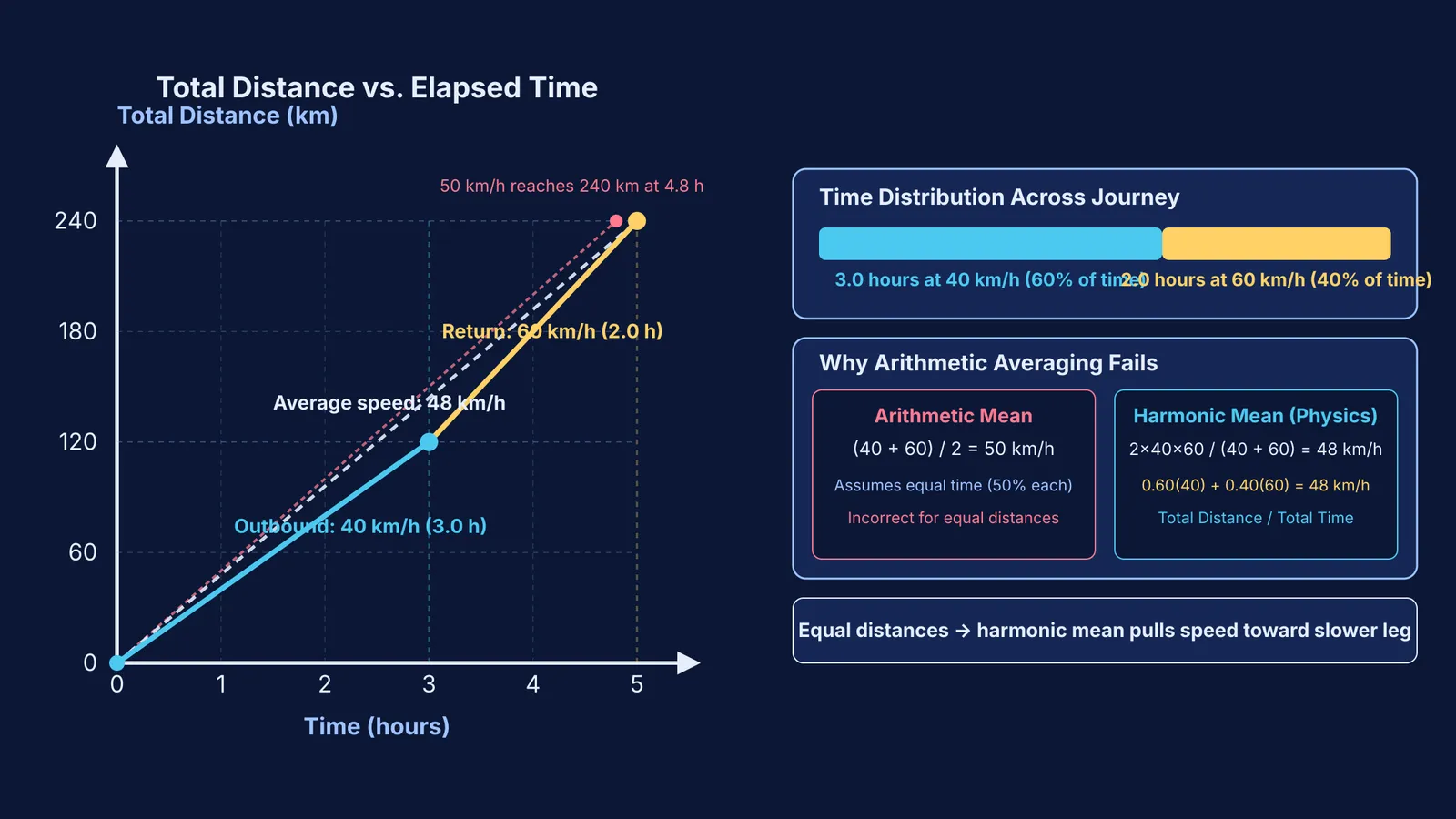
To see why the true average speed is 48 km/h, test the definition from OpenStax University Physics with a concrete distance of 120 km:
Outbound trip: 120 km at 40 km/h takes 120 / 40 = 3.0 h.
Return trip: 120 km at 60 km/h takes 120 / 60 = 2.0 h.
Total path length: 120 km + 120 km = 240 km.
Total elapsed time: 3.0 h + 2.0 h = 5.0 h.
Average speed: 240 km / 5.0 h = 48 km/h.
This 48 km/h result holds for any one-way distance d. Outbound time is d / 40 and return time is d / 60, giving a total time of 5d / 120, or d / 24. Dividing the total distance 2d by d / 24 cancels d, leaving 48 km/h. Conflating this path-based calculation with net displacement is another frequent pitfall, explored in our guide on average speed vs average velocity.
Why does the harmonic mean appear instead of the arithmetic mean?
As demonstrated in P. C. Peters's study, average speed is a time-weighted average: v_avg = (v₁ × t₁ + v₂ × t₂) / (t₁ + t₂). Over the 240 km round trip, you spend 3.0 h out of 5.0 h (60% of total travel time) at 40 km/h, and only 2.0 h out of 5.0 h (40% of travel time) at 60 km/h. Weighting the speeds by these time fractions yields (0.60 × 40) + (0.40 × 60) = 24 + 24 = 48 km/h.
When one-way distances d are identical, substituting t₁ = d / v₁ and t₂ = d / v₂ gives the classical harmonic mean: v_avg = 2d / (d/v₁ + d/v₂) = 2 / (1/v₁ + 1/v₂) = (2 × v₁ × v₂) / (v₁ + v₂).
By the mathematical inequality of arithmetic and harmonic means, the harmonic mean of two unequal positive speeds is always strictly less than their arithmetic mean.
When an algebraic derivation does not immediately reshape physical intuition, visual models help you watch the timer progress; the Fermi Simulation Lab provides interactive simulations for ideas that are easier to see than to read. Dynamic representations bridge abstract rates and intuition, supporting the active-learning principles examined in simulations vs static diagrams.
What happens when one leg of the trip is much faster?
Examining extreme cases, as highlighted by Juan Miguel Campanario, illustrates the severe time penalty imposed by the slower speed. Suppose you complete an outbound 120 km leg at 40 km/h, taking 3.0 h, and want your round-trip average to reach 80 km/h. To average 80 km/h over 240 km, the entire journey must take 240 / 80 = 3.0 h. Because you spent all 3.0 h reaching your destination, the return trip would have to take 0.0 seconds—an impossible infinite speed. As return speed approaches infinity, round-trip average speed approaches an upper bound of 2 × v₁, or 80 km/h.
To avoid averaging traps in exams, follow this quick diagnostic:
Equal time intervals: When travel times are identical, use the arithmetic mean (v₁ + v₂) / 2.
Equal distance intervals: When distances are identical, use the harmonic mean 2 × v₁ × v₂ / (v₁ + v₂).
Sanity check: Ensure your calculated speed lies closer to the slower speed, avoiding the traps covered in our guide on mechanics mistakes.
To build confidence on multi-step kinematics questions, the Fermi Problem Library offers worked problems with a step-by-step solver that explains the reasoning rather than printing an answer.


