On this page
Numbers and Quantification is the first chapter of CBSE's Applied Mathematics XI book, second edition (April 2026). It covers binary numbers, indices, logarithms and antilogarithms, and a new section on the Bhartiya system of numeration.
What does Numbers and Quantification cover in Class 11 Applied Maths?
The CBSE Applied Mathematics (241) curriculum for 2026-27 lists three topics for this part of Unit I:
Binary numbers: the binary system, converting decimal to binary and back, and uses in programming and coding.
Indices, logarithm and antilogarithm: laws of indices, common and natural logarithms, laws of logarithms, logs and exponentials as inverse operations, reading log and antilog tables, and applications.
Introduction to the Bhartiya system of numeration: traditional ways of writing numbers.
Nothing in this chapter is marked as dropped for 2026-27. The book's preface says the Indian Knowledge System content in Chapter 1 is new in this edition.
Marks: Unit I, Numbers, Quantification and Numerical Applications, carries 10 of the 80 theory marks in the 2026-27 curriculum. Those 10 marks are shared with Chapter 2, Numbers in day-to-day life (clocks, calendar, time and work, speed and distance, seating arrangement). CBSE prints no separate figure for Chapter 1.
How it differs from core Maths: the core Mathematics (041) curriculum meets exponential and logarithmic functions as graphs inside Relations and Functions. Applied Maths treats logs as a calculating tool, with characteristic, mantissa and tables. Our Relations and Functions Class 11 guide covers the core side. For how the two subjects compare, see Applied Mathematics in CBSE Class 11 and 12.
How do you convert decimal to binary and back?
Divide by 2 repeatedly and read the remainders from bottom to top. Take 2026:
Remainders, last first: 1, 1, 1, 1, 1, 1, 0, 1, 0, 1, 0.
So 2026 = (11111101010)₂.
Check by adding place values: 1024 + 512 + 256 + 128 + 64 + 32 + 8 + 2 = 2026.
For more drills, see how to convert decimal to binary and add binary by hand.
How do log tables handle money-sized numbers?
A common logarithm has two parts. The characteristic is the power of 10 when the number is in standard form; the mantissa is the positive decimal part, read from the table.
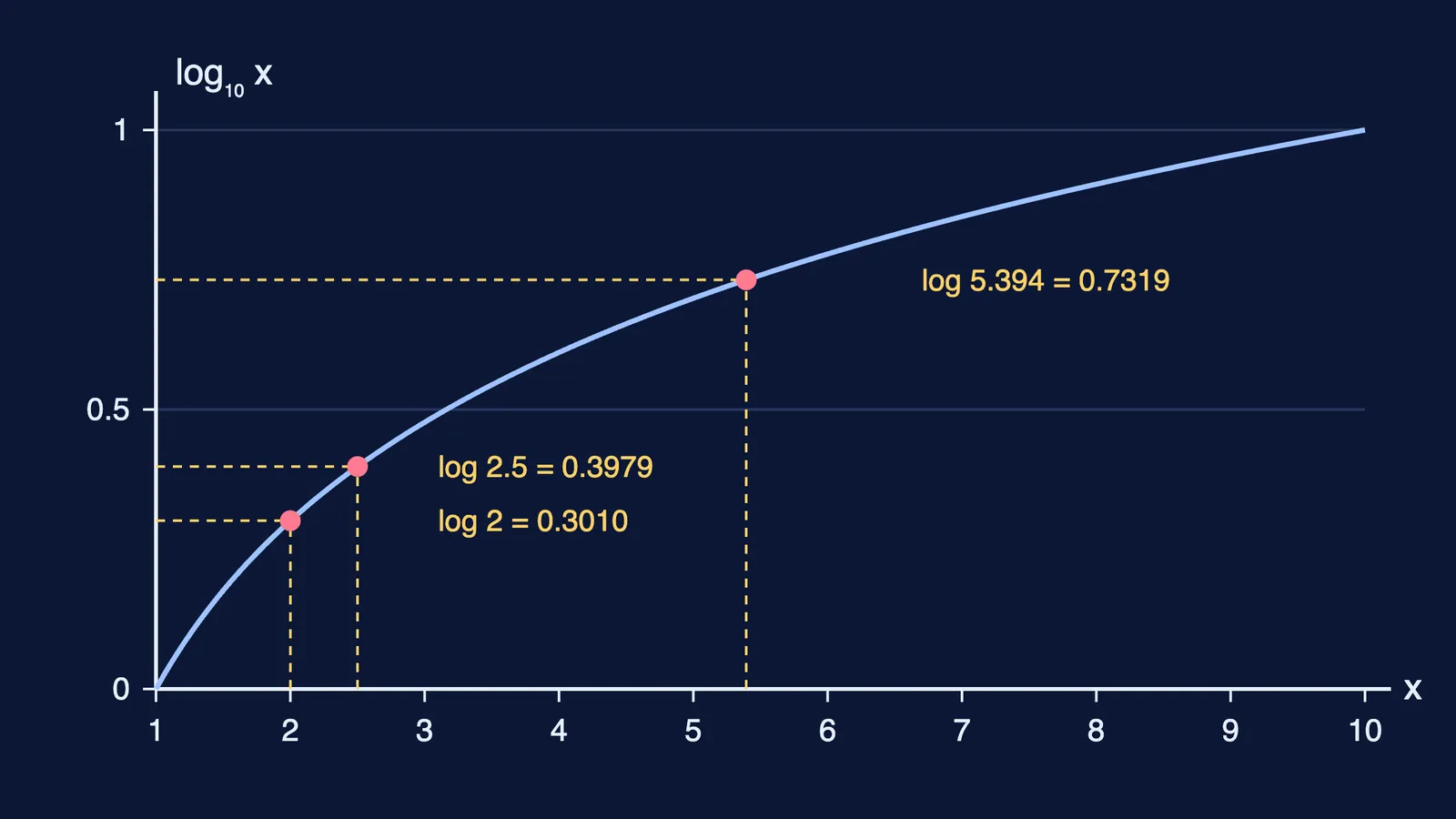
Worked example. A deposit of ₹25,000 grows at 8% a year, compounded yearly, for 10 years. Find A = 25000 × (1.08)¹⁰ using four-figure logs.
25000 = 2.5 × 10⁴, so log 25000 = 4 + 0.3979 = 4.3979.
log 1.08 = 0.0334, so 10 × log 1.08 = 0.3340.
log A = 4.3979 + 0.3340 = 4.7319.
Characteristic 4, mantissa 0.7319. Antilog of 0.7319 is 5.394, so A ≈ 5.394 × 10⁴ = ₹53,940.
A calculator gives ₹53,973.12. About ₹30 of the ₹33 gap comes from rounding log 1.08 to four places, because step 2 multiplies that rounding error by 10; the rest comes from rounding log 2.5 and the antilog. Tables give about four significant figures, not exact rupees.
Negative characteristic. For 0.0045 = 4.5 × 10⁻³, log 0.0045 = 3̄.6532 (bar 3 point 6532): characteristic −3, mantissa +0.6532.
What is the Āryabhaṭa system of numeration?
The book explains how Āryabhaṭa gave a number to each of the 33 Sanskrit consonants: k to m run 1 to 25, and y, r, l, v, ś, ṣ, s, h are 30 to 100. Each vowel multiplies by an even power of 10: a by 10⁰, i by 10², u by 10⁴, ṛ by 10⁶, and so on. Split a word into syllables, multiply consonant by vowel, and add.
Worked example: guru. gu = 3 × 10⁴ = 30,000 and ru = 40 × 10⁴ = 4,00,000, so guru = 4,30,000.
The book also has a short extra-reading box on the Bhūta-sankhyā system, where familiar words stand for numbers (eyes for 2), and the Kaṭapayādi system, where each consonant stands for a digit from 0 to 9.
Practice questions for Numbers and Quantification
CBSE does not publish a Class 11 sample paper, so these mark labels are our suggestion.
(1 mark) Convert (1011011)₂ to decimal.
(2 marks) Convert 300 to binary and check by place values.
(2 marks) Simplify 8^(2/3) × 16^(−1/4).
(1 mark) Write the characteristic of log 0.000732.
(2 marks) Using log 3 = 0.4771, find how many digits 3³⁰ has.
(3 marks) Using logs, find in how many whole years ₹10,000 at 6% compound interest first reaches ₹20,000. Take log 2 = 0.3010 and log 1.06 = 0.0253.
(2 marks) Decode nidhi in the Āryabhaṭa system.
Answers: 1) 91. 2) (100101100)₂, since 256 + 32 + 8 + 4 = 300. 3) 4 × ½ = 2. 4) −4, written 4̄. 5) 30 × 0.4771 = 14.313, so 15 digits. 6) n = 0.3010 ÷ 0.0253 ≈ 11.9, so 12 years. 7) ni = 20 × 10² and dhi = 19 × 10², so 3,900.
Stuck on where the minus sign goes in a log? Fermi's AI tutor works out what you already know, builds a plan for the session, and teaches through it.