On this page
Calculus in Class 11 Applied Mathematics (241) asks one question: how fast does one quantity change when another changes? Here is the 2026-27 syllabus, how it differs from core Maths, and a worked cost-and-revenue example.
What does the 2026-27 syllabus include, and how many marks?
In the CBSE Applied Mathematics curriculum for 2026-27, Unit III Calculus carries 12 of the 80 theory marks in Class 11. The paper is 3 hours long, and internal assessment adds another 20 marks.
The unit has four parts:
Functions and their graphs: domain, co-domain, range and types of functions.
Limits and continuity of a function.
Differentiation as the instantaneous rate of change, linked to the slope of a tangent.
Algebra of derivatives: sum, difference, product and quotient rules, and the chain rule for a function of a function.
CBSE's own book for the course is its Applied Mathematics Class XI student support material (second edition, April 2026); Chapter 7, Calculus, covers the whole unit on pages 134 to 186.
Marginal cost, marginal revenue and increasing or decreasing functions sit in the Class 12 Calculus unit of the same curriculum. The book only previews them, so here a derivative of cost is simply a rate of change.
How is it different from core Maths Limits and Derivatives?
Core Mathematics (041) gives Calculus 08 of the 80 marks in Class 11, and its chapter includes limits and derivatives of trigonometric functions, according to the CBSE Mathematics curriculum for 2026-27. The same document lists the chain rule as assessed only formatively in Class 11 core Maths.
The applied course has no trigonometry, adds continuity, includes the chain rule and uses business settings. If you want the core-syllabus treatment, read our Limits and Derivatives Class 11 maths guide.
How does a derivative measure the rate of change of cost?
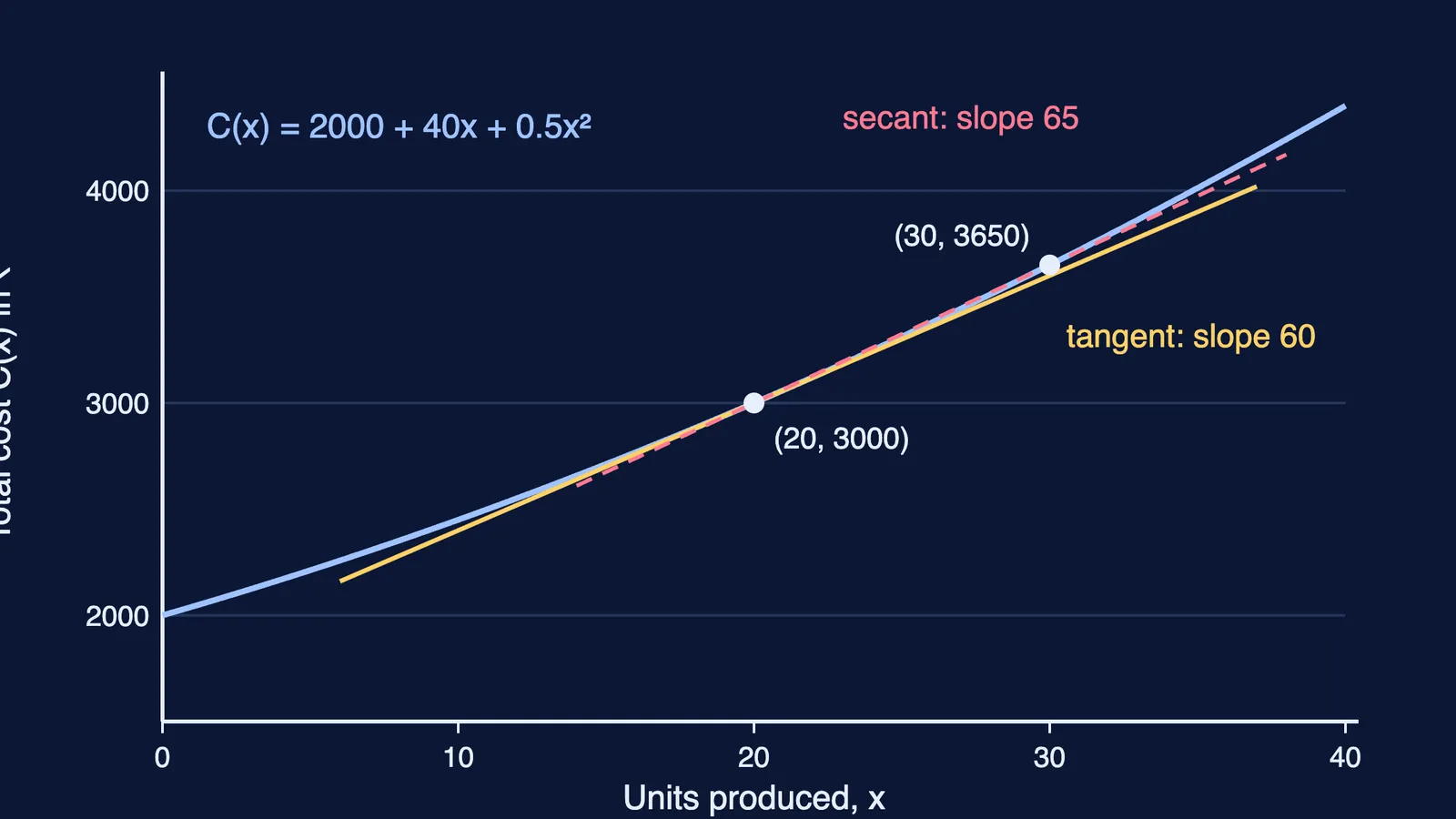
Take a workshop whose cost of making x units is C(x) = 2000 + 40x + 0.5x² rupees (our numbers).
Average rate from 20 to 30 units: C(20) = 2000 + 800 + 200 = ₹3,000 and C(30) = 2000 + 1200 + 450 = ₹3,650. The average rate is (3650 − 3000)/10 = ₹65 per unit. This is the slope of the secant in the graph above.
Rate at exactly 20 units, by first principle: [C(20 + h) − C(20)]/h = (60h + 0.5h²)/h = 60 + 0.5h.
Let h shrink: h = 1 gives 60.5, h = 0.1 gives 60.05, h = 0.01 gives 60.005. The limit as h → 0 is 60.
Check with the rules: C′(x) = 40 + x, so C′(20) = ₹60 per unit. This is the slope of the tangent.
So at 20 units, cost rises about ₹60 per extra unit. The 21st unit actually costs C(21) − C(20) = 3060.50 − 3000 = ₹60.50.
How do the derivative rules apply to revenue and average cost?
Suppose revenue is R(x) = 120x − x². Then R′(x) = 120 − 2x and R′(20) = ₹80 per unit.
Profit is P(x) = R(x) − C(x), so by the difference rule P′(20) = R′(20) − C′(20) = 80 − 60 = ₹20 per unit. At 20 units, profit is still rising by about ₹20 for each extra unit.
Average cost is AC(x) = C(x)/x. By the quotient rule, AC′(x) = [x·C′(x) − C(x)]/x². At x = 20 this is (20 × 60 − 3000)/400 = −4.5. The minus sign tells you average cost per unit is still falling at 20 units, by about ₹4.50 for each extra unit. Check: differentiating AC(x) = 2000/x + 40 + 0.5x gives −2000/400 + 0.5 = −4.5.
Economics students can compare this with short run cost curves in Class 11 Economics.
What questions should you practise?
Our own questions; mark labels are our suggestion, not CBSE's.
(2 marks) Evaluate the limit of (x² − 16)/(x − 4) as x → 4. Answer: 8.
(3 marks) f(x) = 3x + 1 for x < 2, f(2) = 7, and f(x) = x² + 3 for x > 2. Is f continuous at x = 2? Answer: yes; both one-sided limits and f(2) equal 7.
(3 marks) Using first principle, find the derivative of f(x) = 3x² − 5x. Answer: 6x − 5.
(2 marks) Differentiate (2x + 3)⁵ and evaluate it at x = −1. Answer: 10(2x + 3)⁴, which is 10 at x = −1.
(4 marks) C(x) = 500 + 12x + 0.2x² and R(x) = 30x. Find C′(10), compare it with C(11) − C(10), and find the rate of change of profit at x = 10. Answer: ₹16; ₹16.20; ₹14 per unit.
Revise in the book's order: functions, then limits, continuity and derivatives. Stuck on a step and not sure where to begin? Fermi's AI tutor works out what you already know and builds a plan for the session. For how this elective fits your subject choices, see our overview of CBSE Applied Mathematics.