On this page
Short-run costs sit in Unit 6, "Producer Behaviour and Supply", of the CBSE Economics curriculum for 2026-27, a unit worth 14 marks in the Class XI theory paper. The textbook is Chapter 3, Production and Costs, of NCERT's Introductory Microeconomics (Reprint 2026-27).
What are the seven short-run costs?
In the short run some inputs cannot be changed, so NCERT splits costs into fixed and variable.
TFC: cost of fixed inputs, the same at every output, even zero.
TVC: cost of variable inputs, zero at zero output and rising with output.
TC = TFC + TVC.
AFC = TFC ÷ q.
AVC = TVC ÷ q.
AC = TC ÷ q = AFC + AVC.
MC = ΔTC ÷ Δq, the extra cost of one more unit. In the short run it equals ΔTVC ÷ Δq.
A worked cost schedule you can check
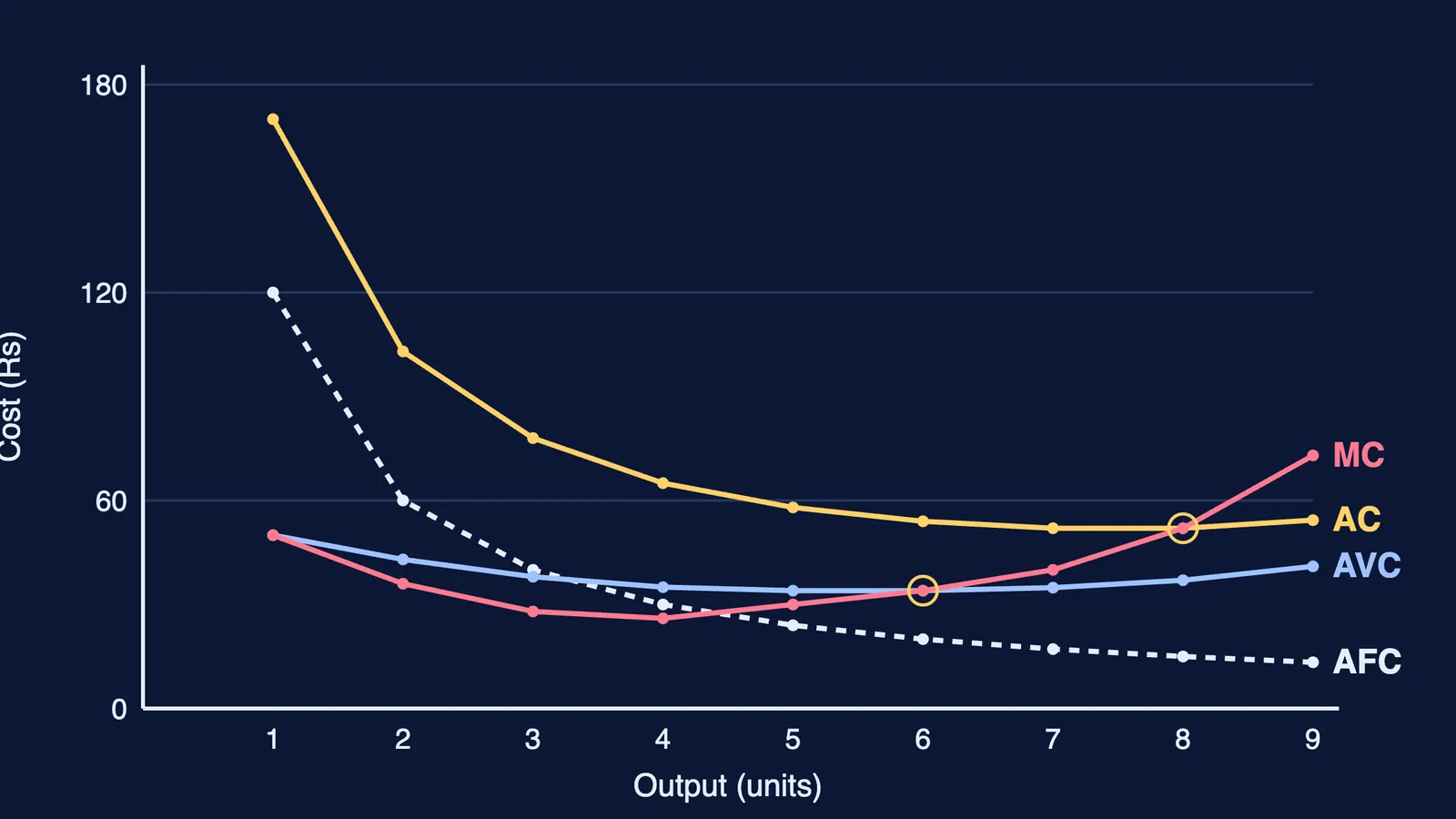
A small unit prints T-shirts. Press and rent cost Rs 120 a day (TFC); ink, shirts and wages are TVC. The numbers are invented and checked in Python. Values are for q = 1 to 9; at q = 0, TC = 120 and the rest are undefined.
TVC: 50, 86, 114, 140, 170, 204, 244, 296, 369
TC: 170, 206, 234, 260, 290, 324, 364, 416, 489
AFC: 120, 60, 40, 30, 24, 20, 17.14, 15, 13.33
AVC: 50, 43, 38, 35, 34, 34, 34.86, 37, 41
AC: 170, 103, 78, 65, 58, 54, 52, 52, 54.33
MC: 50, 36, 28, 26, 30, 34, 40, 52, 73
One row in full, for q = 7:
TC = 120 + 244 = 364.
AFC = 120 ÷ 7 = 17.14; AVC = 244 ÷ 7 = 34.86; AC = 364 ÷ 7 = 52, and 17.14 + 34.86 = 52.
MC = TC at 7 − TC at 6 = 364 − 324 = 40.
Quick checks: the MC values sum to TVC at 9 units (369), and at q = 1, MC equals AVC.
What shapes do short-run cost curves have?
TFC is horizontal. TVC starts at the origin and rises; TC has the same shape, shifted up by TFC.
AFC falls throughout and never touches either axis. NCERT calls it a rectangular hyperbola, because AFC × q always equals TFC (here 120 × 1 = 60 × 2 = 15 × 8).
MC is U-shaped: it falls from 50 to 26 at the fourth unit, then rises to 73. NCERT links this to the law of variable proportions: marginal product first rises, then falls.
AVC and AC are U-shaped too. AC lies above AVC by exactly AFC, so the gap narrows (120 at q = 1, 13.33 at q = 9) but never closes.
Why does MC cut AVC and AC at their minimum points?
If the next unit costs less than the average, the average falls; if more, it rises. From the second to the fifth unit MC is below AVC, so AVC falls from 50 to 34. The sixth unit's MC (from 5 to 6 units) is 34, equal to AVC at both outputs. From the seventh unit MC (40) is above AVC, and AVC climbs to 34.86. So MC crosses AVC from below at its lowest point. AC behaves the same way: MC stays below AC through the seventh unit; the eighth unit's MC (from 7 to 8 units) is 52, equal to AC at both outputs; and the ninth unit's MC of 73 pulls AC up to 54.33. NCERT's chapter states both results.
The AC minimum lies further right because AFC keeps falling: between q = 6 and 7, AVC rises 0.86 while AFC drops 2.86, so AC still falls.
Which mistakes cost marks in cost questions?
Writing averages or MC at zero output. They are undefined there; put a dash.
Calculating MC as TC ÷ q. That is AC.
Drawing AFC U-shaped or touching an axis.
Letting AVC meet AC. The gap is AFC, which is never zero.
Drawing MC cutting AVC or AC on their falling side, or from above. It cuts each from below, at the minimum.
Forgetting that TFC equals TC at zero output.
If you keep reaching the right column by the wrong method, the Fermi Problem Library has worked problems with a step-by-step solver that explains the reasoning rather than printing an answer.
How do short-run costs connect to the rest of Unit 6?
The U-shape of MC comes from returns to a factor, covered in our production function guide to TP, AP and MP. The CBSE curriculum then states producer's equilibrium in terms of marginal revenue and marginal cost, followed by supply, which our law of supply and market equilibrium guide works through. Then compare forms of market feature by feature.