On this page
Relations is a short chapter in Class 11 Applied Mathematics (241). Here is what the 2026-27 syllabus asks for, how it differs from core Maths, and a worked example with prices and budgets.
What does Relations cover in Applied Maths 2026-27?
The CBSE Applied Mathematics curriculum for 2026-27 puts Relations inside Unit II, Algebra, as two topics: ordered pairs and the Cartesian product of two sets (2.4), and relations (2.5). Under 2.5 it lists expressing a relation as a subset of a Cartesian product, and the domain and range of a relation.
Unit II, Algebra, carries 18 of the 80 marks in the Class 11 theory paper, according to the same curriculum. Those 18 marks are shared with Sets, Mathematical Logic and Sequences and Series, so CBSE prints no separate figure for Relations.
In CBSE's Applied Mathematics Class XI Student Support Material, second edition, April 2026, Relations is Chapter 5. It covers:
ordered pairs and when two of them are equal
the Cartesian product A × B, and n(A × B) = n(A) × n(B)
a relation as a subset of A × B, written in roster form, set-builder form or as an arrow diagram
domain, range and co-domain
how many relations exist from A to B, which is 2 raised to the power pq when n(A) = p and n(B) = q
a short section on empty and universal relations
The curriculum list does not name empty and universal relations, but the book has them and they take two lines to learn.
How is this different from Relations and Functions in core Maths?
In core Mathematics (041), relations and functions are one chapter. The 2026-27 core Maths curriculum adds functions as a special type of relation, real-valued functions and their graphs, the product R × R × R, and sum, difference, product and quotient of functions.
Applied Maths splits these apart. Functions appear in Unit III, Calculus, as topic 3.1, with dependent and independent variables and graphs, per the applied curriculum. The Relations chapter stops at relations. The book's examples lean toward everyday and business settings: items and prices, bus routes between city zones, train timings.
If you want the function side now, our Relations and Functions Class 11 guide for core Maths covers it. Still choosing between the two subjects? Read who should choose Applied Mathematics in Class 11 and 12.
How do you find a relation from a Cartesian product?
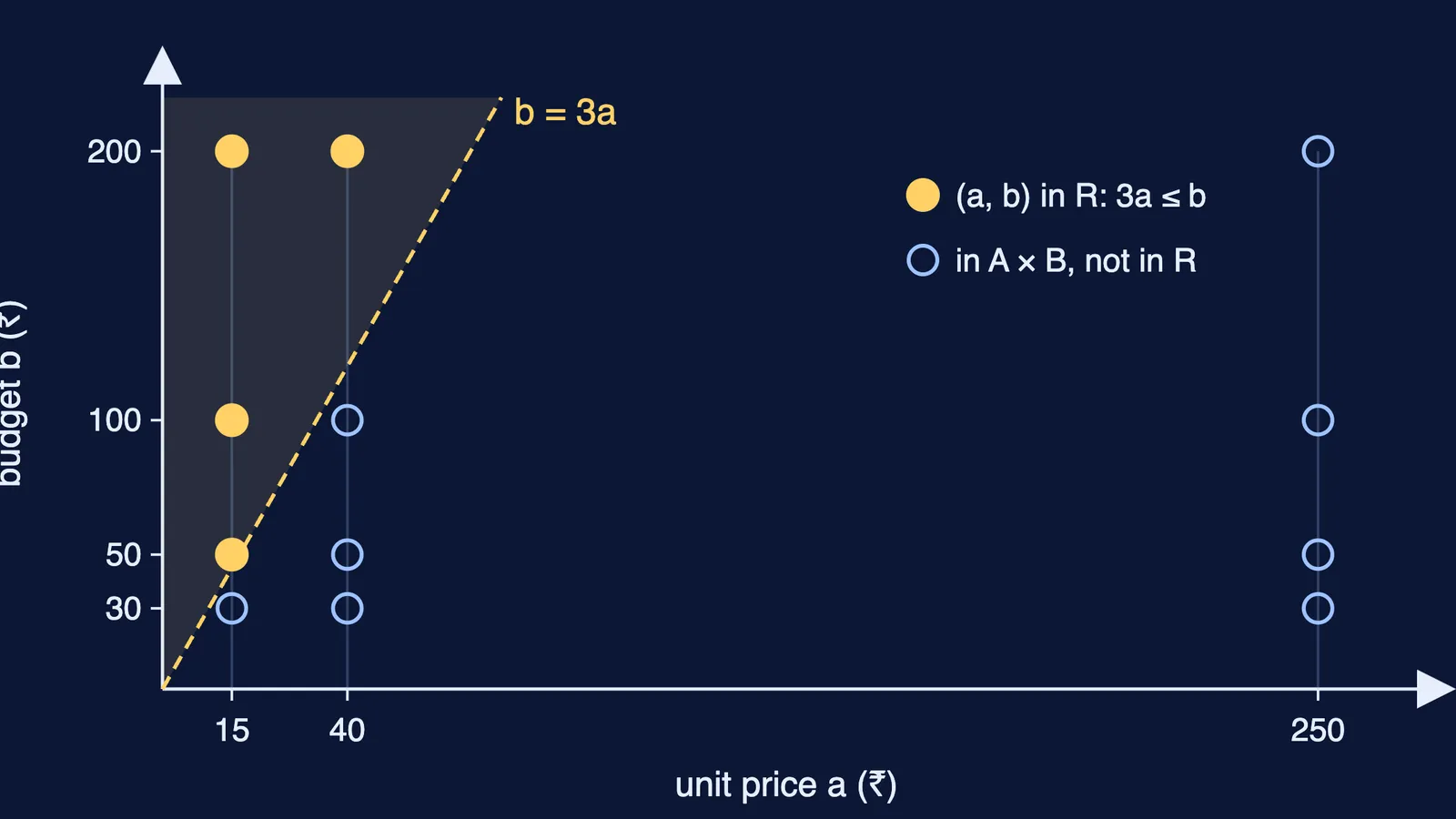
A shop sells items with unit prices A = {15, 40, 250} (in ₹). Customers have budgets B = {30, 50, 100, 200} (in ₹). Define R = {(a, b) : 3a ≤ b, a ∈ A, b ∈ B}, meaning "three units of the item fit within the budget".
n(A × B) = 3 × 4 = 12 ordered pairs.
Test each price. For a = 15, 3a = 45, which fits budgets 50, 100 and 200 but not 30. For a = 40, 3a = 120, which fits only 200. For a = 250, 3a = 750, which fits none.
Write R in roster form: R = {(15, 50), (15, 100), (15, 200), (40, 200)}.
Domain = {15, 40}. Range = {50, 100, 200}. Co-domain = B = {30, 50, 100, 200}.
Number of relations from A to B: 2 to the power 12 = 4096.
The item priced 250 is not in the domain, which a relation allows. The range is smaller than the co-domain because nothing fits a budget of 30.
Which mistakes cost marks in Relations?
Writing (b, a) for (a, b). (15, 50) is in A × B; (50, 15) is not.
Giving the co-domain when the question asks for the range.
Listing a pair that is not in A × B.
Writing pq instead of 2 to the power pq for the count of relations.
Unsure where your own gaps are? Fermi's AI tutor works out what you already know and builds a plan for the session.
Practice questions
Our own questions; the mark labels are our suggestion, not CBSE's.
(1 mark) A booking is recorded as the ordered pair (seats, price in ₹). If (x + 4, 3y) = (10, 450), find x and y.
(2 marks) Delivery days A = {Mon, Tue, Wed, Thu, Fri} and vehicles B = {van, bike}. Find n(A × B) and how many relations exist from A to B.
(3 marks) Prices P = {20, 35, 60} and budgets C = {50, 100}, in ₹. Let R = {(p, c) : 2p ≤ c}. Write R in roster form and state its domain and range.
(2 marks) A has 4 elements and there are 256 relations from A to B. Find n(B).
Answers: 1. x = 6, y = 150. 2. 10 pairs and 2 to the power 10 = 1024 relations. 3. R = {(20, 50), (20, 100), (35, 100)}, domain {20, 35}, range {50, 100}. 4. n(B) = 2, since 2 to the power 4n(B) = 256 gives 4n(B) = 8.