On this page
Probability is Chapter 9 of the CBSE book Applied Mathematics Class XI, Student Support Material (second edition, April 2026).
What does Probability cover in Class 11 Applied Maths, and how many marks?
In the CBSE Applied Mathematics (241) curriculum for 2026-27, Probability is topic 4.2 of Unit IV, Combinatorics and Probability. The theory paper is 80 marks over 3 hours, with 20 marks of internal assessment.
Unit IV carries 10 marks, shared between Combinatorics and Probability; CBSE prints no separate figure for this chapter.
The Class XI support material covers the curriculum list in three sections: 9.1 random experiments and sample spaces, 9.2 events (impossible and sure, independent and dependent, mutually exclusive and exhaustive) and 9.3 conditional probability. Bayes' theorem and total probability are not in the chapter.
How is it different from core Maths Probability?
Both use the same symbols: events are subsets of the sample space S, P(E) = n(E)/n(S) when outcomes are equally likely, and P(not E) = 1 − P(E). Three things differ.
Conditional probability comes a year earlier. In the core Mathematics curriculum, conditional probability, independent events and Bayes' theorem sit in Class 12. Applied Maths teaches conditional probability and independence in Class 11.
Less axiom work. NCERT's core Chapter 14 (Reprint 2026-27) builds probability from three axioms. The applied book uses the classical ratio of favourable to total outcomes.
Context first. Its examples and exercises draw on insurance, quality checks and loan approvals.
If you take core Maths, our Class 11 Probability guide for core Mathematics follows NCERT's events and axioms. The counting you need for harder questions is in our Combinatorics Class 11 Applied Maths guide.
What is conditional probability, in plain words?
The conditional probability of E given F is P(E|F) = P(E ∩ F)/P(F), provided P(F) ≠ 0, as defined in Chapter 9 of the support material. Once F has happened, F is your new sample space.
Events E and F are independent when P(E ∩ F) = P(E) × P(F), so knowing F does not change the chance of E. Mutually exclusive means E ∩ F = ∅, so they cannot happen together. Two mutually exclusive events with non-zero probabilities are never independent.
How do you solve probability problems with business and game examples?
Our own numbers, each worked by hand and checked in Python.
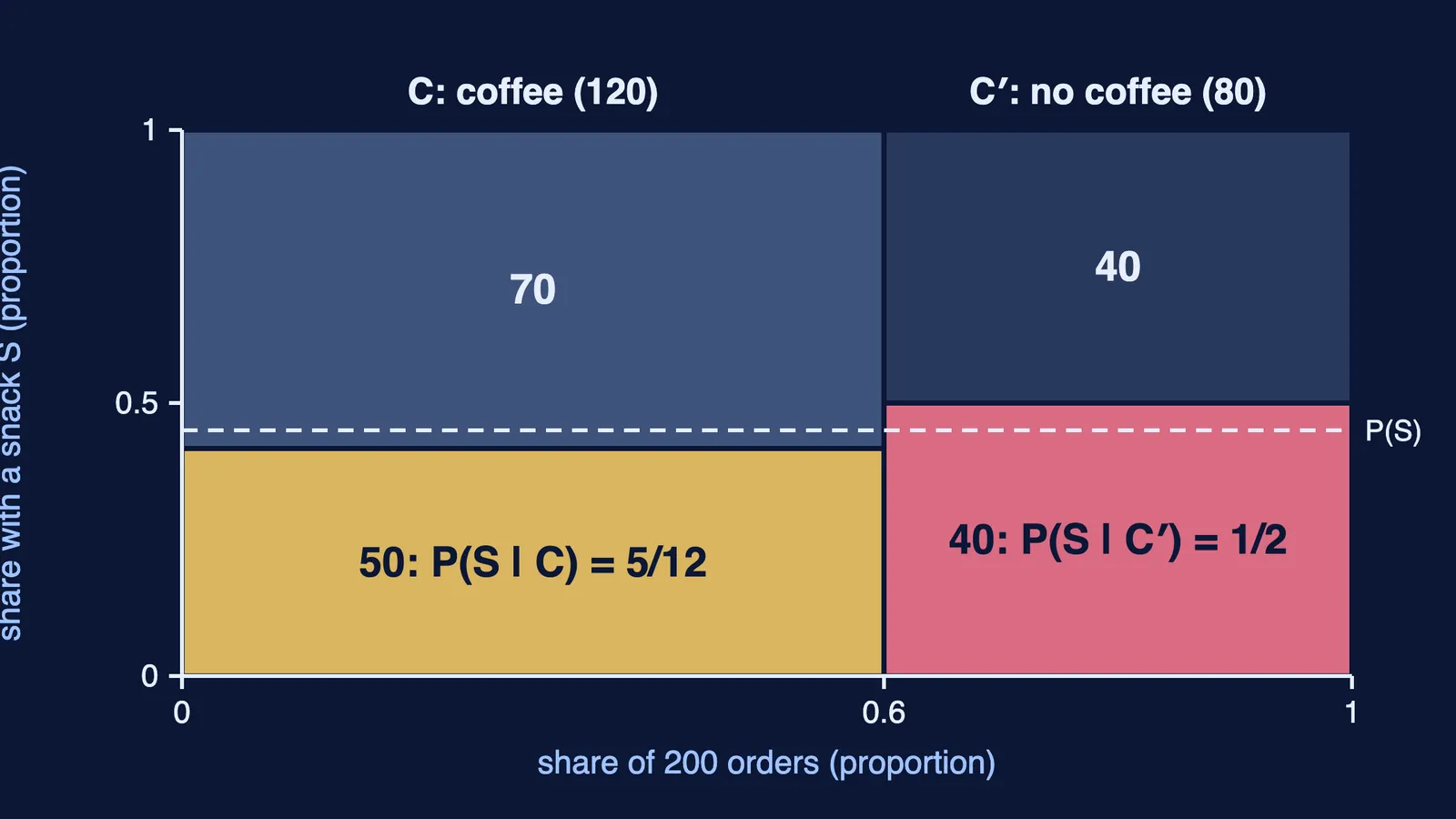
1. Café orders (the diagram above). A café logs 200 orders: 120 include coffee (C), 90 include a snack (S), and 50 include both.
P(C or S) = 120/200 + 90/200 − 50/200 = 160/200 = 4/5, so P(neither) = 1/5.
P(S|C) = 50/120 = 5/12.
P(S|C′) = 40/80 = 1/2.
P(S) = 90/200 = 9/20, but P(C) × P(S) = 3/5 × 9/20 = 27/100, while P(C ∩ S) = 50/200 = 1/4. They differ, so C and S are dependent.
2. A lucky dip. At a school fair, 3 of 10 envelopes hold a prize, and you open two without putting the first back.
P(both prizes) = 3/10 × 2/9 = 6/90 = 1/15.
P(at least one prize) = 1 − 7/10 × 6/9 = 1 − 42/90 = 8/15.
P(second is a prize | first was a prize) = 2/9, but P(second is a prize) on its own is 3/10. So the draws are dependent.
What questions can you practise for the school exam?
We wrote these questions ourselves, and the marks shown are our own guide rather than a CBSE allocation.
(1 mark) A bank approves a loan with probability 0.72. Find the probability it is not approved.
(2 marks) A spinner has 8 equal sectors numbered 1 to 8 and is spun once. A = number at most 4, B = even number. Are A and B mutually exclusive? Are they independent?
(3 marks) Of 250 customers of an online store, 150 paid by UPI, 80 bought a sale item and 45 did both. Find P(sale | UPI) and P(UPI | sale), and say whether the two events are independent.
(3 marks) A shop runs two online ads that work independently. On a given day, the first brings a sale with probability 0.65 and the second with probability 0.4. Find P(both bring a sale), P(at least one does) and P(exactly one does).
Answers: 1) 0.28. 2) Not mutually exclusive, since both contain 2 and 4; independent, since P(A ∩ B) = 2/8 = 1/4 = 1/2 × 1/2. 3) 45/150 = 0.3 and 45/80 = 0.5625; P(sale) = 80/250 = 0.32 ≠ 0.3, so dependent. 4) 0.65 × 0.4 = 0.26, 1 − 0.35 × 0.6 = 0.79, and 0.65 × 0.6 + 0.35 × 0.4 = 0.53.
Which mistakes cost marks?
Dividing by n(S) instead of n(F) in P(E|F).
Mixing up P(E|F) and P(F|E): in question 3 they are 0.3 and 0.5625.
Calling mutually exclusive events independent.
Treating draws without replacement as independent.
For the entrance-exam version, see Probability for JEE Main: how to prepare.
Stuck on which event to condition on? Fermi's AI tutor works out what you already know, builds a plan for the session, and teaches through it.