On this page
Tax and Utility Bills is Chapter 14 of CBSE's Applied Mathematics XI, second edition (April 2026), a student support material book. It covers GST, income tax under the new regime, and electricity, water and piped gas (PNG) bills.
What does Tax and Utility Bills cover in Class 11 Applied Maths?
The CBSE Applied Mathematics (241) curriculum for 2026-27 lists it as topic 6.3: income tax and GST under the new tax guidelines, and electricity, water and PNG bills. The book has two sections:
Tax: direct and indirect taxes; CGST, SGST, IGST and UTGST; input tax credit; income tax slabs, standard deduction, the Section 87A rebate, marginal relief, surcharge and the 4% Health and Education Cess.
Utility bills: fixed charges, slab-wise consumption charges, surcharges, duty, sewerage charges and arrears.
The book describes the old regime, but every worked example uses the new one. Nothing is marked as dropped for 2026-27.
How many marks is this chapter worth?
The curriculum gives Unit VI, Basics of Financial Mathematics, 15 of the 80 theory marks, plus 20 for internal assessment. They are shared with Interest and Annuities; CBSE prints no per-chapter figure.
Which tax slabs and GST rates should you use?
Use the book's figures in the exam. It works income tax with the new-regime slabs for FY 2025-26: nil up to ₹4 lakh, then 5%, 10%, 15%, 20% and 25% on each further ₹4 lakh, and 30% above ₹24 lakh. In the book, salaried people get a ₹75,000 standard deduction, and the Section 87A rebate (up to ₹60,000) makes taxable income up to ₹12 lakh tax-free for resident individuals. Its GST table lists 0%, 5%, 18% and 40% slabs from 22 September 2025.
Core Mathematics (041) has no tax or billing unit in Class 11, per its 2026-27 curriculum, so this chapter is Applied Maths only. Our guide to CBSE Applied Mathematics explains how the subject fits together.
How do you calculate GST, income tax and an electricity bill?
These are our own numbers; the electricity tariff is illustrative.
GST. A printer sells for ₹8,400 at 18% GST within one state (GST basics here). GST = ₹1,512, split as CGST ₹756 and SGST ₹756; invoice ₹9,912. Sold to another state, the full ₹1,512 is IGST. Backwards: ₹11,800 including 18% GST means a base of 11,800 ÷ 1.18 = ₹10,000.
Income tax (book's FY 2025-26 figures). Meera's gross salary is ₹14,25,000.
Taxable income = 14,25,000 − 75,000 = ₹13,50,000.
Slab tax = 20,000 + 40,000 + 15% of 1,50,000 (22,500) = ₹82,500.
No 87A rebate above ₹12 lakh. Marginal relief caps tax at the excess over ₹12 lakh (₹1,50,000), which is more than ₹82,500, so it does not apply.
Cess = 4% of 82,500 = ₹3,300. Total = ₹85,800.
At a taxable ₹12,40,000, slab tax is ₹66,000 but marginal relief caps it at the ₹40,000 excess over ₹12 lakh; with cess, ₹41,600.
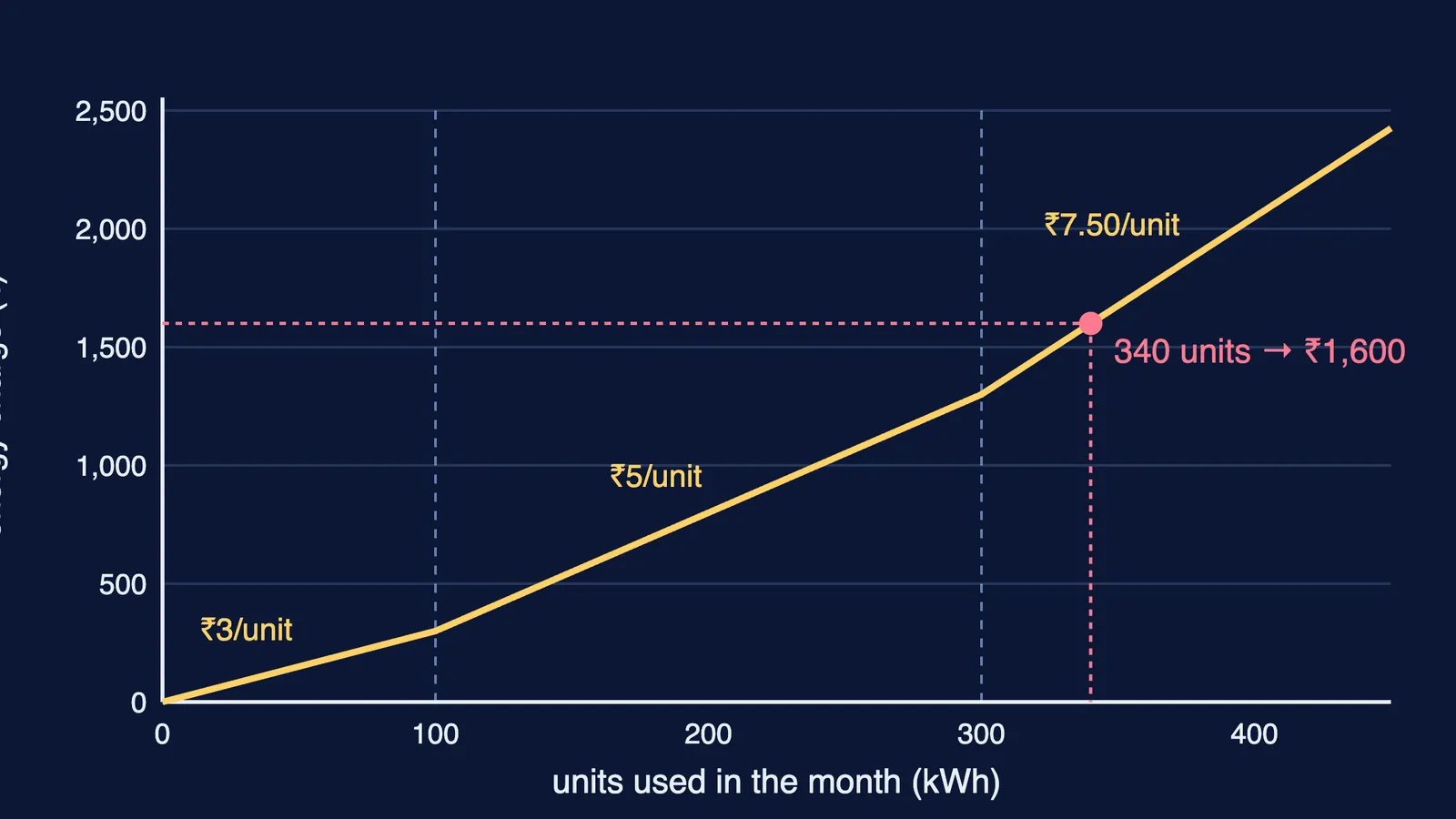
Electricity bill. A home on a 3 kW load uses 340 units. Tariff: fixed ₹40 per kW; ₹3 per unit for 0-100, ₹5 for 101-300, ₹7.50 above 300; duty 5% of the energy charge.
Fixed charge = 3 × 40 = ₹120.
Energy charge = 100 × 3 + 200 × 5 + 40 × 7.50 = ₹1,600.
Duty = ₹80. Total = ₹1,800.
Charging all 340 units at ₹7.50 gives ₹2,550, which is what skipping the slabs costs you on paper. See our piecewise view of slab billing.
We checked every answer by hand and in Python.
Practice questions
Our own questions; mark labels are our suggestion.
(1 mark) A Pune dealer sells goods worth ₹6,500 to a buyer in Indore at 18% GST. Name the tax and find it.
(2 marks) A bill including 5% GST is ₹2,940. Find the price before GST and the CGST.
(2 marks) A trader buys for ₹36,000 plus 18% GST and sells within the state for ₹50,000 plus 18% GST. Find the net GST payable.
(3 marks) A salaried person earns ₹11,60,000 plus ₹40,000 FD interest. Find the tax.
(3 marks) A home uses 32 kL of water: ₹6/kL for 0-10, ₹10/kL for 10-25, ₹16/kL above 25. Sewerage is 40% of consumption charges; meter rent ₹50. Find the bill.
(3 marks) A family uses 58 SCM of PNG in 60 days: ₹30/SCM up to 40, ₹40/SCM above. Fixed charge ₹100; GST 5% on both. Find the bill.
Answers: 1. IGST, ₹1,170. 2. ₹2,800; CGST ₹70. 3. ₹9,000 − ₹6,480 = ₹2,520. 4. Taxable ₹11,25,000; slab tax ₹52,500, cancelled by the rebate: nil. 5. ₹322 + ₹128.80 + ₹50 = ₹500.80. 6. ₹1,920 + ₹100 = ₹2,020; GST ₹101; total ₹2,121.
Stuck on where marginal relief starts? Fermi's AI tutor holds a line of reasoning across a whole session, notices where a student is stuck, and decides whether to explain, ask, or show.