On this page
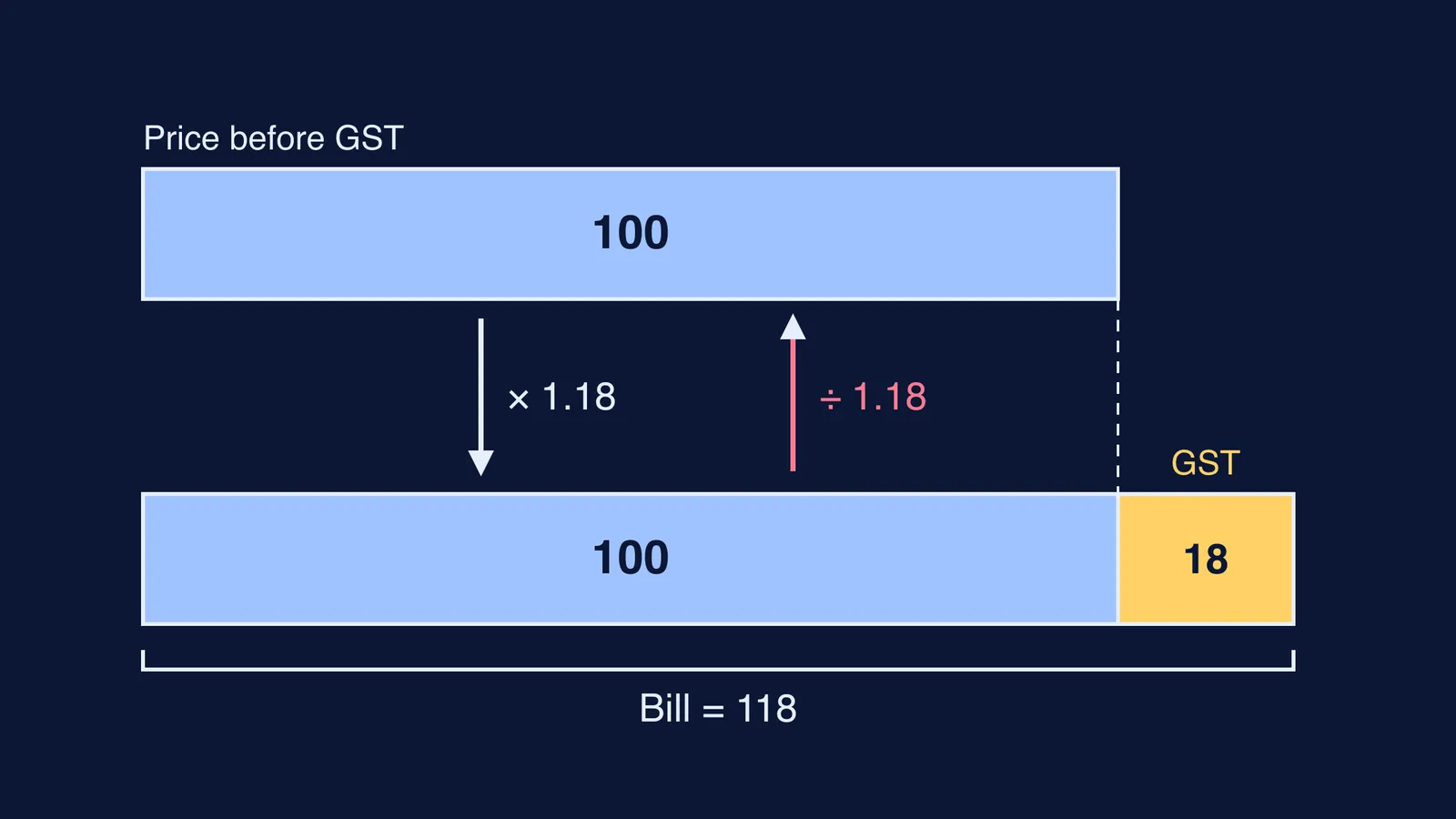
GST questions in Class 8 come in two kinds. Either you know the price and add the tax, or you have the final bill and must work back to the price before tax. Both are percentage problems, and one idea solves them: the bill is (100 + rate)% of the original price.
What is GST, and what rates apply now?
The government's FAQ on GST, published by the Central Board of Excise and Customs in 2017, defines GST as a destination-based tax on consumption of goods and services. It replaced older taxes such as State VAT and Central Sales Tax, which is why textbooks often call this topic "sales tax".
The 56th GST Council meeting moved to a structure with a standard rate of 18%, a merit rate of 5% and a special rate of 40% for a select few goods and services, according to the Press Information Bureau release. The same release says the new rates for most goods took effect from 22 September 2025. Toothpaste, toilet soap bars and bicycles moved to 5%, all TVs are now taxed at 18%, and exercise books and notebooks moved from 12% to nil.
Your textbook may still use older rates such as 12% or 28%. The method below works for any rate.
How do you add GST to a price?
GST is a percentage of the price before tax. So:
GST amount = price × rate ÷ 100
Bill amount = price + GST amount
Or in one step: bill = price × (100 + rate) ÷ 100.
Example 1. A TV costs ₹15,000 before tax, and TVs are taxed at 18% under the new GST rates.
GST = 15,000 × 18 ÷ 100 = ₹2,700
Bill = 15,000 + 2,700 = ₹17,700
Check in one step: 15,000 × 118 ÷ 100 = ₹17,700
Example 2. A bicycle costs ₹6,000 before tax at 5%. GST = 6,000 × 5 ÷ 100 = ₹300, so the bill is ₹6,300.
How do you find the original price from a GST-inclusive bill?
This is the step that is easiest to get wrong. If the bill includes 18% GST, the bill is 118% of the original price, not 100%. So you divide by 118 and multiply by 100:
Original price = bill × 100 ÷ (100 + rate)
Example 3. A bill of ₹17,700 includes GST at 18%.
Original price = 17,700 × 100 ÷ 118 = ₹15,000
GST paid = 17,700 − 15,000 = ₹2,700
Example 4. A bill of ₹1,260 includes GST at 5%. Original price = 1,260 × 100 ÷ 105 = ₹1,200, so the GST was ₹60.
A quick way to remember it: "adding tax" means multiply by 1.18, so "removing tax" means divide by 1.18. Multiplying by 0.82 is not the reverse.
How do you read a GST bill from a shop?
Within one state, both the Centre and the state charge GST on the same price. The CBEC FAQ calls these Central GST (CGST) and State GST (SGST), and a sale from one state to another carries Integrated GST (IGST) instead. That is why a bill shows two tax lines.
Here is a sample bill we made up for practice, from a shop in your own state. It uses the rates in the PIB release, with the 5% split into two equal halves for CGST and SGST:
Toothpaste, 2 × ₹60: taxable value ₹120, GST 5%
Chocolate, 1 × ₹200: taxable value ₹200, GST 5%
Notebooks, 4 × ₹50: taxable value ₹200, GST nil
Total taxable value: ₹520
CGST at 2.5% on ₹320: ₹8
SGST at 2.5% on ₹320: ₹8
Amount payable: ₹536
Reading it line by line:
Find the taxable value. This is the price before tax, quantity × rate per item.
Group the items by GST rate. Here only ₹320 is taxed; the notebooks are nil.
Work out each half. 2.5% of ₹320 is ₹8, once for CGST and once for SGST.
Add up. ₹520 + ₹8 + ₹8 = ₹536.
Check your answer: 320 × 1.05 + 200 = 336 + 200 = ₹536.
Practice set
A pressure cooker costs ₹1,400 before 5% GST. What is the bill?
A bill of ₹2,360 includes 18% GST. What was the original price?
A bill shows taxable value ₹800 with CGST 9% and SGST 9%. What is the amount payable?
Answers: ₹1,470; ₹2,000; ₹944.
If you got question 2 wrong, go back to Example 3 and redo it step by step. The Fermi Problem Library has worked problems with a step-by-step solver that explains the reasoning rather than printing an answer, which helps when you know the formula but pick the wrong one. If percentages themselves feel shaky, the Fermi Concept Library gives each mathematics concept its own lesson.
Next time you see a bill, try working back to the price before tax yourself.