

On this page
Most state distribution companies calculate your electricity bill using a telescopic tariff structure. Instead of charging a flat rate for everything you consume, they split your usage into blocks, or "slabs", where the cost per unit increases as you cross each threshold. Because the rules change at specific points, this tariff is a perfect example of a piecewise linear function in real life.
Here is how you can write a real electricity tariff as a set of continuous algebra equations, draw its graph, and calculate the exact cost for any usage without making standard multiplication mistakes.
What are electricity bill slab rates?
Electricity boards use slab rates to keep power affordable for basic needs while charging more for heavy consumption. As you consume more units (kilowatt-hours, or kWh), the extra units spill into the next, more expensive slab.
For example, the Maharashtra State Electricity Distribution Co. Ltd. (MSEDCL) sets the domestic LT-I residential tariff based on specific usage thresholds. As of April 2024, the tariff includes a fixed monthly charge of ₹128. The energy charge is ₹5.88 per unit for the first 100 units, ₹11.46 per unit for usage between 101 and 300 units, and ₹15.72 per unit for usage between 301 and 500 units.
The most common mistake when calculating a bill is multiplying the total usage by the highest rate. If you use 250 units, you do not pay ₹11.46 for all 250 units. The first 100 units are always billed at the cheaper ₹5.88 rate, and only the remaining 150 units cost ₹11.46.
How do you write slab rates as a piecewise function?
We can build a single mathematical function B(x) to find the base bill amount for any number of units x. A piecewise function uses different formulas for different intervals of x.
Slab 1: 0 to 100 units If your usage is between 0 and 100 units, the bill is just the fixed charge plus the cost of the units at the lowest rate. B(x) = 128 + 5.88x
Slab 2: 101 to 300 units If you cross 100 units, the cost of those first 100 units is locked in. The first 100 units cost 100 × 5.88 = 588. Adding the ₹128 fixed charge gives ₹716. For any usage x in this second slab, you pay ₹716 plus ₹11.46 for every unit over 100. B(x) = 716 + 11.46(x - 100) By multiplying out the brackets, we get 11.46x - 1146. B(x) = 716 - 1146 + 11.46x B(x) = 11.46x - 430
Slab 3: 301 to 500 units If your usage enters the third slab, the cost of the first 300 units is completely locked in. Using our second equation, exactly 300 units cost 11.46 × 300 - 430 = 3438 - 430 = 3008. For any usage x in the third slab, you pay ₹3008 plus ₹15.72 for every unit over 300. B(x) = 3008 + 15.72(x - 300) B(x) = 3008 + 15.72x - 4716 B(x) = 15.72x - 1708
We have now converted a complicated set of billing rules into a clean piecewise linear function. If you are confused by how the limits ensure the pieces meet perfectly at the boundaries, the Fermi Concept Library maps out piecewise continuous functions so you can see where they fit into calculus and algebra.
How do you graph a slab tariff?
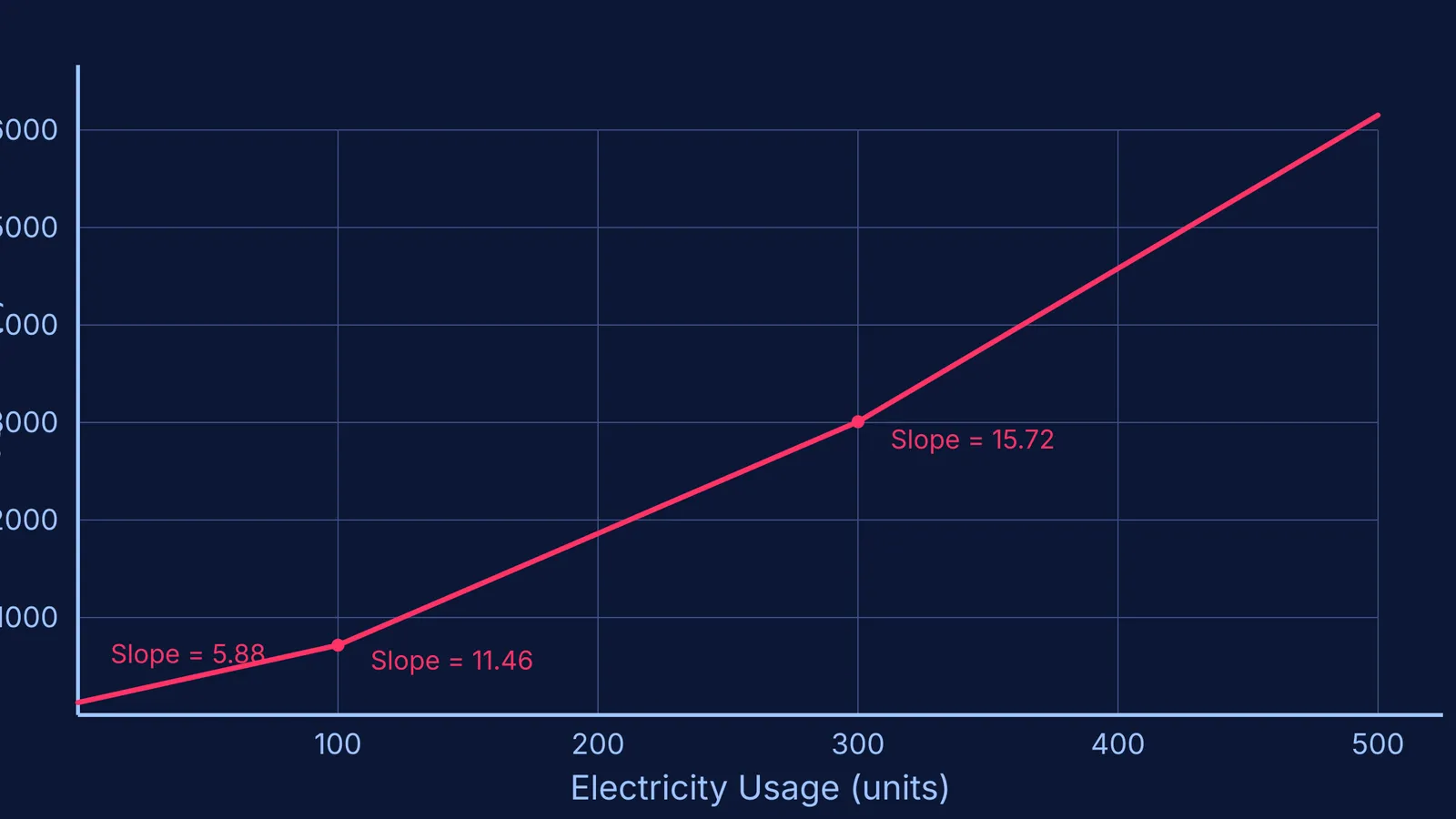
When you graph B(x) against x, you do not get a single straight line. Instead, you get a line that bends upwards at each threshold.
From 0 to 100 units, the graph rises with a gentle slope of 5.88.
At exactly 100 units, there is a "hinge" or vertex in the graph. The function is continuous, meaning there are no breaks, but it is not differentiable at this point because the slope suddenly increases to 11.46.
At exactly 300 units, the graph bends again, steepening to a slope of 15.72.
How do you find the bill for any usage?
To calculate the base bill for a specific usage, you first check which interval x falls into, and then you use the corresponding equation. (Note that actual electricity bills will also add taxes and fluctuating fuel adjustment costs on top of this base amount).
Example: Calculating the base bill for 280 units Because 280 is between 101 and 300, we use the second equation: B(x) = 11.46x - 430 B(280) = 11.46 × 280 - 430 B(280) = 3208.8 - 430 B(280) = 2778.8
The base bill amount is ₹2778.80.
If you frequently make substitution or arithmetic errors when piecing these segments together, Fermi's AI tutor can work out what you already know and build a plan for the session, writing on a board alongside you to trace the algebra step by step.


