On this page
In Class 11 Applied Mathematics (241), Straight Lines turns slope into a rate: rupees per unit made, or sales lost per rupee of price. Here is the 2026-27 syllabus, how it differs from core Maths, and worked cost, demand and supply examples.
What does the 2026-27 syllabus include, and how many marks?
In the CBSE Applied Mathematics curriculum for 2026-27, Unit VII Coordinate Geometry carries 5 of the 80 theory marks in Class 11. Those 5 marks are shared by two chapters, Straight Lines and Circles and Parabola, so there is no separate figure for this chapter. The paper is 3 hours long, and internal assessment adds 20 marks.
The curriculum lists two content points: the concept of slope, and the different forms a line's equation can take. Its learning outcomes add using linear equations to model demand and supply curves.
The CBSE book for the course is Applied Mathematics Class XI student support material (second edition, April 2026). Chapter 15, Straight Lines, runs from page 361 to 375. It covers slope, parallel lines (m₁ = m₂) and perpendicular lines (m₁m₂ = −1), lines parallel to the axes, the point-slope, two-point, slope-intercept and intercept forms, and the general form Ax + By + C = 0.
How is it different from core Maths Straight Lines?
Core Mathematics (041) gives Coordinate Geometry 12 of 80 marks in Class 11, and that unit also contains Conic Sections and Three-dimensional Geometry, according to the CBSE Mathematics curriculum for 2026-27. The core chapter lists the angle between two lines and the distance of a point from a line, which the applied curriculum does not list.
The applied course swaps that geometry for modelling: write a line from business data, read slope and intercepts as quantities with units, and find where two lines meet. For the core-syllabus treatment, read our Straight Lines Class 11 maths guide.
How do you write a cost line from two data points?
A home bakery spends ₹5,200 in a week when it makes 40 cakes and ₹7,600 when it makes 70 cakes (our numbers). Assume total cost C is linear in the number of cakes x.
Slope: m = (7600 − 5200)/(70 − 40) = 2400/30 = 80. Each extra cake adds ₹80, the variable cost per cake.
Point-slope form through (40, 5200): C − 5200 = 80(x − 40).
Slope-intercept form: C = 80x + 2000. The intercept ₹2,000 is the fixed cost, paid even when x = 0.
Check with the other point: 80 × 70 + 2000 = 7,600. Correct.
How do demand and supply lines give an equilibrium?
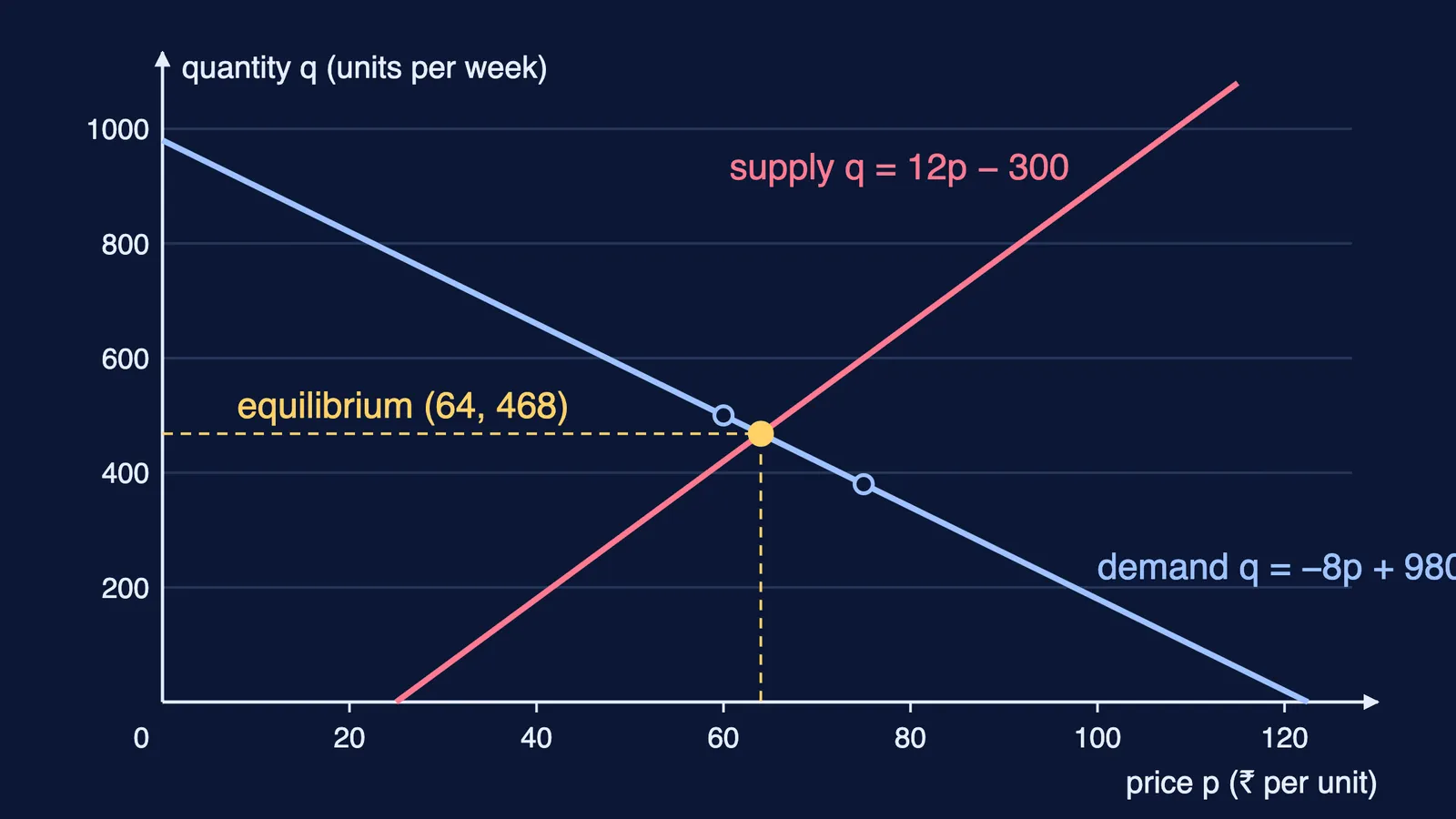
The book writes demand as q = mp + b, with price p as the independent variable. The graph above uses the same layout.
A stall sells 500 notebooks a week at ₹60 each and 380 a week at ₹75 (our numbers).
Slope: m = (380 − 500)/(75 − 60) = −120/15 = −8. Each ₹1 rise in price loses 8 sales a week.
Intercept: 500 = −8(60) + b, so b = 980. Demand: q = −8p + 980.
Intercepts: at p = 0, q = 980; at q = 0, p = 980/8 = ₹122.50. In intercept form, p/122.5 + q/980 = 1.
Now suppose suppliers offer q = 12p − 300 notebooks a week (our numbers), so none are offered below ₹25.
At equilibrium, supply equals demand: 12p − 300 = −8p + 980, so 20p = 1280 and p = ₹64.
Quantity: q = 12(64) − 300 = 468. Check with demand: −8(64) + 980 = 468. Both agree.
What questions should you practise?
We wrote these questions, and the mark labels are our suggestion, not CBSE's. Answers follow each question.
(1 mark) Find the slope of the line through (2, −1) and (6, 9). Answer: 10/4 = 5/2.
(2 marks) A taxi charges ₹90 for 4 km and ₹174 for 10 km, and the fare F is linear in distance d. Find F in terms of d. Answer: F = 14d + 34, a fixed charge of ₹34 and ₹14 per km.
(3 marks) Reduce 6x + 4y − 24 = 0 to slope-intercept and intercept forms. Answer: y = −(3/2)x + 6; x/4 + y/6 = 1.
(3 marks) Find the line through (1, 2) perpendicular to 2x − 5y + 7 = 0. Answer: slope −5/2, so 5x + 2y − 9 = 0.
(4 marks) Demand is q = −5p + 700 and supply is q = 15p − 140. Find the equilibrium price and quantity. Answer: p = ₹42, q = 490.
Preparing for entrance exams too? Our guide to Straight Lines for JEE Main goes further into the geometry.
Stuck on which form to use for a question? Fermi's AI tutor works out what you already know and builds a plan for the session, so you start with a clear next step.