On this page
Regression Analysis is Chapter 12 of the CBSE Applied Mathematics XI student support material (second edition, April 2026), and the preface says it is new in this edition. Correlation tells you how strongly two variables move together; regression turns that into an equation that predicts one from the other.
What does the 2026-27 curriculum include?
The CBSE Applied Mathematics (241) curriculum for 2026-27 lists regression as topic 5.4 in Unit V, Descriptive Statistics: the concept, dependent and independent variables, regression coefficients, and regression equations with their properties. You should be able to tell correlation from regression, compute the coefficients and pick the right tool for a real problem.
Unit V carries 10 of the 80 theory marks, shared with dispersion, percentiles and correlation, so there is no separate figure for this chapter.
How is regression different from correlation?
Correlation gives one number, r, for the strength and direction of a link, treating both variables alike; our Class 11 correlation guide covers Pearson's and Spearman's coefficients. Neither the core Mathematics nor the Economics curriculum for 2026-27 includes regression, so this is new ground.
Regression picks a dependent variable (the one you estimate) and an independent one, then fits the line with the smallest sum of squared errors (least squares). So there are two lines:
y on x: y − ȳ = byx(x − x̄), used to estimate y for a given x
x on y: x − x̄ = bxy(y − ȳ), used to estimate x for a given y
A regression coefficient is the average change in the dependent variable per unit change in the independent one. With deviations from the means, byx = Σdx·dy ÷ Σdx² and bxy = Σdx·dy ÷ Σdy².
Worked example: juice price and daily sales
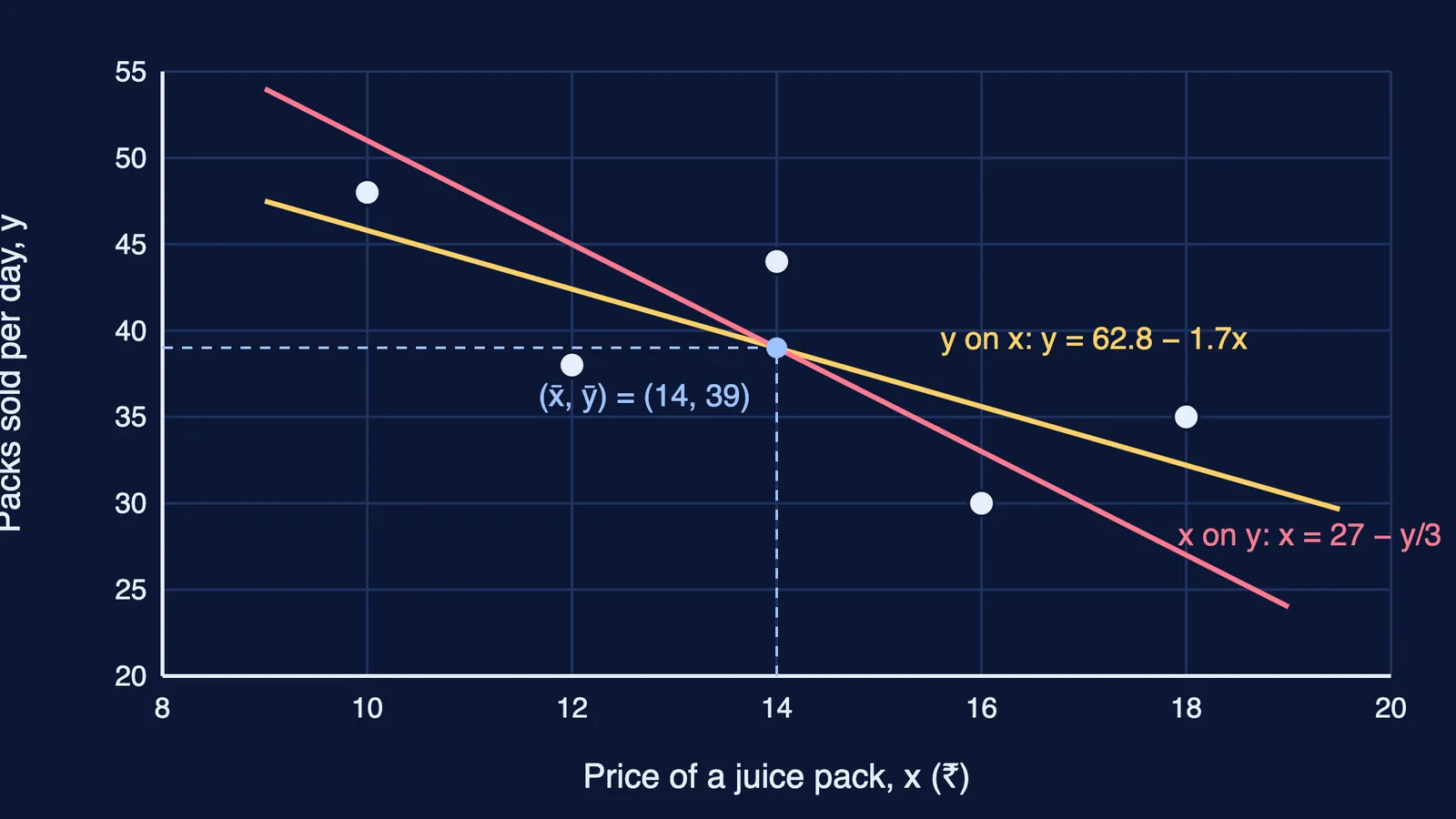
A canteen tries five prices for a juice pack (our numbers). Price x in rupees: 10, 12, 14, 16, 18. Packs sold y: 48, 38, 44, 30, 35.
Means: x̄ = 70 ÷ 5 = 14 and ȳ = 195 ÷ 5 = 39.
Deviations: dx = −4, −2, 0, 2, 4 and dy = 9, −1, 5, −9, −4.
Sums: Σdx² = 40, Σdy² = 204, Σdx·dy = −36 + 2 + 0 − 18 − 16 = −68.
Coefficients: byx = −68 ÷ 40 = −1.7 and bxy = −68 ÷ 204 = −1/3 ≈ −0.333.
y on x: y − 39 = −1.7(x − 14), so y = 62.8 − 1.7x. At ₹15, y = 37.3, about 37 packs.
x on y: x − 14 = −(1/3)(y − 39), so x = 27 − y/3. To sell 45 packs, x = ₹12.
Check r: r² = byx × bxy = 1.7/3 ≈ 0.567, so r ≈ −0.75 (same sign as the coefficients).
Each extra rupee goes with about 1.7 fewer packs a day, on average; the diagram above shows both lines crossing at (14, 39). A fitted line shows association, not cause; see correlation vs causation, with examples.
What are the properties of regression lines?
Both lines pass through (x̄, ȳ), so solving the two equations gives the means.
byx, bxy and r share one sign, and r is their geometric mean: r = ±√(byx × bxy).
If one coefficient exceeds 1 in size, the other must be below 1, since their product is r² ≤ 1; this tells you which equation is y on x.
Coefficients ignore a change of origin but not a change of scale.
The two lines coincide when r = ±1 and are perpendicular when r = 0.
To check in a spreadsheet, Google Sheets' SLOPE and INTERCEPT take (data_y, data_x). With prices in A2:A6 and sales in B2:B6, =SLOPE(B2:B6, A2:A6) gives −1.7 and INTERCEPT gives 62.8; swapping the ranges gives x on y.
Practice questions with answers
Our own questions; the mark labels are our suggestion, not CBSE's.
(1 mark) byx = −0.8 and bxy = −0.45. Find r. Answer: r² = 0.36 and both are negative, so r = −0.6.
(3 marks) The regression lines are 2x + 5y = 52 and 8x + 5y = 88. Find the means, identify y on x, and find r. Answer: x̄ = 6, ȳ = 8. Taking 2x + 5y = 52 as y on x gives byx = −0.4 and bxy = −5/8, product 0.25; the other way gives 4, but r² cannot exceed 1. So r = −0.5.
(4 marks, case-based) A typing class records weekly practice hours x (mean 6 h, σ = 2 h) and typing speed y (mean 40 words a minute, σ = 10), with r = 0.6. Estimate y at 9 hours. Answer: byx = 0.6 × 10 ÷ 2 = 3 words a minute per hour, so y = 40 + 3 × 3 = 49 words a minute.
Stuck on which line answers which question? Fermi's AI tutor works out what you already know, builds a plan for the session and checks understanding as it goes.