On this page
Differentiation and its Applications opens the Calculus unit of Class 12 Applied Mathematics (241) and puts the derivative to work on cost, revenue and profit. Below: the 2026-27 syllabus, the contrast with core Maths, and one worked profit problem.
What does the 2026-27 syllabus include, and how many marks?
In the CBSE Applied Mathematics curriculum for 2026-27, Unit III Calculus carries 15 of the 80 theory marks in Class 12. That 15 is shared with Integration and Differential Equations; CBSE prints no separate figure for this chapter.
Differentiation has five listed topics:
Derivatives up to second order, including parametric and implicit functions.
Rates of change, for example of an area or a volume over time.
Marginal cost and marginal revenue.
Increasing and decreasing functions on an interval.
Critical points, local and absolute maxima and minima by the first and second derivative tests, and optimisation of cost, revenue and profit only.
CBSE's own study resource for the chapter is its Applied Mathematics XII support material, Chapter 3a (first edition, July 2021). Its sections on logarithmic differentiation and on tangents and normals are not named in the 2026-27 list: background only.
How is it different from core Maths Application of Derivatives?
Core Mathematics (041) gives Calculus 35 of 80 marks in Class 12, and its derivative chapters also cover inverse trigonometric functions and logarithmic differentiation, according to the CBSE Mathematics curriculum for 2026-27.
The applied list has no trigonometric functions, adds marginal cost and marginal revenue, and restricts optimisation to business settings. For the core treatment, read our Application of Derivatives Class 12 board guide.
How do you find maximum profit using derivatives?
A workshop sells x sofas a month (our numbers, money in ₹ thousand). The demand price is p = 120 − x, and total cost is C(x) = x³ − 22x² + 192x + 100.
Revenue: R(x) = px = 120x − x², so marginal revenue MR = R′(x) = 120 − 2x.
Marginal cost: MC = C′(x) = 3x² − 44x + 192.
C″(x) = 6x − 44 is negative for x < 22/3, so marginal cost first falls, then rises.
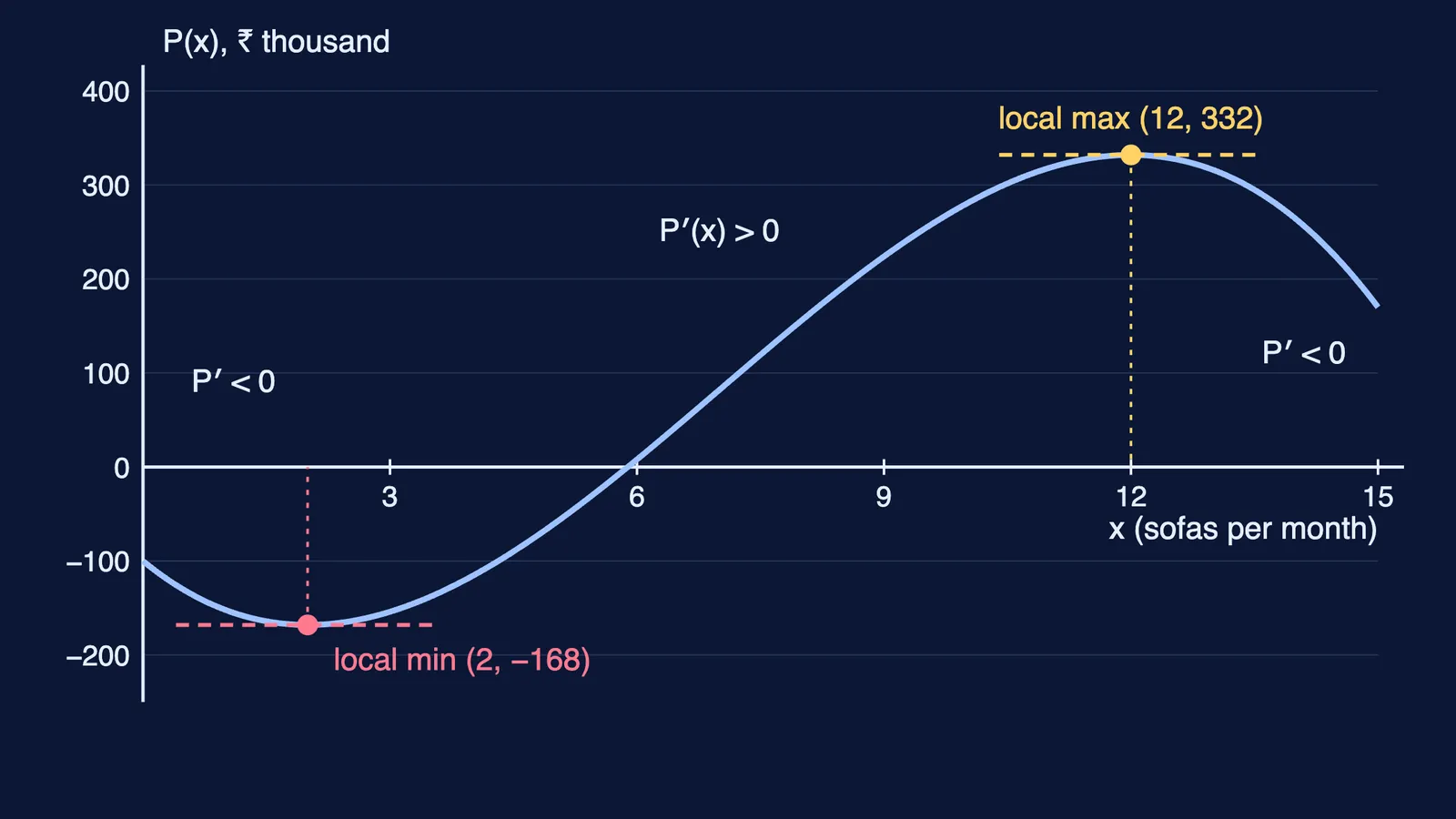
Profit: P(x) = R(x) − C(x) = −x³ + 21x² − 72x − 100.
P′(x) = −3x² + 42x − 72 = −3(x − 2)(x − 12). The critical points are x = 2 and x = 12.
Signs: P′(x) < 0 on (0, 2), P′(x) > 0 on (2, 12) and P′(x) < 0 for x > 12.
Second derivative test: P″(x) = −6x + 42. P″(2) = 30 > 0, a local minimum, with P(2) = −168. P″(12) = −30 < 0, a local maximum, with P(12) = −1728 + 3024 − 864 − 100 = 332.
So the best plan is 12 sofas a month at ₹108 thousand each, for ₹332 thousand profit. Check: at x = 12, MR = 120 − 24 = 96 and MC = 432 − 528 + 192 = 96. Profit peaks where MR = MC, as the support material notes.
With P(0) = −100 and P falling after x = 12, ₹332 thousand is the absolute maximum for x ≥ 0.
How do parametric and rate-of-change questions look?
Parametric, second order: if x = 2t + 1 and y = t³, then dy/dx = (3t²)/2. For the second derivative, differentiate in t and divide by dx/dt again: d²y/dx² = (3t)/2, which is 3 at t = 2. Check: eliminating t gives y″ = 3(x − 1)/4, which is 3 at x = 5 (t = 2).
Rate of change: a cube's edge grows at 0.2 cm/s. When the edge is 5 cm, dV/dt = 3a² × da/dt = 3 × 25 × 0.2 = 15 cm³/s.
What questions should you practise?
Original questions; the mark labels are our suggestion, using the question types in the CBSE Applied Mathematics sample paper for 2026-27: 1-mark MCQs, 2-, 3- and 5-mark answers, and 4-mark case studies.
(1 mark) If x = 3t² and y = 2t³, find d²y/dx² at t = 1. Answer: 1/6.
(2 marks) For x² + xy + y² = 7, find dy/dx at (1, 2). Answer: −4/5.
(3 marks) Find the intervals where f(x) = x³ − 9x² + 24x + 5 is increasing or decreasing. Answer: increasing on (−∞, 2) and (4, ∞); decreasing on (2, 4).
(5 marks) Demand is p = 200 − 4x and cost is C(x) = 500 + 40x. Find the output, price and maximum profit. Answer: x = 20, p = ₹120, profit ₹1,100.
(4 marks, case study) A bakery's daily cost for x trays is C(x) = 2x² + 50x + 800 rupees. (i) Write AC(x). (ii) Find AC′(x). (iii) Find the x that minimises AC, and the minimum. Answers: AC(x) = 2x + 50 + 800/x; AC′(x) = 2 − 800/x²; x = 20 trays, ₹130 per tray.
Stuck on the second derivative test? Fermi's AI tutor works out what you already know and builds a plan for the session. For Class 11 groundwork, see Calculus in Class 11 Applied Maths.