On this page
Inferential Statistics is Unit V of CBSE Class 12 Applied Mathematics (241), and the CBSE 2026-27 curriculum gives it 05 of the 80 theory marks. There is no NCERT textbook for this paper; CBSE's Student Support Material, Chapter 5 is the reference text. Its question: what can a small sample tell you about a whole population?
What does the 2026-27 syllabus cover?
The curriculum has three parts:
5.1 Population and sample: representative versus non-representative and biased versus unbiased samples, and simple random and systematic random sampling (sample size under 100).
5.2 Parameter, statistic and inference: mean and standard deviation only, the central limit theorem, and a conceptual idea of significance and sampling distributions.
5.3 t-test: null and alternate hypotheses, degrees of freedom, and a t-test for one group with a small sample. Only non-directional alternate hypotheses are listed.
Core Class 12 Mathematics (041) has no hypothesis testing in its 2026-27 curriculum. What carries over is the standard deviation from Class 11 statistics.
What is the difference between a parameter and a statistic?
A parameter describes the whole population and uses Greek letters, μ for mean and σ for standard deviation, as the support material sets out. A statistic describes a sample and uses English letters, such as x̄ and s.
The mean weight of every carton a dairy packed today is a parameter; the mean of nine cartons is a statistic, and another nine would differ slightly. The spread of such sample means is the sampling distribution. The central limit theorem says it nears a normal curve as samples grow, whatever the population's shape; the support material treats 30 or more as large enough. Sampling error is also why exit polls can miss.
How do you do a one-sample t-test step by step?
Use it when the population is roughly normal and σ is unknown. The test statistic, in the notation of the 2026-27 sample paper's marking scheme, is t = (x̄ − μ) ÷ (s/√n), with degrees of freedom df = n − 1.
Write H₀: μ = claimed value; H₁: μ ≠ claimed value.
Find x̄ and s, dividing the sum of squared deviations by n − 1 (the support material's rainfall example gives S = 1.30 only this way).
Compute t.
Find df = n − 1 and read the two-tailed 5% critical value, the 0.975 column of a table such as the NIST t-table.
If |t| exceeds the critical value, reject H₀; otherwise do not. State what that means for the claim.
Worked example: is the carton really 500 mL?
A dairy claims its juice cartons average 500 mL. Nine cartons measure 497, 499, 496, 502, 498, 495, 500, 497 and 498 mL. Test at the 5% level.
H₀: μ = 500 mL. H₁: μ ≠ 500 mL.
Sum = 4482, so x̄ = 4482 ÷ 9 = 498 mL. The deviations are −1, 1, −2, 4, 0, −3, 2, −1, 0; their squares add to 36. So s² = 36 ÷ 8 = 4.5 and s = 2.121 mL.
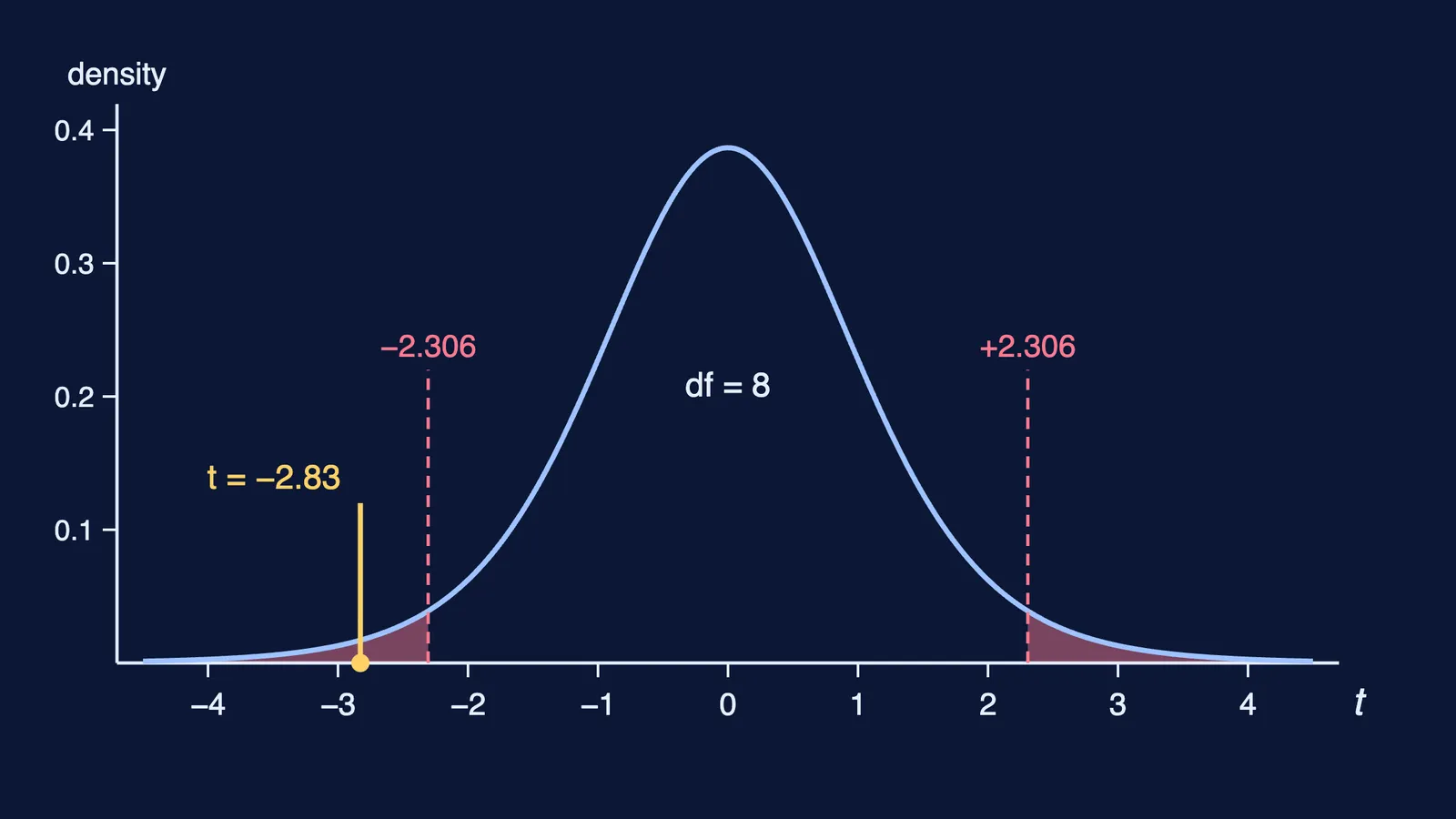
Standard error = 2.121 ÷ √9 = 0.707 mL. t = (498 − 500) ÷ 0.707 = −2.83.
df = 9 − 1 = 8. From the NIST table, t₈(0.025) = 2.306.
|t| = 2.83 > 2.306, so reject H₀. At the 5% level, the sample suggests the cartons hold less than 500 mL on average.
Rejecting H₀ is evidence, not proof; a 5% level accepts a 5% risk of rejecting a true claim. Our post on what a p-value means explains that idea with coin tosses.
Practice questions in the sample-paper format
The 2026-27 sample paper has a 1-mark MCQ on parameter versus statistic and a 3-mark one-sample t-test. These questions are our own, in its 1-, 2- and 3-mark types.
(1 mark) A sample of 60 households in a town has a mean monthly electricity bill of ₹1,840. Is ₹1,840 a parameter or a statistic?
(2 marks) A school says its students sleep 8 hours a night on average. Write H₀ and H₁ for testing this claim.
(2 marks) A sample has 16 values. State df and the two-tailed 5% critical t value.
(3 marks) A bakery claims its loaves weigh 250 g on average. 16 loaves give x̄ = 247 g and s = 6 g. Test at the 5% level.
Answers: (1) a statistic (from a sample); (2) H₀: μ = 8 hours, H₁: μ ≠ 8 hours; (3) df = 15, critical value 2.131 from the NIST table; (4) t = (247 − 250) ÷ (6/4) = −2.00, and |t| = 2.00 < 2.131 with df = 15, so do not reject H₀.
Not sure where to start? Fermi's AI tutor works out what you already know, builds a plan for the session, and teaches through it.