On this page
In the 2026-27 CBSE curriculum for Class XII Applied Mathematics (241), Financial Mathematics is Unit VII, worth 15 of 80 theory marks (CBSE Applied Mathematics curriculum 2026-27). CBSE covers it in Chapter 7 of its Applied Mathematics XII support material. Core Mathematics (041) has no finance unit (CBSE Mathematics curriculum 2026-27), so there is no core version.
What does the 2026-27 syllabus cover?
Perpetuity and sinking funds, and how a sinking fund differs from a savings account
Valuation of bonds by the present value approach
EMI by the flat-rate and reducing-balance methods
Compound annual growth rate (CAGR) versus annual growth rate
The linear method of depreciation
The support material chapter (first edition, July 2021) also teaches nominal and effective rates, shares and debentures, and two other depreciation methods; the 2026-27 curriculum does not list them for Class XII. Effective rates are Class XI work: see our Class 11 interest and annuities guide.
In the 2026-27 Applied Maths sample paper, the unit appears as three 1-mark MCQs, a 2-mark depreciation question, 3-mark bond and CAGR-or-sinking-fund questions, and a 4-mark EMI case study. Calculators are not allowed; the paper supplies powers and logarithms.
Which formulas do you need?
R is the payment, i the rate and n the number of periods.
Perpetuity, payments at the end of each period: P = R/i; at the start: P = R + R/i
Sinking fund deposit to reach A: R = A·i / [(1 + i)ⁿ − 1]
Bond value: V = R·[1 − (1 + i)⁻ⁿ]/i + C(1 + i)⁻ⁿ, with R the coupon per period and C the redemption value
Flat-rate EMI: (P + I)/n, with I the simple interest on the whole loan
Reducing-balance EMI: P·i(1 + i)ⁿ / [(1 + i)ⁿ − 1]
CAGR = [(EV/SV)^(1/n) − 1] × 100
Linear depreciation: D = (C − S)/n, with cost C, scrap value S and life n years
A perpetuity has no future value, since payments never stop.
How do you solve each type?
Our own numbers, checked by hand and in Python.
Perpetuity. A trust pays a ₹9,600 scholarship at every year end, forever, at 6.4%. P = 9,600/0.064 = ₹1,50,000. Paid at the start of each year, P = ₹1,59,600.
Sinking fund. A firm needs ₹2,64,000 in 4 years, depositing at each year end at 7.2% compounded annually. With (1.072)⁴ ≈ 1.320624, R = 2,64,000 × 0.072 ÷ 0.320624 ≈ ₹59,284. More in our sinking fund formula guide.
Bond. A ₹5,000 bond pays an 8.4% coupon half-yearly and is redeemed at par in 3 years; the yield is 9.6% compounded half-yearly. R = ₹210, i = 0.048, n = 6 and (1.048)⁻⁶ ≈ 0.754801. V = 210 × 5.10832 + 5,000 × 0.754801 = 1,072.75 + 3,774.00 = ₹4,846.75. Yield above coupon rate means a discount.
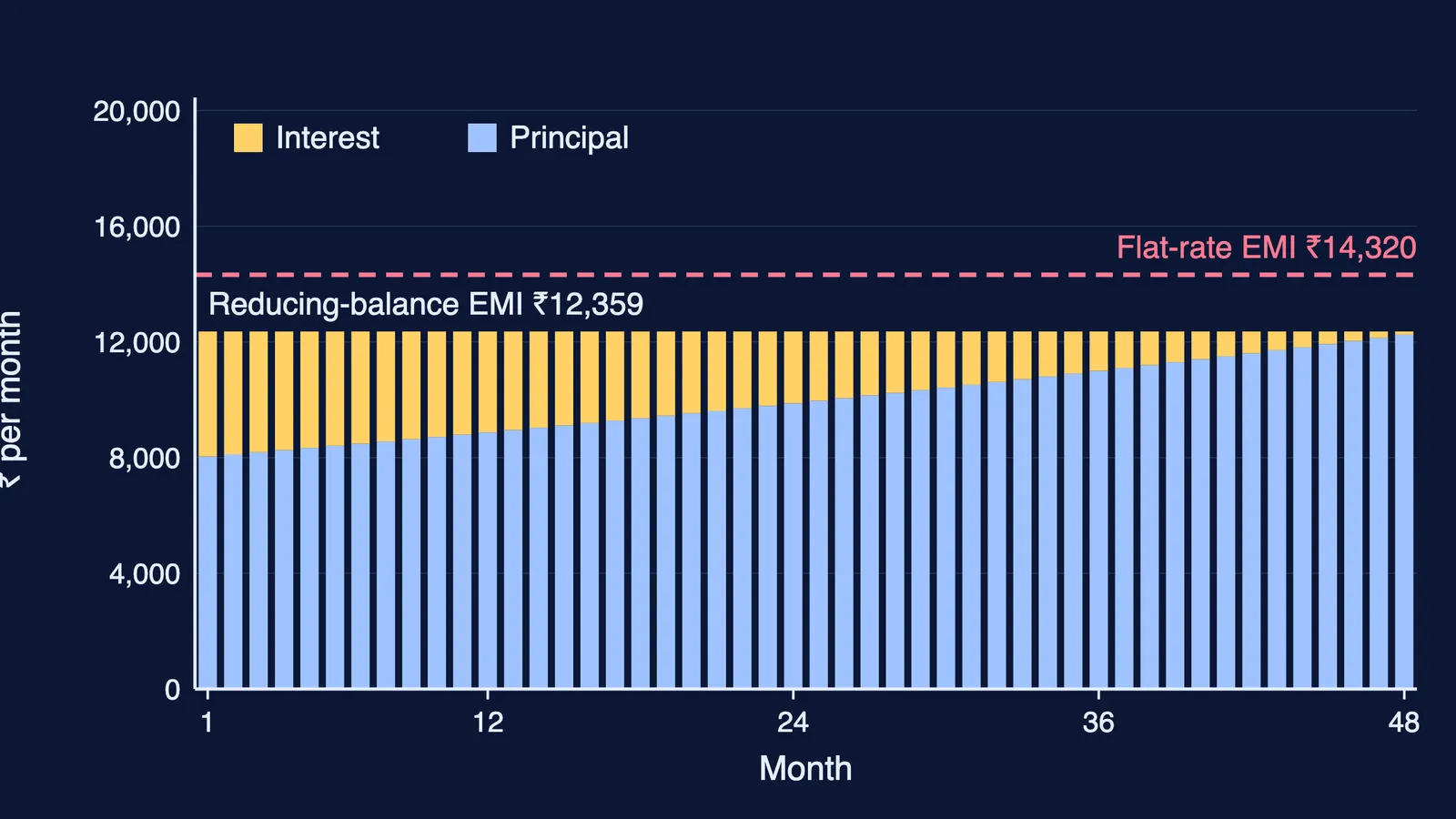
EMI. A ₹4,80,000 loan at 10.8% a year for 48 months. Flat rate: I = 4,80,000 × 0.108 × 4 = ₹2,07,360, so EMI = 6,87,360 ÷ 48 = ₹14,320. Reducing balance: i = 0.009 and (1.009)⁴⁸ ≈ 1.537361, so EMI = 4,320 × 1.537361 ÷ 0.537361 ≈ ₹12,359.28, with total interest about ₹1,13,246.
CAGR. Revenue grows from ₹12,50,000 to ₹21,60,000 in 3 years. EV/SV = 1.728 = (1.2)³, so CAGR = 20%. The average annual growth rate, 72.8% ÷ 3 ≈ 24.27%, overstates it.
Depreciation. A machine costs ₹93,000, with scrap value ₹8,700 after 6 years. D = 84,300 ÷ 6 = ₹14,050 a year; book value after 4 years = ₹36,800.
Why does a reducing-balance EMI cost less?
Flat rate charges interest on the full ₹4,80,000 throughout; reducing balance charges it only on what is still owed. In month 1 of our loan, ₹4,320 of the EMI is interest and ₹8,039.28 principal; by month 48, it is ₹110.24 interest and ₹12,249.04 principal. Our reducing-balance EMI formula explainer shows where the formula comes from.
Practice questions
Our own questions, in the formats the 2026-27 sample paper uses.
(MCQ, 1 mark) At 7.2% compounded quarterly, the present value of a perpetuity of ₹4,500 paid at the start of each quarter is: (A) ₹2,50,000 (B) ₹2,54,500 (C) ₹62,500 (D) undefined
(VSA, 2 marks) Equipment costs ₹1,45,000; scrap value is ₹19,400 after 8 years. Find the linear depreciation per year and the book value after 3 years.
(SA, 3 marks) An investment grew from ₹90,000 to ₹1,31,769 at a CAGR of 10%. For how many years was it held? [Use log 1.4641 = 0.1656 and log 1.1 = 0.0414]
(Case study, 4 marks) Find the monthly instalment on a ₹2,10,000 loan at 13.2% a year for 2 years by (i) the flat-rate method and (ii) the reducing-balance method. [Use (1.011)²⁴ = 1.3003]
Answers. 1: (B), 4,500 + 4,500/0.018 = ₹2,54,500. 2: ₹15,700; ₹97,900. 3: 1,31,769 ÷ 90,000 = 1.4641, so n = 0.1656 ÷ 0.0414 = 4 years. 4: (i) 2,65,440 ÷ 24 = ₹11,060; (ii) 2,310 × 1.3003 ÷ 0.3003 ≈ ₹10,002.
Stuck? Fermi's AI tutor works out what you already know and builds a plan for the session.