

On this page
What is a sinking fund and why is it used?
A sinking fund is an interest-bearing account created to accumulate a predetermined sum of money by a specific future date through regular, equal deposits. Rather than struggling to raise a massive lump sum when a debt matures or expensive machinery breaks down, an organization or individual sets aside smaller periodic installments that grow steadily with compound interest. In modern corporate accounting and public finance, sinking funds are widely used to retire debentures, amortize long-term bond issues, and replace depreciating capital assets.
For students studying Commerce and Applied Mathematics, this concept forms a cornerstone of financial literacy. In the CBSE Applied Mathematics Senior Secondary Curriculum, Unit 7 on Financial Mathematics carries 15 marks out of the 80-mark theory paper, covering sinking funds alongside bonds, perpetuities, and depreciation. Beyond secondary school exams, state governments across India maintain a Consolidated Sinking Fund administered by the Reserve Bank of India guidelines to redeem market borrowings and buffer against future fiscal obligations. Understanding how periodic deposits compound over time helps students connect textbook algebra with practical money management, much like calculating compound interest step by step in earlier grades.
How do you derive the sinking fund formula from an annuity?
Mathematically, a sinking fund is an application of an ordinary annuity, where equal payments occur at the end of each compounding interval. As explained in Rupinder Sekhon and Roberta Bloom's Applied Finite Mathematics/06%3A_Mathematics_of_Finance/6.03%3A_Annuities_and_Sinking_Funds), if you deposit an installment R at the end of each period for n periods at a periodic compound interest rate i, each deposit earns interest for a different duration:
The 1st installment earns interest for n − 1 periods, growing to R(1 + i)ⁿ⁻¹.
The 2nd installment earns interest for n − 2 periods, growing to R(1 + i)ⁿ⁻².
Subsequent installments compound similarly until the final installment, deposited at the end of period n, earns no interest and equals R.
The total accumulated future value A is the sum of these individual terminal values:
A = R + R(1 + i) + R(1 + i)² + ... + R(1 + i)ⁿ⁻¹
This series represents a finite geometric progression with first term R, common ratio 1 + i, and n terms. Applying the standard summation technique used when summing terms in a geometric progression, the sum simplifies to the future value of an ordinary annuity:
A = R × [((1 + i)ⁿ − 1) / i]
To find the periodic payment R required to reach a known target amount A, simply rearrange the formula:
R = (A × i) / [(1 + i)ⁿ − 1]
Here, i is the interest rate per compounding period (nominal annual rate r divided by the number of compounding periods per year m), and n is the total number of installments (time in years t multiplied by m). If you want to explore how compound interest transitions into ordinary annuities and perpetuities, the Fermi Concept Library covers every concept in mathematics with its own lesson and place in the learning map.
How do you calculate sinking fund payments in a worked example?
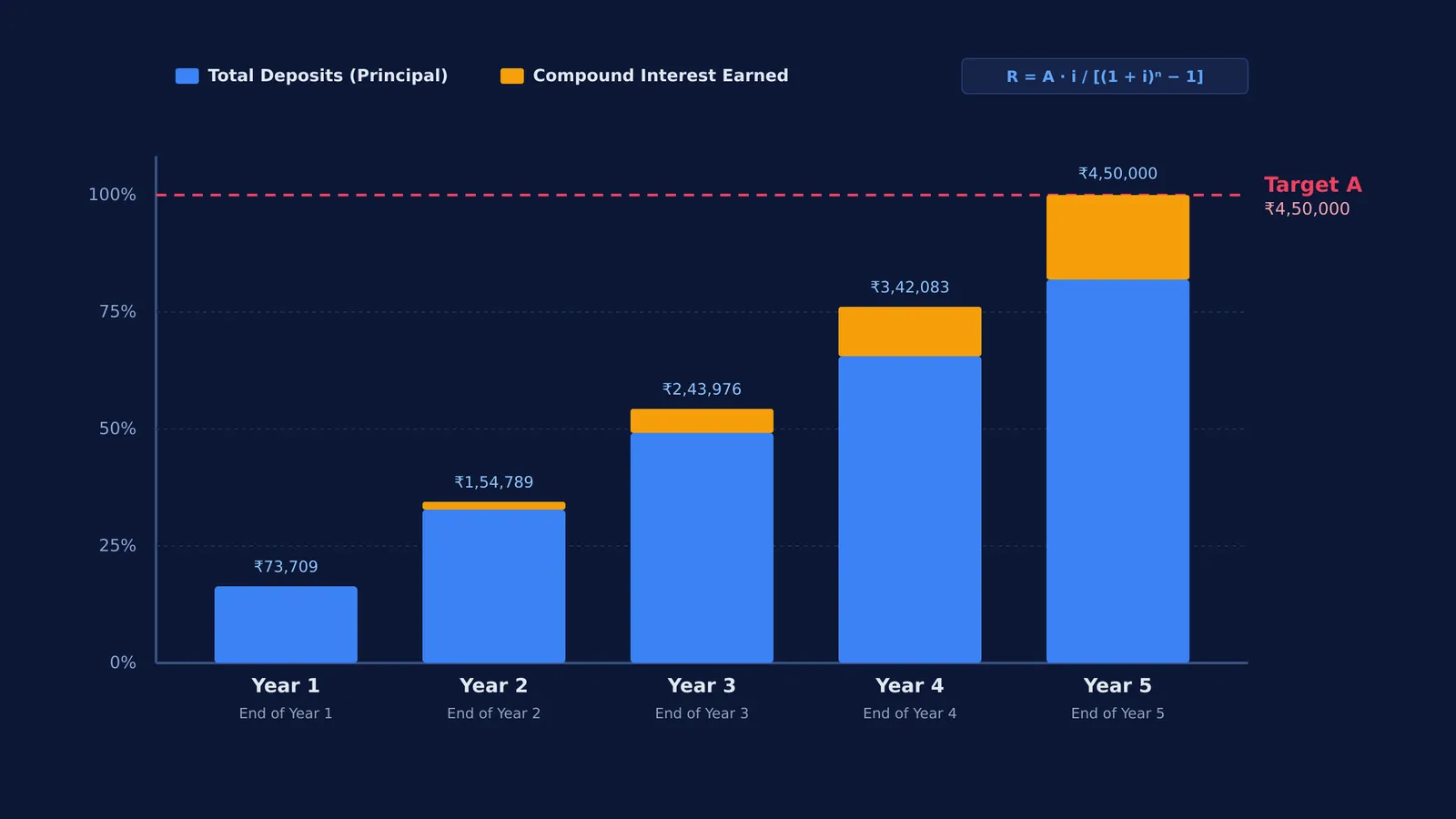
Consider a typical problem from the CBSE Applied Mathematics Senior Secondary Curriculum: a logistics company plans to replace an industrial vehicle in 5 years. The new vehicle is expected to cost ₹5,00,000, while the scrap value of the existing vehicle after 5 years will be ₹50,000. The company establishes a sinking fund earning 10% per annum compounded annually. What equal installment must be deposited at the end of each year?
Determine the net target amount (A): The company does not need to save the full replacement price because selling the old machine provides cash. Target A = Cost of new asset − Salvage value = ₹5,00,000 − ₹50,000 = ₹4,50,000.
Identify rate and periods: Annual rate r = 10%, compounded annually, so periodic rate i = 0.10. Total periods n = 5 years × 1 = 5.
Compute the compound growth factor: (1 + i)ⁿ = (1.10)⁵ = 1.61051.
Apply the sinking fund formula:
R = (4,50,000 × 0.10) / (1.61051 − 1) R = 45,000 / 0.61051 ≈ ₹73,708.87
Over the 5 years, the company deposits a total principal of 5 × ₹73,708.87 = ₹3,68,544.35. The remaining ₹81,455.65 comes entirely from accumulated compound interest. When working through multi-step compounding equations, students often mix up interest rates per period with annual nominal rates. The Fermi Problem Library provides worked problems with a step-by-step solver that explains the reasoning rather than just printing an answer.
What are the most common mistakes in sinking fund calculations?
Even students confident in algebra lose marks on financial mathematics questions through subtle oversight, as noted in the CBSE Applied Mathematics Senior Secondary Curriculum guidelines. Keep these diagnostic checks in mind when solving problems:
Compounding frequency mismatch: If interest compounds semi-annually or quarterly, adjust both i and n before substituting into the formula. An annual rate of 12% compounded quarterly means i = 0.12 / 4 = 0.03, and 5 years means n = 5 × 4 = 20 periods.
Ordinary annuity versus annuity due: Standard sinking funds assume payments occur at the end of each period. If a problem specifies that deposits are made at the beginning of each period, multiply the ordinary annuity denominator by (1 + i), which slightly reduces the required periodic installment.
Arithmetic rounding too early: Rounding (1 + i)ⁿ prematurely to two decimal places introduces substantial compounding errors across large principal amounts. Keep at least five decimal places until obtaining the final payment.
Confusing sinking funds with recurring deposits: While both involve regular installments, questions on recurring deposit formulas in secondary maths often use simple interest on monthly installments, whereas sinking funds strictly operate under periodic compound interest.
Checking each parameter against these rules ensures full marks on board examinations and builds robust intuition for corporate finance.


