On this page
Public Nutrition and Health is Chapter 3 of the NCERT Human Ecology and Family Sciences Part I textbook for Class 12 (reprint 2026-27). Here are the key definitions, the programmes and our own practice questions.
How many marks is Public Nutrition and Health worth?
The CBSE Home Science (064) curriculum for 2026-27 gives Unit II, Nutrition, Food Science and Technology, 23 of the 70 theory marks. Four chapters share those 23 marks: Clinical Nutrition and Dietetics, Public Nutrition and Health, Food Processing and Technology, and Food Quality and Food Safety. There is no separate chapter figure.
The curriculum keeps every main section of the NCERT chapter. For micronutrients it names three to study: iron deficiency anaemia, vitamin A deficiency and iodine deficiency disorders. The textbook also names zinc, folic acid, B12 and others but details only those three. The curriculum also lists practicals on supplementary foods and a mid-day meal menu.
What is public health nutrition?
In NCERT's framing, public health nutrition means preventing nutrition-related problems across a population, plus the government policies and programmes built to solve them. Unlike clinical nutrition, it deals with the problems of a community, especially its vulnerable groups.
NCERT lays the causes out in three layers: immediate (poor diet, illness), household (food access, care practices, water and sanitation, health services) and basic (resources and social, economic and political systems).
What are the main nutritional problems in India?
The chapter describes India as facing a double burden of malnutrition: undernutrition and overnutrition together.
Protein-energy malnutrition (PEM): too little energy and protein for the body's needs.
Underweight: low weight for age. Stunting: low height for age. Wasting: low weight for height.
Marasmus follows a severe shortage of food energy; kwashiorkor is linked to protein deficiency.
Hidden hunger is NCERT's term for micronutrient deficiency.
Iron deficiency anaemia: low haemoglobin, so less oxygen reaches tissues; tiredness and pallor follow.
Vitamin A deficiency: begins with night blindness and weakens resistance to infection.
Iodine deficiency disorders: goitre in adults, and lasting harm to the unborn baby when a mother lacks iodine.
NCERT states that malnutrition underlies at least 50 per cent of deaths in children under five, and that almost one-fifth of babies born in India weigh under 2500 g (NCERT Chapter 3).
How does India tackle malnutrition?
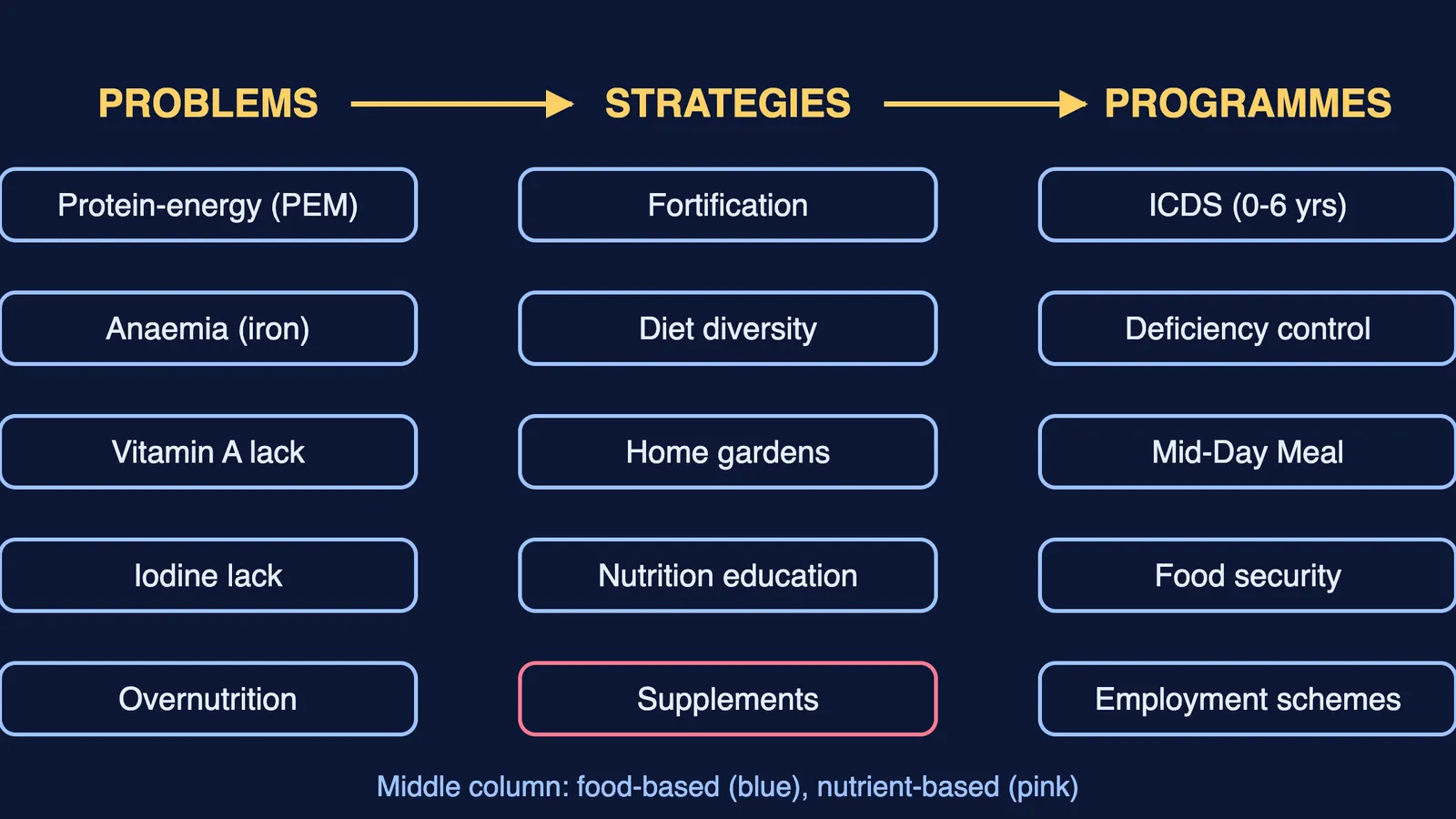
NCERT sorts strategies into two families. Food-based strategies use food itself: dietary diversification, home gardens, nutrition education and fortification such as iodised salt. They are sustainable, with no overdose risk. Nutrient-based strategies give supplements such as iron, folic acid and vitamin A to groups at risk. They work fast but cost more and can miss people. The textbook's long-term aim is to shift from supplements towards food.
NCERT records that POSHAN Abhiyaan was launched in March 2018 in Jhunjhunu, Rajasthan, targeting stunting, undernutrition and anaemia, among other aims. The programmes it lists are:
ICDS, for children up to 6 years and pregnant and nursing mothers
deficiency control programmes for vitamin A, anaemia and iodine
food supplementation, such as the school mid-day meal
food security, such as the Public Distribution System
self-employment and wage employment schemes
The mid-day meal now runs as PM POSHAN. The Ministry of Education's PM POSHAN site says the scheme, earlier the National Programme for Mid-Day Meal in Schools, provides one hot cooked meal to children in Classes I to VIII in government and government-aided schools.
Health care runs at three levels: primary health centres, then community health centres and district hospitals, then tertiary hospitals.
How to answer the 3-mark strategy question
In the CBSE 2026-27 sample paper, Q23 asks for one advantage and two drawbacks of the food-based strategy, marked 1+2=3. A frame using fortification:
Context: "Adding iodine to salt is a food-based strategy."
Advantage: "It is cheap and reaches everyone who buys that food."
Drawback: "It depends on research and on food companies taking part."
Drawback: "It does not by itself change eating habits."
Practice questions for Public Nutrition and Health
The same sample paper runs from 1-mark MCQs to 5-mark long answers and tests this chapter in 1-, 2- and 3-mark questions. These questions are ours.
(1 mark, MCQ) A 4-year-old's weight is normal for her height, but her height is well below the expected value for her age. This shows (a) wasting (b) stunting (c) kwashiorkor (d) goitre.
(2 marks) Why is micronutrient deficiency called "hidden hunger"? Give one example.
(3 marks) Compare supplementation and dietary diversification on cost, speed and sustainability.
(4 marks) Many adolescent girls in a village are anaemic. Suggest two food-based and two nutrient-based measures.
(5 marks) Explain the immediate, household and basic causes of undernutrition, with one example of each.
Answer to Q1: (b) stunting.
See our Class 12 Home Science study plan and why anaemia makes you tired. For careers, see BSc Home Science specialisations.
Not sure where to start revising? Fermi's AI tutor works out what you already know and builds a plan for the session.