

On this page
Home Science in Class 12 is a multidisciplinary subject that blends biology, chemistry, and resource management into practical life skills. To succeed, you need to balance a 70-mark theory paper with a 30-mark practical component. Because it covers such a broad spectrum of topics—from clinical nutrition to textile design—a scattered approach to studying will leave you feeling overwhelmed.
Here is a look at how to tackle the syllabus efficiently, prioritise the highest-yield chapters, and apply the science of learning to your revision.
What is the syllabus for Class 12 Home Science?
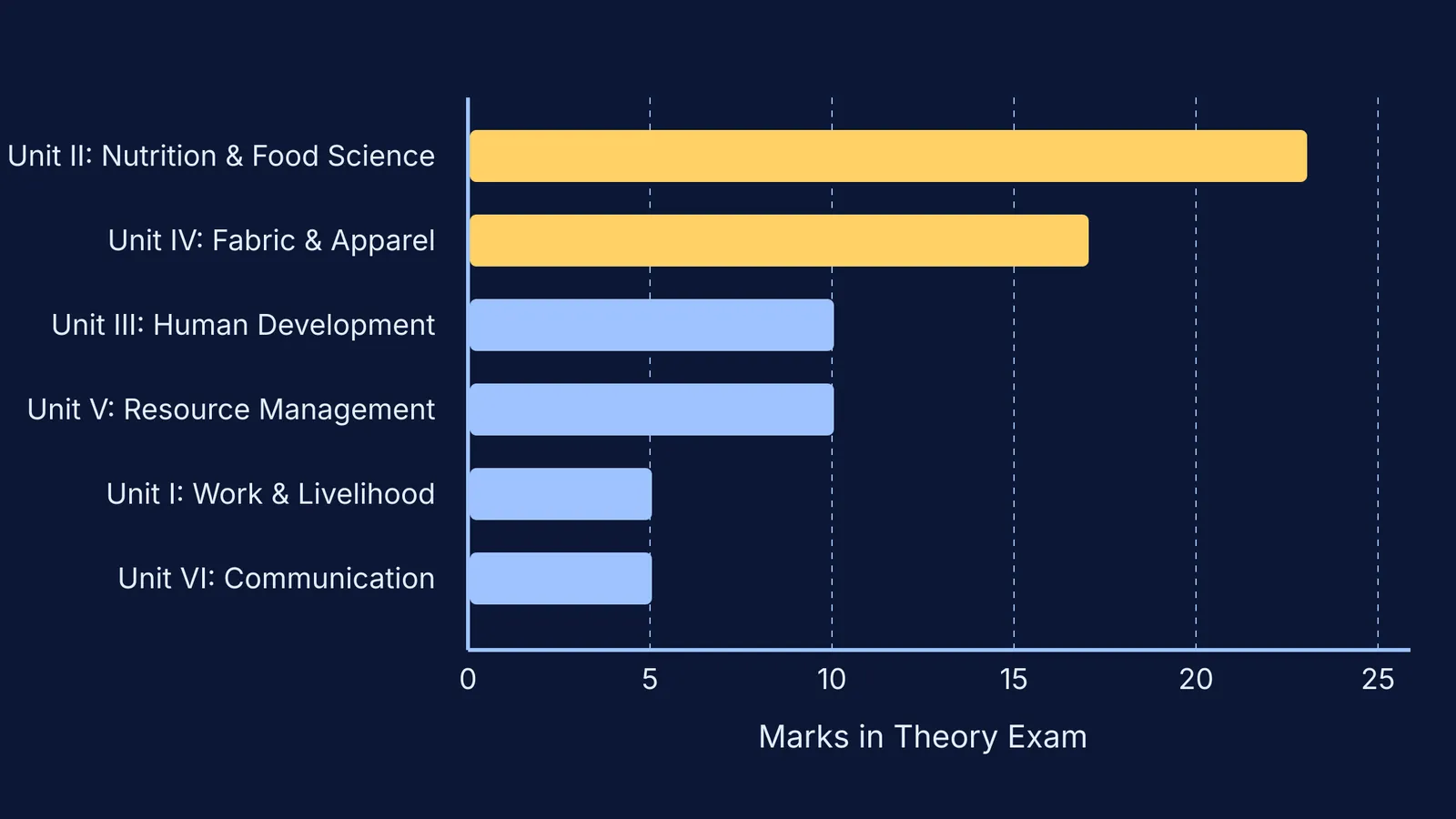
The CBSE theory curriculum spans six units, but they are not weighted equally. To maximize your score, you must focus your energy where it counts most.
Unit II: Nutrition, Food Science and Technology (23 marks) covers clinical nutrition, dietetics, food safety, and public health. This is the heaviest unit and requires a strong grasp of both biological concepts and government health guidelines.
Unit IV: Fabric and Apparel (17 marks) dives into textile design, the fashion industry, and the care of fabrics in institutions.
Unit III: Human Development and Family Studies (10 marks) and Unit V: Resource Management (10 marks) make up the next tier. These sections explore early childhood care, special education, hospitality management, and consumer protection.
Unit I: Work, Livelihood and Career (5 marks) and Unit VI: Communication and Extension (5 marks) round out the paper, focusing on career choices, media management, and development communication.
Because Nutrition and Fabric account for 40 of the 70 theory marks, these two units should anchor your study schedule. You should dedicate over half of your theory revision time exclusively to these chapters.
How to prepare for Home Science theory?
Reading the textbook repeatedly gives an illusion of competence but is a poor strategy for long-term memory. When you simply re-read, your brain recognizes the words and tricks you into thinking you have mastered the concept. Instead, use retrieval practice by forcing your brain to pull information out without looking at the notes. Taking practice tests improves long-term retention significantly better than restudying the same material.
Furthermore, engaging actively with the material is crucial. Active learning leads to increases in examination performance that raise average grades by half a letter, and students relying on traditional lecturing see their failure rates increase by 55% over the rates observed under active learning.
To apply this to Home Science:
Use flashcards for definitions: Create physical or digital cards for precise terms like *Recommended Dietary Allowance (RDA)*, *food adulteration*, *ergonomics*, and *standardisation*.
Practise case-based questions: Exams often present real-world scenarios, such as designing a therapeutic menu for a patient with hypertension or advising a consumer on their legal rights after a faulty purchase. Practise writing out the full reasoning and steps before checking the official marking scheme.
Map out processes: Draw flowcharts for food processing techniques or the stages of early childhood development rather than reading them in paragraph form.
If you do not know where to begin your revision or which chapter to tackle next, Fermi's AI tutor can work out what you already know and build a plan for the session, so you sit down to a clear next step.
How to ace the practical exams?
The 30-mark practical examination is where theory meets reality. It typically involves maintaining a project file, sitting for a viva voce, and performing hands-on tasks like stain removal, identifying fabric weaves, or testing food samples for common adulterants.
Do not treat practicals as an afterthought. Instead, connect your practical tasks to the underlying science. Understanding fabric care becomes much easier when you know the chemistry involved, such as how soaps clean: micelles and hard water in Class 10 carbon. Similarly, the Human Development unit builds on early biology concepts like from fertilisation to implantation: the first week of pregnancy. By understanding the "why" behind a process, you will confidently answer the examiner's questions during the viva voce.
How to build a revision schedule?
Start your revision by downloading the latest syllabus from the official board website to ensure you are not studying deleted topics. Allocate your study blocks strictly based on the unit weightage.
For every three hours you spend studying, spend at least two of those hours actively testing yourself using previous years' papers or sample papers rather than passively reading the textbook. Aim to complete your practical files early in the academic year so that your final months are entirely free for theory revision.
By grounding your preparation in the highest-weightage topics, linking theory to practical applications, and employing active retrieval, you can handle the diverse demands of Class 12 Home Science.


