On this page
Chapter 12 of NCERT's Human Ecology and Family Sciences Part II (reprint 2026-27) covers consumer problems, rights, quality marks and consumer law.
What does the 2026-27 syllabus include?
The CBSE Home Science (064) curriculum for 2026-27 puts this chapter in Unit V, Resource Management, with Hospitality Management. Unit V carries 10 of the 70 theory marks. CBSE gives no per-chapter split. For the whole paper, see how to study Home Science for the Class 12 exam.
The curriculum keeps the introduction, significance, scope and these concepts: consumer product, behaviour, forum, footfalls, problems, the Consumer Protection Act, rights, standardised marks, protection councils and responsibilities. It names five marks, printed as "ISI, Wool Mark, Hall Mark, Silk Mark, Eco mark". The book also covers Agmark, FPO and FSSAI.
In the practical exam, a leaflet or pamphlet on consumer education is worth 5 of the 30 practical marks, on one of four themes: the Consumer Protection Act, consumer responsibilities, consumer organisation or consumer problems.
What problems do consumers face?
NCERT lists nine:
Poor-quality goods that are hard to spot
Adulteration: something added or removed, changing the product and sometimes harming health (see our guide to testing food adulteration at home)
High prices, with overcharging of buyers who lack information
Not knowing your rights or the laws that protect you
Misleading labels, thin advertisements and oversized, flashy packaging
Short weights and tampered scales
Fakes and look-alike brands
Sales promotion schemes, such as lucky draws and exchange offers, that are not always genuine
Poor service from utilities, banks and insurers
In CBSE's 2026-27 sample paper, Q31 (2+3=5 marks) asks for consumer expectations and problems created by shopkeepers, or, as the choice, features of the Consumer Protection Act and roles of voluntary consumer organisations.
What are the six consumer rights?
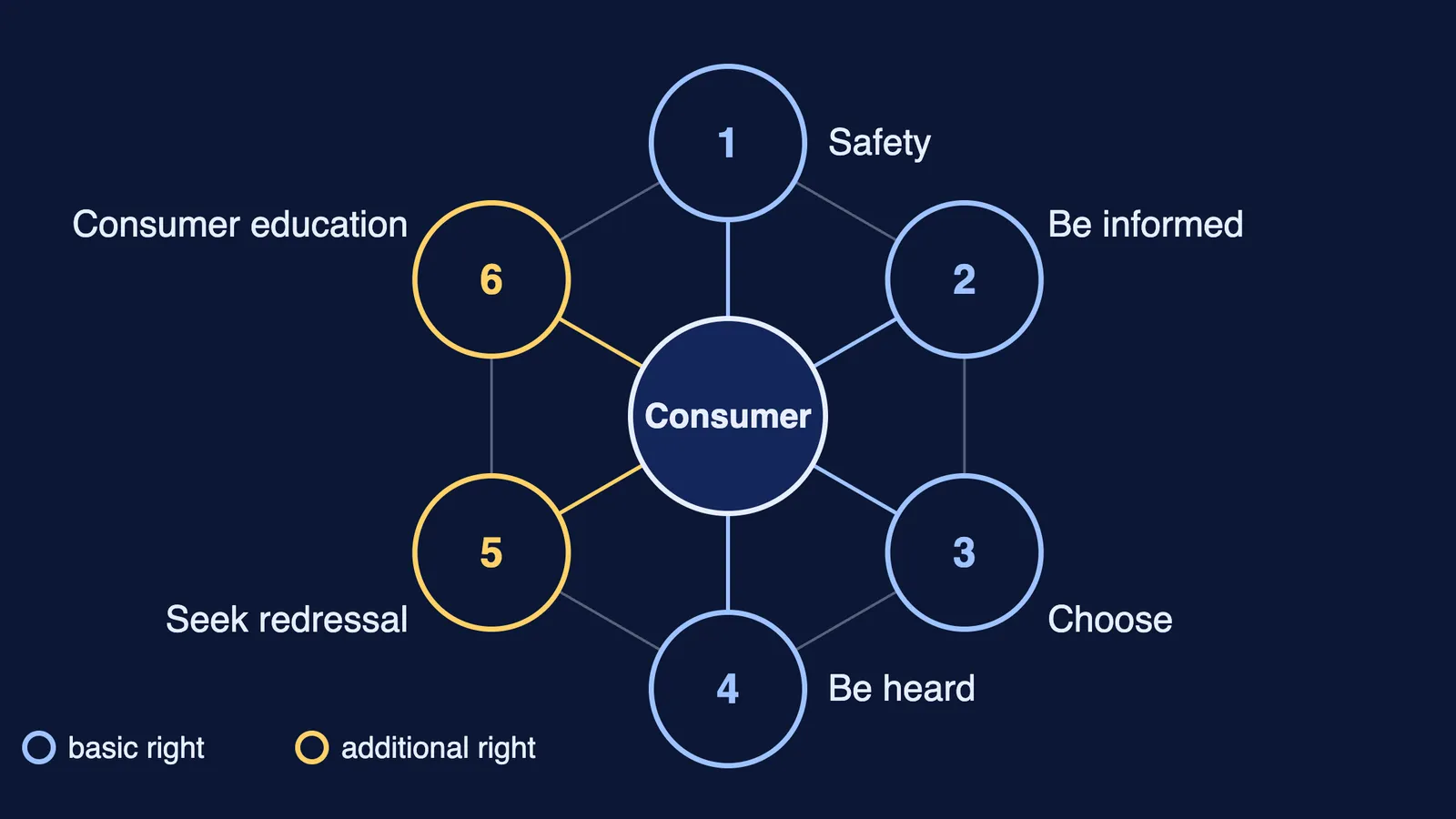
NCERT lists six rights under the Consumer Protection Act, 1986: four basic rights and two additional ones:
Safety: protection from goods and services that endanger health or life.
Be informed: knowing quality, quantity, purity and price before you pay.
Choose: access to a range of products at competitive prices.
Be heard: your interests count in consumer forums.
Seek redressal: fair settlement of a genuine complaint, with compensation.
Consumer education: the knowledge and skill to buy wisely.
Rights come with responsibilities: keep up with consumer laws, pay honestly, compare prices, read labels, buy certified products, keep bills and read the terms of services.
Which standard marks should you know?
ISI: the Bureau of Indian Standards certification mark for foods, electrical goods, soaps and paints; some items need it by law.
Agmark: for agricultural produce. FPO sets minimum standards for fruit and vegetable products.
Woolmark: pure wool, with no other fibre.
Silk Mark: natural silk.
Hallmark: gold, silver or platinum tested for purity at an assaying and hallmarking centre.
Ecomark: a BIS label, shaped like an earthen pot, for environment-friendly household products.
FSSAI: the food authority set up under the Food Safety and Standards Act 2006.
Voluntary consumer organisations test products, publish magazines and handle complaints. NCERT names VOICE (Delhi), which brings out Consumer Voice, and CERC (Ahmedabad), which brings out Insight.
How did the Consumer Protection Act change?
The chapter's rights section cites the Consumer Protection Act, 1986, and also notes that a 2019 Act replaced it. According to the Press Information Bureau, the Consumer Protection Act, 2019 came into force on 20 July 2020.
Changes the release lists include a Central Consumer Protection Authority that can investigate, order recalls and penalise misleading advertisements; product liability for makers, service providers and sellers; electronic filing, and filing where the consumer lives; and mediation through consumer commissions. In the exam, answer from the textbook. This is a study summary, not legal advice. For the Business Studies view, see our Consumer Protection Act 2019 guide.
Practice questions in the 2026-27 format
(1 mark) Which mark belongs on a gold chain? (a) ISI (b) Hallmark (c) Agmark (d) Ecomark
(1 mark) Assertion: A grocer whose scale has no verification stamp may be short-changing you. Reason: Only a stamped, verified scale counts as genuine.
(2 marks) Meera's new mixer stopped working in a week. State two consumer responsibilities that will help her complaint.
(3 marks) A biscuit box, far larger than its contents, says "new pack" though nothing changed. Name the problem and link it to one right and two responsibilities.
(4 marks) A family is buying a woollen shawl, a room heater, a jar of jam and a gold ring. Name the mark to check on each and say what it assures.
(5 marks, 2 + 3) I. Give two reasons consumer education matters more in a global market. II. Explain how three consumer responsibilities help a buyer get redressal.
Answers: 1 (b). 2 Both true; the reason explains the assertion. 6 II: for example, keeping the bill as proof, reading the terms of a service, keeping up with consumer laws.
Not sure where to start your next study session? Fermi's AI tutor works out what you already know and builds a plan for the session.