

On this page
Consumer Protection is Unit 12 of CBSE Class 12 Business Studies. In the CBSE 2026-27 Business Studies syllabus it sits in Part B beside Marketing Management, and the two units together carry 15 marks. You need the meaning of consumer, rights and responsibilities, who can file a complaint, the redressal machinery and the remedies.
If you studied consumer rights in Class 10, our Class 10 notes on the six rights and COPRA cover the older 1986 law.
Who is a consumer under the Consumer Protection Act, 2019?
The Consumer Protection Act, 2019 is Act No. 35 of 2019 and received the President's assent on 9 August 2019. Section 2(7) defines a consumer as anyone who buys goods or hires a service for a price paid, promised or partly paid, including anyone who uses them with the buyer's approval.
Two details earn marks:
Someone who buys goods for resale or any commercial purpose is not a consumer, but goods bought and used only to earn a living through self-employment are not commercial.
Buying online, by teleshopping, direct selling or multi-level marketing counts the same as buying in a shop.
What are the six consumer rights?
Section 2(9) of the Consumer Protection Act, 2019 lists them:
The right to be protected against the marketing of goods and services hazardous to life and property.
The right to be informed about quality, quantity, potency, purity, standard and price.
The right to be assured, wherever possible, of access to a variety of goods and services at competitive prices.
The right to be heard at appropriate fora.
The right to seek redressal against unfair or restrictive trade practices.
The right to consumer awareness.
A memory hook: Safety, Information, Choice, Hearing, Redressal, Awareness.
Who can file a complaint, and in which commission?
Under Section 2(5) of the Act, a complainant can be a consumer, a registered voluntary consumer association, the Central or a State Government, the Central Consumer Protection Authority, several consumers with the same interest, a legal heir or representative, or a minor's parent or guardian. Section 35 allows electronic filing, and Section 34 lets you file where you live or work.
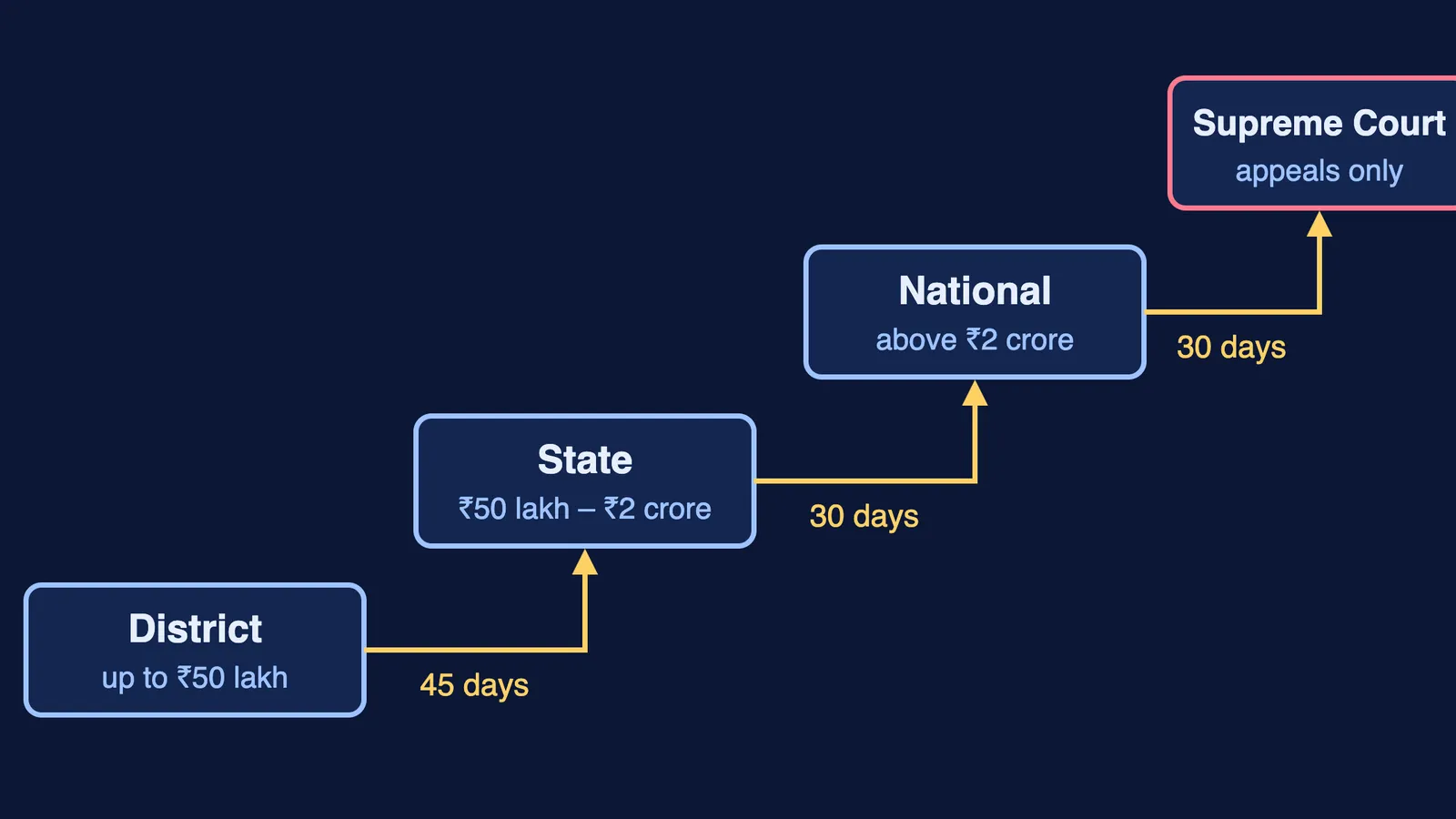
The value paid decides the tier. Under the Jurisdiction Rules announced on 30 December 2021, the limits are:
District Commission: value paid up to ₹50 lakh.
State Commission: above ₹50 lakh and up to ₹2 crore, plus appeals from District Commissions.
National Commission: above ₹2 crore, plus appeals from State Commissions.
A complaint must be filed within two years of the cause of action (Section 69), unless the commission accepts a good reason for the delay. Section 38(7) asks a commission to try to decide within three months of the seller receiving notice, or five months if goods need laboratory testing.
What remedies can a consumer commission order?
Section 39 of the Act lets a commission order the trader to remove the defect, replace the goods, refund the price with interest, pay compensation (including punitive damages), stop an unfair trade practice, issue a corrective advertisement and pay costs.
Worked example: which commission hears this case?
Riya buys a laptop online for ₹62,000. It stops charging in week two, and the seller refuses to repair or replace it. Answer in six steps:
Consumer? Yes: bought for her own use, and online purchases count.
Right? She uses the right to seek redressal; if the listing hid the fault, her right to be informed was violated too.
Forum? ₹62,000 is under the ₹50 lakh District limit, so the District Commission where she lives or the seller does business.
Deadline? Within two years of the fault.
Remedy? Repair, replacement or refund with interest, plus compensation.
Appeal? If the seller loses, it has 45 days under Section 41 to appeal to the State Commission, after depositing half the amount ordered.
Change one number and the answer moves: an ₹80 lakh flat goes to the State Commission, a ₹3 crore one to the National Commission. Our guide to answering case-based questions in CBSE board exams shows how to lay out such an answer, and for a real dispute, see your rights when asking a coaching centre for a refund.
How do you revise this chapter in one evening?
20 minutes: write the definition of consumer, both exclusions and the six rights from memory.
20 minutes: draw the three tiers with their limits and appeal periods.
30 minutes: run three cases (a phone, a car, a flat) through the six steps, then list consumer responsibilities from your NCERT chapter.
For the science and maths papers competing for the same evenings, Fermi's AI tutor works out what you already know and builds a plan for the session.
If a real problem comes up at home, the National Consumer Helpline answers on the toll-free number 1915.


