On this page
Differential equations close the Calculus unit of CBSE Class 12 Applied Mathematics (241). The 2026-27 list is short: recognise an equation, find its order and degree, form one from a family of curves, verify a solution and solve simple separable equations. Here is the scope, how it differs from core Maths, and two worked examples.
What is in the 2026-27 syllabus, and how many marks?
CBSE's 2026-27 Applied Mathematics (241) curriculum gives Unit III Calculus 15 of the 80 theory marks in Class 12. Those 15 marks are shared by differentiation, integration and differential equations; the curriculum gives no separate figure for this chapter. Internal assessment adds 20 marks.
The curriculum names two topics under "Differential Equations and Modeling":
3.10: definition, order, degree and examples.
3.11: forming a differential equation by eliminating arbitrary constants, verifying a solution, and solving simple equations by the variable separable method only. The notes column adds "direct integration only", so expect short, clean integrals.
The study material is CBSE's Applied Mathematics XII student support material, Chapter 3c. Its section 3.12 adds modelling: growth and decay, continuously compounded interest, Newton's law of cooling, carbon dating and drug assimilation. The 2026-27 curriculum rows do not name any of these models. Still, the 2026-27 sample paper's 3-mark Q26(B), an either-or option, models a market price with a rate-of-change equation solved by separating variables, so practise turning a worded rate into an equation. Ask your teacher how much of 3.12 to cover.
How is it different from core Maths differential equations?
The core Mathematics (041) curriculum for 2026-27 adds homogeneous and linear equations, which the applied course leaves out. In turn, the applied course lists forming a differential equation by eliminating arbitrary constants, which the core list does not. For the core treatment, see our differential equations Class 12 board exam guide.
How do you find the order and degree?
Order is the highest derivative that appears. Degree is the power of that highest derivative; it is defined only if every derivative appears as a polynomial term.
(d²y/dx²)³ + 4(dy/dx)⁵ − y = 0 has order 2 and degree 3. The power 5 on dy/dx does not matter.
d²y/dx² + log(dy/dx) = 0 has order 2, but its degree is not defined, because a derivative sits inside a log.
A general solution has as many independent arbitrary constants as the order. The 2026-27 sample paper tests this in Q7, a 1-mark MCQ; its marking scheme first merges constants that can be combined into one, then counts.
How do you form a differential equation by eliminating constants?
Differentiate once for each arbitrary constant, then eliminate the constants. Take y = ax² + bx (our example), with a and b arbitrary.
y′ = 2ax + b and y″ = 2a, so a = y″/2.
From y′: b = y′ − xy″.
Substitute into y: y = (y″/2)x² + (y′ − xy″)x.
Simplify: x²y″ − 2xy′ + 2y = 0.
Two constants, so the equation is of order 2. Check: put y = ax² + bx back in; the terms cancel to 0. More practice: forming differential equations by eliminating constants.
Worked example: a separable equation with a given point
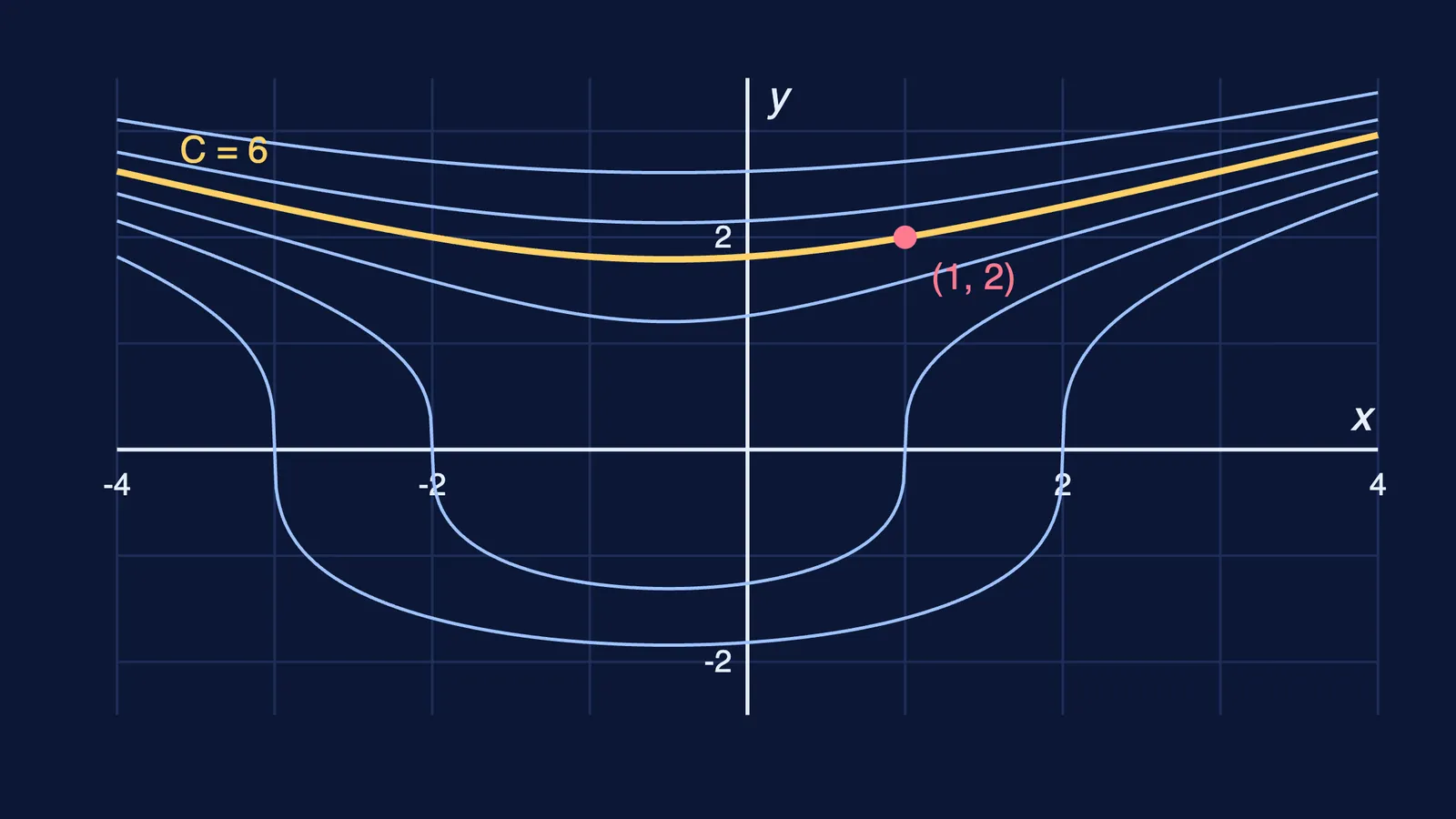
Find the particular solution of dy/dx = (2x + 1)/(3y²), given that y = 2 when x = 1.
Separate: 3y² dy = (2x + 1) dx.
Integrate both sides: y³ = x² + x + C. This is the general solution.
Use the point: 8 = 1 + 1 + C, so C = 6.
Particular solution: y³ = x² + x + 6.
Verify: 3y² dy/dx = 2x + 1, which is the original equation. At x = 2, y = ∛12 ≈ 2.29.
The hero graph shows several members of the family; the condition y(1) = 2 picks out the one with C = 6. We checked every step by hand and with SymPy.
What questions should you practise?
These are written for this guide. In the sample paper, this chapter appears as Q7 (a 1-mark MCQ) and Q26(B) (a 3-mark option); the labels below use the paper's question types and are our suggestion.
(MCQ, 1 mark) The general solution is y = pe^(x + q) + rx, with p, q, r arbitrary. What is the order of the equation? Answer: 2, since pe^q is one constant.
(VSA, 2 marks) Find the order and degree of (d²y/dx²)² + (dy/dx)⁴ = x + y. Answer: order 2, degree 2.
(VSA, 2 marks) Verify that y = 3e^(−2x) + x satisfies dy/dx + 2y = 2x + 1.
(SA, 3 marks) Form the differential equation of the family y = ae^(3x) + b. Answer: y″ = 3y′.
(SA, 3 marks) Solve dy/dx = xe^(−y), given that y = 0 when x = 0. Answer: y = log(1 + x²/2).
Not sure which of these to start with? Fermi's AI tutor works out what you already know and builds a plan for the session. For the Class 11 groundwork on derivatives, revisit our Class 11 Applied Maths calculus guide.