On this page
Integration in Class 12 Applied Mathematics (241) turns a rate into a total: marginal cost into total cost, and demand and supply curves into consumer and producer surplus. Below: the 2026-27 syllabus, the marks, and two worked examples with our own numbers.
What is in the 2026-27 syllabus, and what is it worth?
Under the 2026-27 CBSE curriculum for Applied Mathematics, Unit III Calculus carries 15 of the 80 theory marks in Class 12. They are shared across the unit: differentiation and its applications, integration and its applications, and differential equations and modeling. CBSE prints no separate figure for integration alone.
The curriculum lists four parts for this chapter:
Integration as the reverse of differentiation.
Indefinite integrals of simple algebraic functions by substitution, partial fractions and by parts.
Definite integrals as area under curves up to the 2nd degree, via the fundamental theorem.
Total cost and revenue from marginal functions, equilibrium, and consumer and producer surplus.
CBSE's study book is Chapter 3b of its Applied Mathematics XII support material, dated 2021. It also has a section on properties of definite integrals, which the 2026-27 curriculum does not name; treat it as practice, not syllabus.
How is it different from core Maths Integrals?
The applied curriculum keeps to non-trigonometric functions and curves up to the 2nd degree, and adds economics: most definite integrals here mean rupees. For the core-syllabus treatment, read our Integrals Class 12 board exam guide and the Application of integrals Class 12 guide. The derivative side starts in our Calculus Class 11 applied maths guide.
How do you find total cost from marginal cost?
Total cost is the integral of marginal cost, and the constant of integration is the fixed cost.
Worked example (our numbers). A workshop's marginal cost is MC = 30 + 4x rupees per unit, and its fixed cost is ₹800.
Integrate: C(x) = ∫ (30 + 4x) dx = 30x + 2x² + K.
Use the fixed cost: C(0) = 800, so K = 800 and C(x) = 800 + 30x + 2x².
Extra cost of raising output from 10 to 20 units: ∫ from 10 to 20 of (30 + 4x) dx = [30x + 2x²] from 10 to 20 = 1400 − 500 = ₹900.
Check: C(20) − C(10) = 2200 − 1300 = ₹900. The fixed cost cancels in a definite integral; you need it only for C(x) itself.
How do you calculate consumer and producer surplus?
Consumer surplus (CS) is what buyers save against what they were willing to pay; producer surplus (PS) is what sellers gain over their lowest acceptable price. For equilibrium quantity x₀ and price p₀, the support material uses CS = ∫ from 0 to x₀ of D(x) dx − p₀x₀ and PS = p₀x₀ − ∫ from 0 to x₀ of S(x) dx.
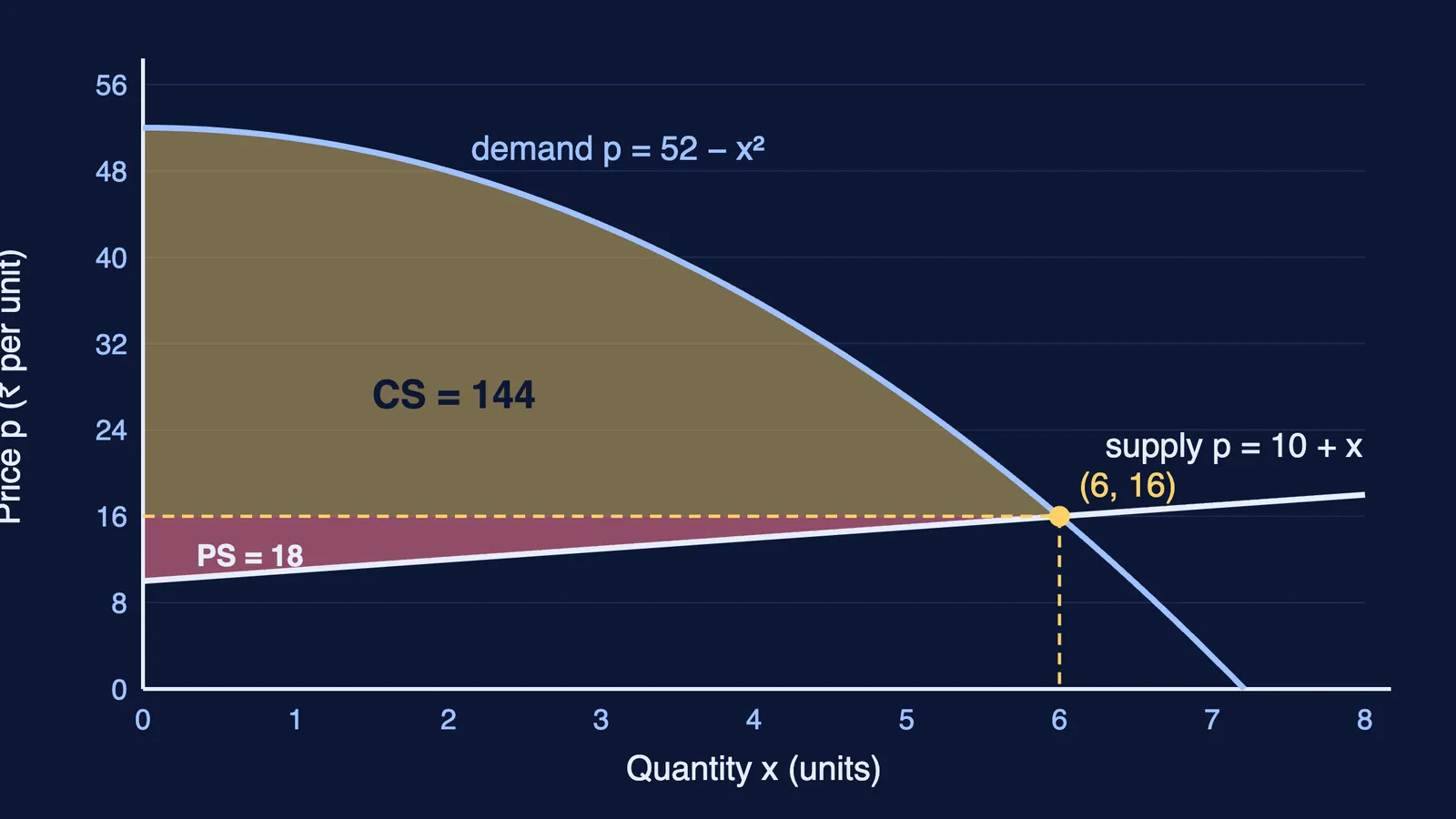
Worked example (our numbers). Demand is p = 52 − x² and supply is p = 10 + x, with p in rupees.
Equilibrium: 52 − x² = 10 + x gives x² + x − 42 = 0, so (x + 7)(x − 6) = 0. Quantity cannot be negative, so x₀ = 6, p₀ = 16 and p₀x₀ = 96.
CS = ∫ from 0 to 6 of (52 − x²) dx − 96 = (312 − 72) − 96 = ₹144.
PS = 96 − ∫ from 0 to 6 of (10 + x) dx = 96 − (60 + 18) = ₹18.
The diagram above shows both regions. We checked both answers by hand and in Python.
What do board questions on this chapter look like?
The CBSE 2026-27 Applied Mathematics sample paper has 1-mark MCQs and assertion-reason, 2-mark VSA, 3-mark SA, 5-mark LA and 4-mark case-study questions. Integration appears in a 1-mark MCQ on revenue from marginal revenue (Q8) and a 5-mark consumer surplus question (Q32). The marking scheme splits Q32's 5 marks into steps, so the setup earns marks before the final number.
Practise with our own questions, labelled by those types:
MCQ, 1 mark: if MR = 50 − 4x, the extra revenue as sales rise from 5 to 10 units is (A) 50 (B) 100 (C) 150 (D) 200.
SA, 3 marks: find ∫ (x + 7)/((x − 1)(x + 3)) dx by partial fractions.
LA, 5 marks: demand p = 64 − x² and supply p = 4 + 7x. Find the equilibrium, CS and PS.
Answers: 1. (B) ₹100. 2. 2 log|x − 1| − log|x + 3| + C. 3. x₀ = 5, p₀ = 39, CS = 250/3 ≈ ₹83.33, PS = 175/2 = ₹87.50.
How should you revise integration for applied maths?
Drill substitution, partial fractions and by parts on algebraic functions.
Do five marginal cost or revenue questions, stating where the constant comes from.
Do five surplus questions with sketches; time one.
Don't know where to start? Fermi's AI tutor works out what you already know, builds a plan for the session and teaches through it.