

On this page
Voting closes, and within minutes TV channels show seat counts built from interviews with a tiny fraction of voters. In 2024 they missed by dozens of seats, which makes exit polls a good statistics lesson.
What is an exit poll, exactly?
Indian law defines an exit poll as an opinion survey of how electors have voted, or which party or candidate they identified with, under Section 126A of the Representation of the People Act, 1951. The same section lets the Election Commission set a window, during a general election from the start of polling until half an hour after polls close in every state, when no one may publish exit poll results. Breaking that rule can mean up to two years in prison, a fine, or both.
How do exit polls work, step by step?
Pick a sample of constituencies and booths that should represent the country.
Interview voters as they leave: whom they voted for, plus age, caste and region.
Weight the answers so the sample matches the known make-up of the electorate.
Estimate each party's vote share, state by state.
Convert those vote shares into seats with a model.
Steps 1 to 4 are statistics you can check. Step 5 is where most of the trouble starts.
What does the margin of error actually mean?
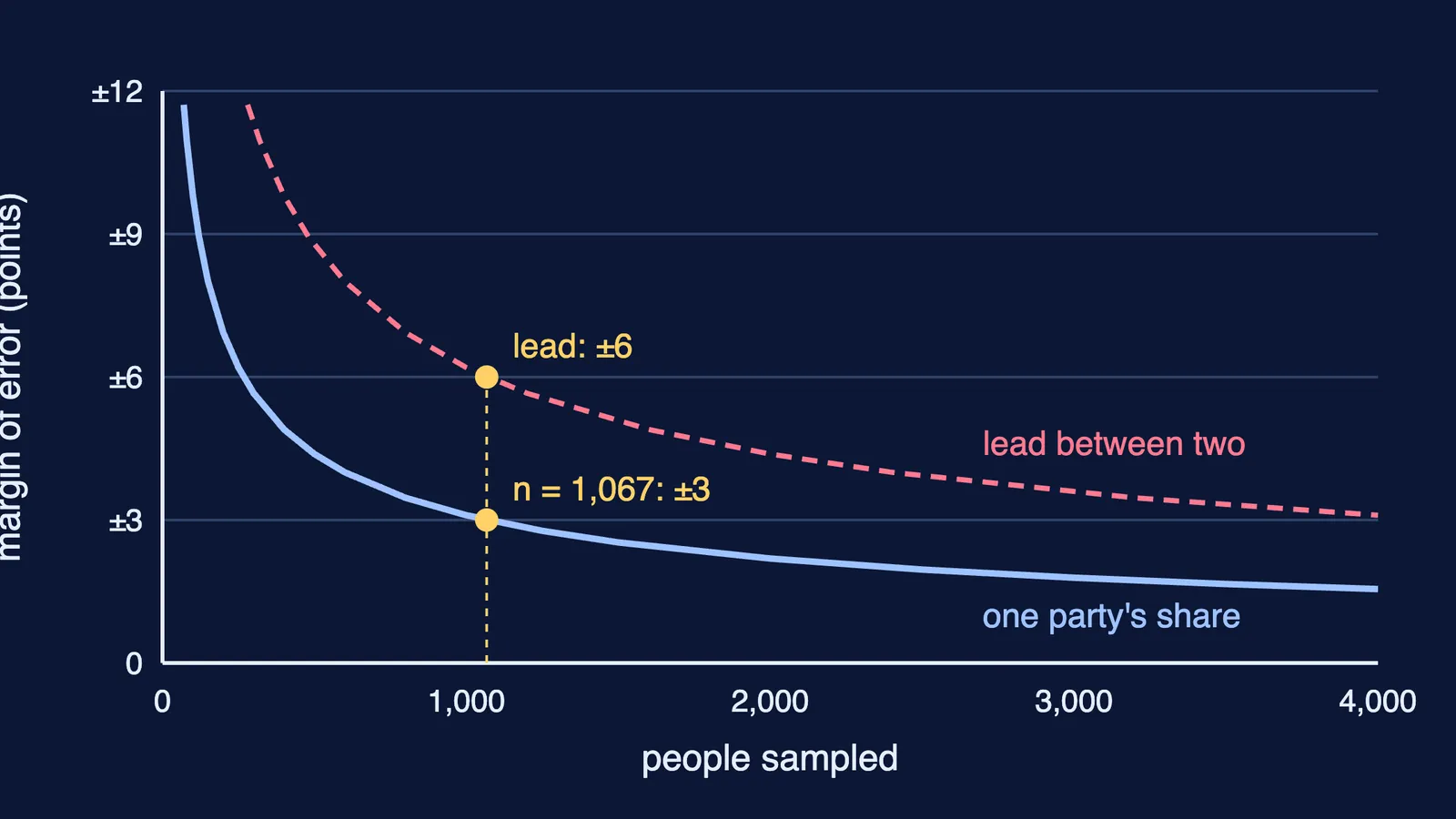
The margin of error is the half-width of a 95% confidence interval for a percentage, as Pew Research Center's methods team defines it. Pew's guide to election polls puts it in plain words: if the same survey were run 100 times, about 95 of the results would land within that many points of the true value.
The same guide says a simple random sample of 1,067 people gives a margin of error of about ±3 points for one candidate's share. The margin on the lead between two candidates is generally about twice as large, so ±3 on each share becomes roughly ±6 on the gap.
You can check the first number yourself. For a share near 50%, the margin is 1.96 × √(0.5 × 0.5 ÷ n). With n = 1,067, that is 1.96 × 0.0153, or 3 points. Quadruple the sample and the margin only halves. Our post on why Mendel's 3:1 ratio needs large numbers shows the same effect with pea plants, and the mean and variance of a binomial distribution explains where the p(1 − p) comes from.
Why do seat predictions miss when vote shares are close?
India elects MPs by first past the post: whoever gets the most votes in a constituency wins it, by one vote or by a lakh. So a small error in vote share can become a large error in seats.
Try this worked example. Imagine 10 seats where a poll shows Party A leading Party B by 1, 2, 3 and so on up to 10 points. The poll says A wins all 10. Now suppose the poll overstated A's share by 1.5 points and understated B's by 1.5. That is a 3-point error in the lead, well inside the ±6 margin on a gap for a 1,067-person sample. A's real lead in the first three seats was zero or negative, so A wins at most 7, not 10. A modest error in votes became an error of 30% or more in seats. In real elections such errors often lean the same way across a state.
What went wrong in India's 2024 exit polls?
The exit polls published on 1 June 2024 all forecast more than 350 seats for the BJP-led NDA, and News 24-Today's Chanakya predicted 400, as South First's review of the misfires reports. The average of 12 exit polls gave the NDA 365 seats, according to Newslaundry's results-day analysis.
The NDA won 293 of the 543 seats, and the BJP won 240, down from 303 in 2019, according to the 2024 Indian general election record. The INDIA bloc won 234.
On results day, Axis My India's managing director, Pradeep Gupta, said his teams could not poll many Dalit voters in Uttar Pradesh, and blamed the West Bengal miss on voters giving unreliable answers, as Newslaundry reported. Those are nonresponse and response bias, the errors the margin of error does not measure.
How should you read the next exit poll?
Ask four questions:
Vote share or only seats? Shares can be checked against the margin of error; seats depend on a model.
How big is the lead? If the gap is under twice the margin, the poll cannot separate the parties.
Who was missed? Which voters may refuse to talk or answer honestly?
Range or single number? A range is more honest about uncertainty.
Turning 18 soon? Here is how to register as a first-time voter. To revise confidence intervals, the Fermi Concept Library covers every concept in mathematics, and the Fermi Problem Library has a step-by-step solver that explains the reasoning.


