On this page
Most students memorise "mean np, variance npq" and stop there. That works until a question gives you the mean and variance and asks for n and p. If you know where the formulas come from, that reversal takes four lines.
What are the mean and variance of a binomial distribution?
A binomial experiment has a fixed number of trials n, only two outcomes per trial (success and failure), and trials that are independent and repeated under identical conditions, according to OpenStax Introductory Statistics.
If X counts the successes, the mean is μ = np and the variance is σ² = npq, where q = 1 − p is the probability of failure on one trial (OpenStax).
The standard deviation is √(npq), written √(np(1 − p)) in the NIST/SEMATECH Engineering Statistics Handbook.
Why is the mean of a binomial distribution np?
The trick is to break X into n small pieces. Let X₁ be 1 if the first trial is a success and 0 if it is not, X₂ the same for the second trial, and so on. Then X = X₁ + X₂ + … + Xₙ, because adding up the 1s counts the successes.
Each piece has mean E(Xᵢ) = 1 × p + 0 × q = p.
Expectations add: E(X₁ + … + Xₙ) = E(X₁) + … + E(Xₙ), as the textbook Introduction to Probability, Statistics, and Random Processes states. Adding p to itself n times gives E(X) = np.
Why is the variance of a binomial distribution npq?
Start with one trial again. Since 0² = 0 and 1² = 1, Xᵢ² = Xᵢ, so E(Xᵢ²) = p. Then Var(Xᵢ) = E(Xᵢ²) − [E(Xᵢ)]² = p − p² = p(1 − p) = pq.
For independent random variables, the variance of the sum is the sum of the variances (probabilitycourse.com). The n trials are independent, so Var(X) = pq + pq + … + pq = npq.
The mean step works without independence; the variance step needs it. Drawing cards without replacement breaks independence, so that count is not binomial.
Worked example: 10 tosses of a fair coin
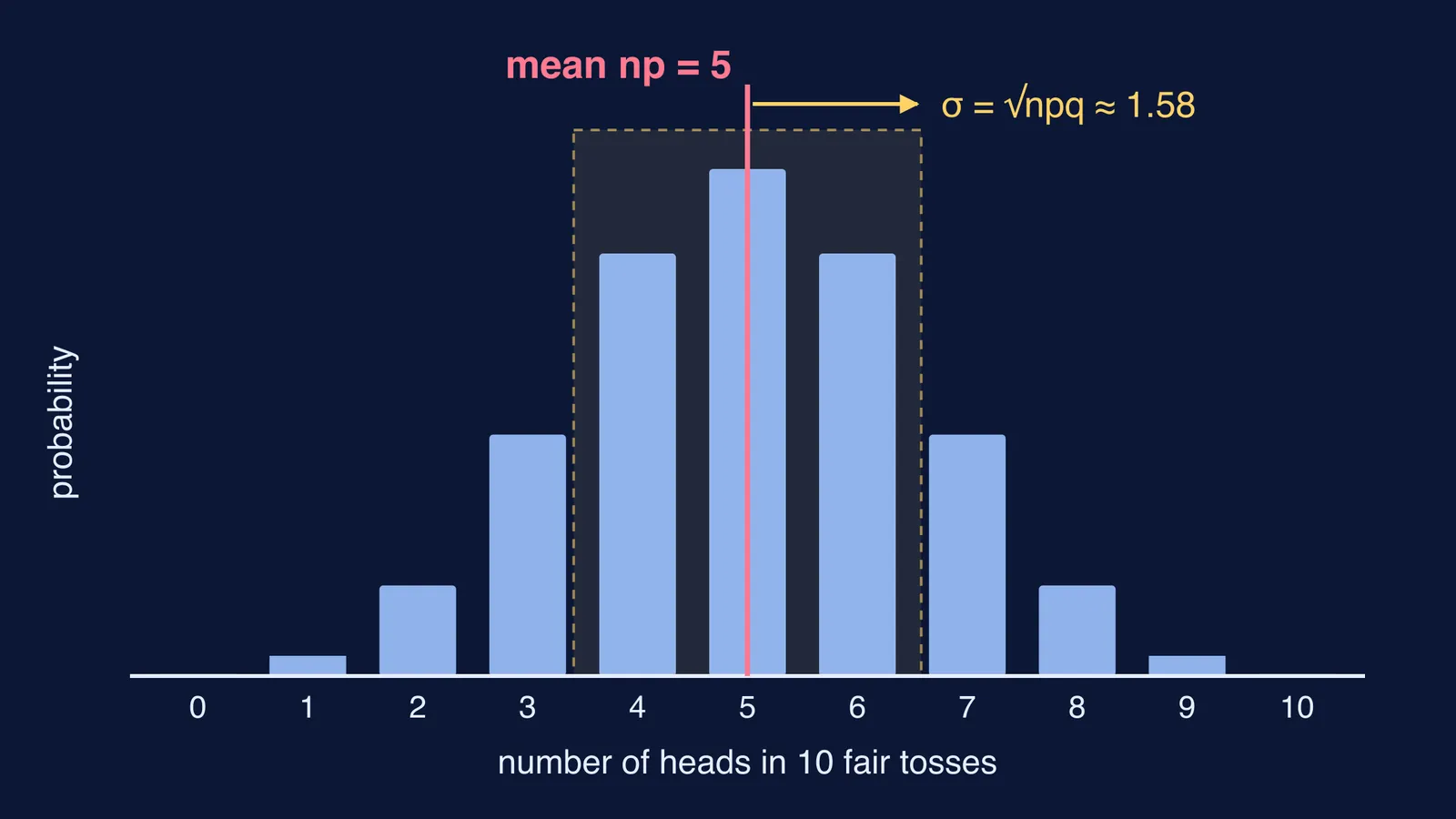
Let X be the number of heads in 10 tosses, so n = 10 and p = q = 1/2.
Mean: np = 10 × 1/2 = 5 heads.
Variance: npq = 10 × 1/2 × 1/2 = 2.5.
Standard deviation: √2.5 ≈ 1.58 heads.
Check it the long way. P(X = x) = ¹⁰Cₓ / 1024, and the counts ¹⁰Cₓ for x = 0 to 10 are 1, 10, 45, 120, 210, 252, 210, 120, 45, 10, 1. Multiplying each x by its count and adding gives 5120, and 5120 / 1024 = 5. Doing the same with x² gives 28160, so E(X²) = 28160 / 1024 = 27.5 and the variance is 27.5 − 5² = 2.5. The formulas match.
What the numbers mean: the outcomes within one standard deviation of 5 are 4, 5 and 6 heads, with probability (210 + 252 + 210) / 1024 = 672 / 1024, about 0.66. You can watch the bars pile up around np in our binomial distribution simulation.
How do you find n and p from the mean and variance?
Here is an NCERT-style question: the mean and variance of a binomial distribution are 4 and 4/3. Find n, p and P(X ≥ 1).
Divide variance by mean: npq / np = q, so q = (4/3) / 4 = 1/3.
Find p: p = 1 − q = 2/3.
Find n: n = mean / p = 4 ÷ (2/3) = 6.
Check: npq = 6 × 2/3 × 1/3 = 4/3. Correct.
Use the complement: P(X ≥ 1) = 1 − P(X = 0) = 1 − (1/3)⁶ = 728/729.
Step 5 is the "at least one" pattern; see our post on binomial probability of at least one success.
Before you write the final answer, run this checklist:
If the question gives the standard deviation, square it before dividing.
n must come out as a positive whole number. If it does not, recheck your arithmetic.
If the variance is bigger than the mean, write that no binomial distribution exists.
Write the distribution in full at the end: X ~ B(6, 2/3).
If you pick the right method but slip in the working, the Fermi Problem Library has worked problems with a step-by-step solver that explains the reasoning rather than printing an answer. If the shaky part is the idea of a random variable itself, start with our explainer on probability distributions of a random variable or the lesson in the Fermi Concept Library.
Is the binomial distribution in the CBSE Class 12 syllabus?
The CBSE Mathematics curriculum for 2026-27 lists conditional probability, the multiplication theorem, independent events, total probability and Bayes' theorem under Class XII Probability; the binomial distribution is not on that list.
So for a CBSE board paper this is enrichment. For an entrance exam or another board, check that exam's current official syllabus before deciding how much time to give it.
Try the reversal once more on your own: mean 6, variance 2. You should get q = 1/3, p = 2/3 and n = 9.