

On this page
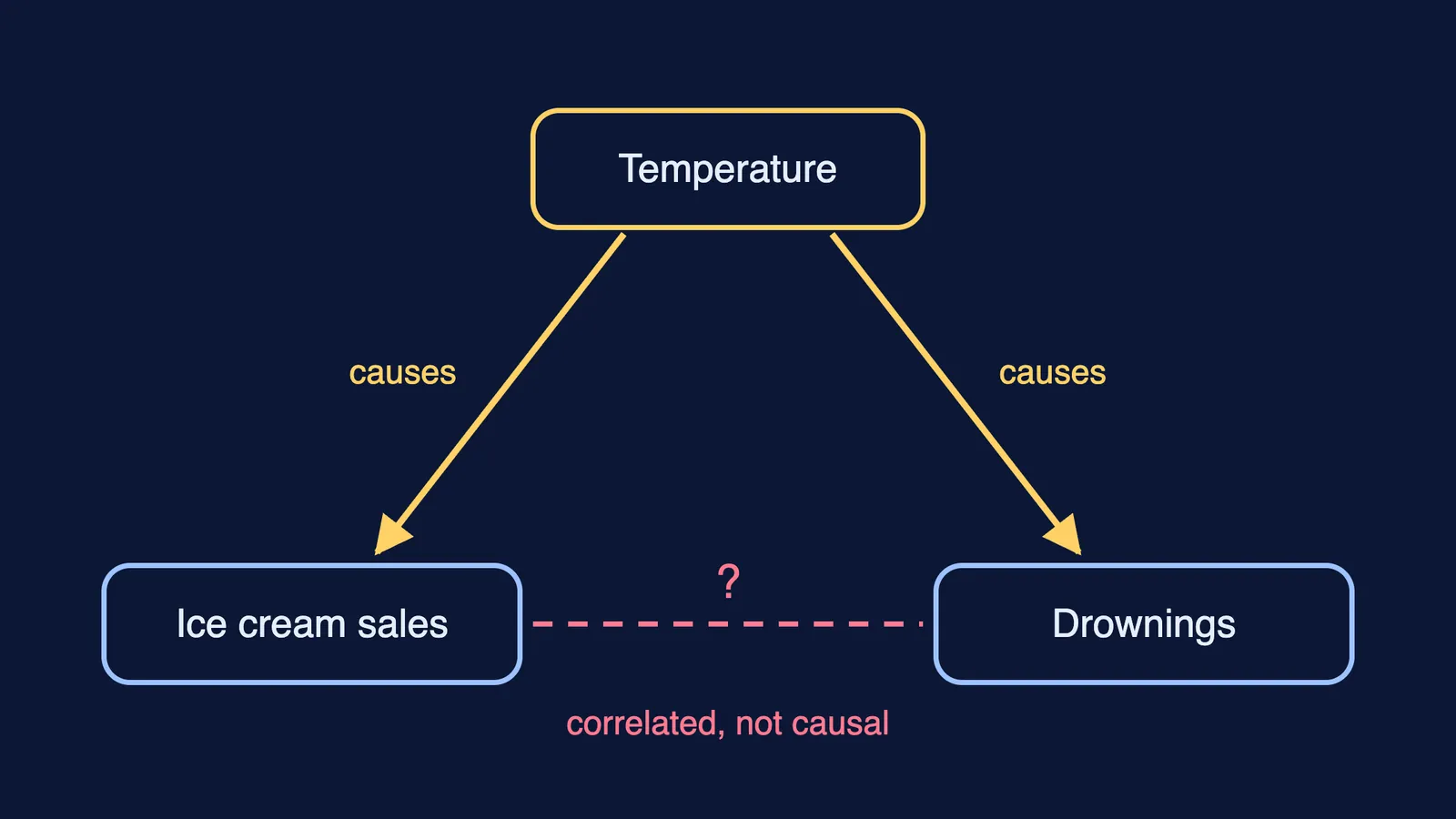
Every summer, two numbers climb together: ice cream sales and drowning deaths. Plot one against the other and you get a neat upward line. Nobody thinks a cone makes you sink. Seeing why this pattern misleads is a skill you will use in science, exams and the news.
What is the difference between correlation and causation?
Correlation means two quantities tend to move together: when one goes up, the other tends to go up (or down). Causation means that changing one quantity actually produces a change in the other. You can measure correlation from data alone; causation is a claim about what would happen if you stepped in and changed something.
Ice cream and drowning is the classic case. In a classroom activity for high school physics designed by Alvaro Suarez and Marcelo Vachetta, students receive ice cream and drowning data inside a fictional news article, plot it, and identify temperature as the hidden variable behind the correlation (Suarez and Vachetta, arXiv 2412.04150). Hot weather sends people to buy ice cream, and it sends people into the water. The two numbers share a cause; neither causes the other.
Why does correlation not imply causation?
When two things move together, there are four possible explanations:
A causes B. More practice leads to fewer careless mistakes.
B causes A (reverse causation). Liking a subject may follow good marks rather than produce them.
A third variable causes both (confounding). Temperature drives ice cream sales and drownings.
Coincidence. Compare enough pairs of numbers and some will line up by chance.
In 2012, Franz Messerli reported in the New England Journal of Medicine that chocolate eaten per person and Nobel laureates per 10 million people were correlated at r = 0.791 across 23 countries (Messerli, NEJM 2012; figures as reported in this PMC commentary). A correlation coefficient runs from -1 to +1, so 0.791 is strong. Before believing that chocolate makes scientists, ask what else could drive both: a country's wealth, for instance, can pay for chocolate and for universities at the same time.
How do experiments show causation?
In a randomised controlled trial, chance (like a coin toss) decides who gets the treatment. Randomising tends to spread every confounder, even ones nobody thought of, evenly across the groups, so if the groups end up different, the treatment is the likeliest reason.
Medicine learned this with hormone therapy for women after menopause. The Women's Health Initiative trial noted that despite decades of observational evidence, the balance of risks and benefits was still uncertain, so it randomly assigned 16,608 women aged 50 to 79 to the hormones or a placebo (Women's Health Initiative, JAMA 2002). It was stopped after a mean of 5.2 years because the risks, including invasive breast cancer, exceeded the benefits, and the authors concluded the regimen should not be started to prevent heart disease. This is a story about evidence, not health advice: questions about any treatment belong with a doctor.
You can see the same logic at study-desk scale in our post on an experiment comparing rereading with practice testing.
How can you tell if a claim is causal?
Use this four-question check on any headline, WhatsApp forward or exam passage. Worked example: students who take tuition score higher in board exams, so tuition raises marks.
Could it be chance? How many students were compared? A handful proves little.
Could it run backwards? Parents of students already doing well may add tuition to aim higher.
Is there a confounder? Family income, parents' education and study time can affect both who takes tuition and who scores well.
Did chance decide who got the treatment? If not, read the claim as linked with, not causes.
Verdict: a correlation. Causation would need similar students, with chance deciding who got the extra help. Our look at what the evidence says about breakfast and school performance runs into exactly this problem.
If the statistics behind these questions feel shaky, the Fermi Concept Library has a lesson for every concept in mathematics, and Fermi's AI tutor can work through a data question with you, deciding whether to explain, ask or show rather than just handing over an answer.
Why does this matter for students?
Practical questions ask which variable you controlled and why, and data passages hide exactly these traps. Beyond exams, it is the habit of asking for evidence before accepting a claim, the idea behind scientific temper and what Article 51A asks of students.
The next time two numbers rise together, pause and name the four possibilities before you pick one.


