On this page
Combinatorics is Chapter 8 of the CBSE book Applied Mathematics Class XI, Student Support Material (second edition, April 2026). It uses the same nPr and nCr as core Maths, with more word problems: seating plans, PINs, teams and orders.
What does Combinatorics cover in Class 11 Applied Maths, and how many marks?
In the CBSE Applied Mathematics (241) curriculum for 2026-27, Combinatorics is topic 4.1 of Unit IV, Combinatorics and Probability. The theory paper is 80 marks over 3 hours, with 20 marks of internal assessment.
Unit IV carries 10 marks, shared between Combinatorics and Probability; CBSE prints no separate figure for this chapter.
The curriculum lists factorials, the fundamental principle of counting, permutations, combinations and the difference between them. The Class XI book covers these in four sections, adding permutations of objects that are alike and combinations with repetition. Circular arrangements are not in the chapter.
How is it different from core Maths permutations and combinations?
The formulas are the same: nPr = n!/(n − r)!, nCr = n!/(r!(n − r)!), and nPr = nCr × r!. Three things differ.
Problems first. Each result gets a short proof and is then put to work on worked problems, so marks come from setting the situation up correctly.
More context. Problems are about passwords, routes, team selection and batting orders.
One extra result. The book adds combinations with repetition: choosing r objects from n kinds when a kind can be picked again gives n + r − 1Cr. The NCERT Class 11 Mathematics chapter (Reprint 2026-27) covers arrangements with repetition (nʳ) but not this selection formula.
If you take core Maths instead, our Permutations and Combinations Class 11 guide for core Mathematics follows the NCERT chapter. If you are still choosing between the two subjects, see who should choose Applied Mathematics in Class 11 and 12.
How do you pick the right formula?
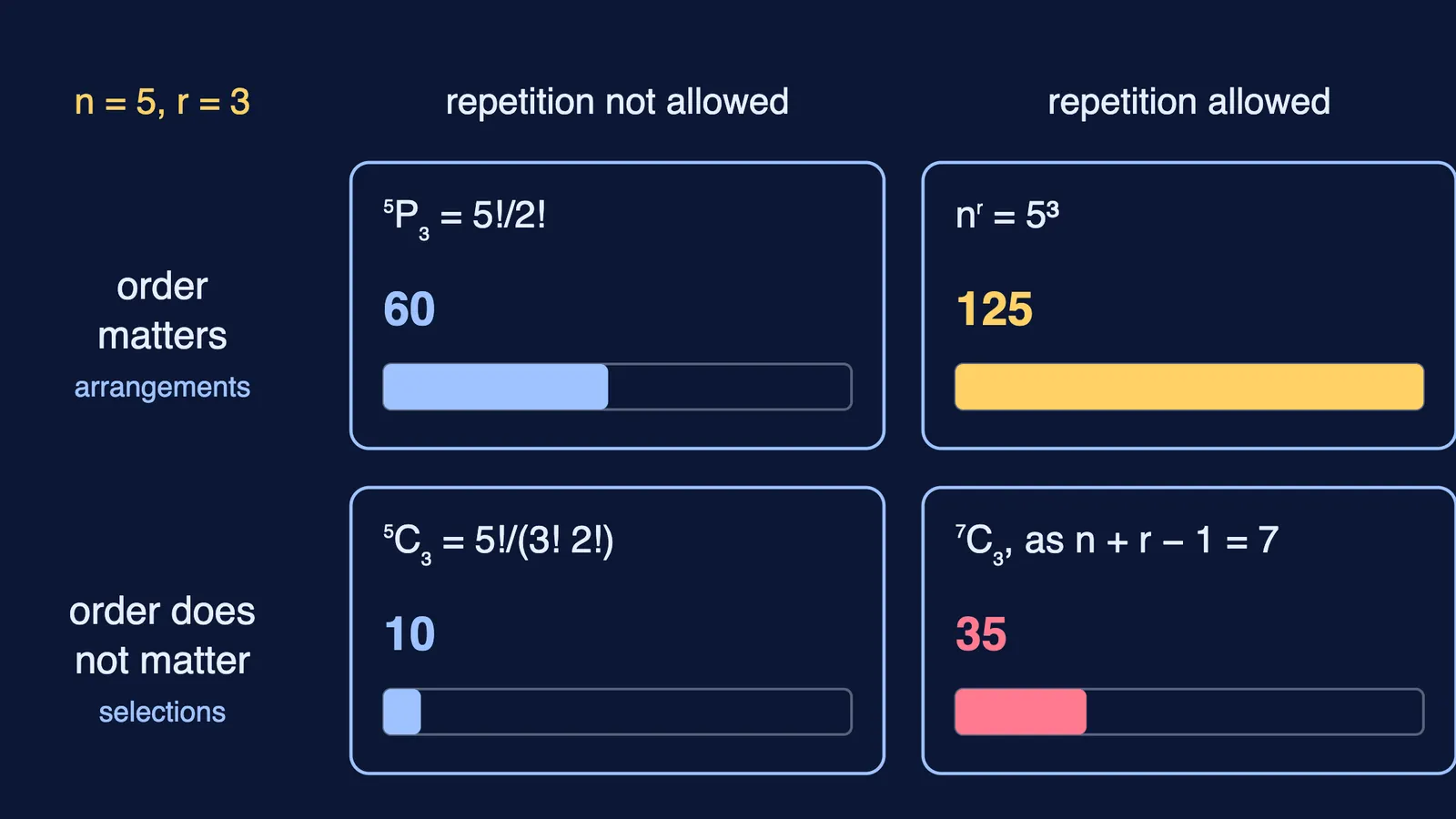
Ask two questions first: does order matter, and can an item be used again? The answers give four cases. For n = 5 items and r = 3 picks:
Order matters, no repetition: 5P3 = 5 × 4 × 3 = 60.
Order matters, repetition allowed: 5³ = 125.
Order does not matter, no repetition: 5C3 = 10.
Order does not matter, repetition allowed: 7C3 = 35.
How do you solve combinatorics word problems?
Our own numbers, each worked by hand and checked by listing every case in Python.
1. Podium. Eleven teams run an inter-school relay; gold, silver and bronze are different medals. Order matters, no repeats: 11P3 = 11 × 10 × 9 = 990 ways.
2. Letters with repeats. How many arrangements of the letters of DECEMBER are there? There are 8 letters with E three times, so 8!/3! = 40320/6 = 6720.
3. Committee with a condition. Choose 5 students from 9 Commerce and 4 Humanities students, with at least 3 from Humanities.
3 Humanities and 2 Commerce: 4C3 × 9C2 = 4 × 36 = 144
4 Humanities and 1 Commerce: 4C4 × 9C1 = 1 × 9 = 9
Total = 153. A Python listing of all 1287 possible groups of 5 gives the same count.
4. Selection with repetition. A sweet shop sells 4 kinds of laddoo, and you fill a box of 8 (kinds can repeat). Here n = 4 and r = 8, so the count is 4 + 8 − 1C8 = 11C8 = 11C3 = 165.
What questions can you practise for the school exam?
CBSE has no Class 11 sample paper, so the mark labels below are our suggestion, not CBSE's.
(1 mark) In how many ways can 3 prefects be chosen from 12 students?
(2 marks) How many 5-digit PINs can be made from the digits 0 to 9 if no digit repeats?
(3 marks) How many arrangements of the letters of COMMITTEE are there?
(5 marks) A juice stall sells 4 flavours. (a) In how many ways can you order 10 bottles? (b) In how many of these is every flavour bought at least twice?
Answers: 1) 12C3 = 220. 2) 10P5 = 10 × 9 × 8 × 7 × 6 = 30240. 3) 9!/(2! 2! 2!) = 362880/8 = 45360. 4) (a) 4 + 10 − 1C10 = 13C10 = 286; (b) set aside two bottles of each flavour first, then choose the other 2 bottles freely: 4 + 2 − 1C2 = 5C2 = 10.
For the entrance-exam version of this chapter see Permutations and Combinations for JEE Main: how to prepare.
Not sure where to start with a word problem? Fermi's AI tutor works out what you already know, builds a plan for the session, and teaches through it.