On this page
Sets opens the algebra unit of CBSE Class 11 Applied Mathematics (241). The notation matches core maths, but the applied book focuses on counting people in surveys and markets.
What does the 2026-27 Applied Maths syllabus include in Sets?
The CBSE Applied Mathematics curriculum for 2026-27 places Sets in Unit II, Algebra, which carries 18 of the 80 theory marks. Those 18 marks are shared with Relations, Mathematical Logic, and Sequences and Series, so Sets has no mark figure of its own.
It lists roster and set-builder form, types of sets, equal versus equivalent sets, subsets, the power set, the universal set, intervals, Venn diagrams, operations on sets and Venn-diagram problems.
The prescribed book is CBSE's Applied Mathematics XI, second edition (April 2026), where Sets is Chapter 4 (pages 66-98). The curriculum topics cover all eight sections of the chapter.
How is applied maths Sets different from core maths Sets?
The definitions, operations and De Morgan's laws are the same. The difference is weight. In the core Mathematics curriculum for 2026-27, practical problems on union and intersection of two sets are assessed only formatively, so they add nothing to summative exams. The applied book gives these counting problems a full section, with consumer, newspaper and digital-payment cases, some with three sets.
For the core-syllabus treatment, read our Sets Class 11 maths guide; for the elective as a whole, see CBSE Applied Mathematics explained.
Which formulas do survey problems use?
Our three-set Venn diagram post shows why the triple overlap is added back. For finite sets A and B, the book gives n(A ∪ B) = n(A) + n(B) − n(A ∩ B), or n(A) + n(B) when A and B are disjoint. For three sets, n(A ∪ B ∪ C) = n(A) + n(B) + n(C) − n(A ∩ B) − n(B ∩ C) − n(A ∩ C) + n(A ∩ B ∩ C). People in neither set: n(U) − n(A ∪ B) = n(A′ ∩ B′).
How do you solve a survey problem with a Venn diagram?
Our own numbers, checked by hand and in Python.
Example 1 (two sets). A mall surveys 360 shoppers: 210 pay by UPI (A), 150 by card (B), and 55 use both.
At least one: n(A ∪ B) = 210 + 150 − 55 = 305.
UPI only: n(A − B) = 210 − 55 = 155.
Card only: n(B − A) = 150 − 55 = 95.
Neither: 360 − 305 = 55.
Check: 155 + 95 + 55 + 55 = 360.
Example 2 (least overlap). Of 600 consumers, 410 like brand P and 320 like brand Q. Since n(P ∪ Q) ≤ 600, n(P ∩ Q) = 730 − n(P ∪ Q) ≥ 130. At least 130 like both; at most 320, the size of the smaller set.
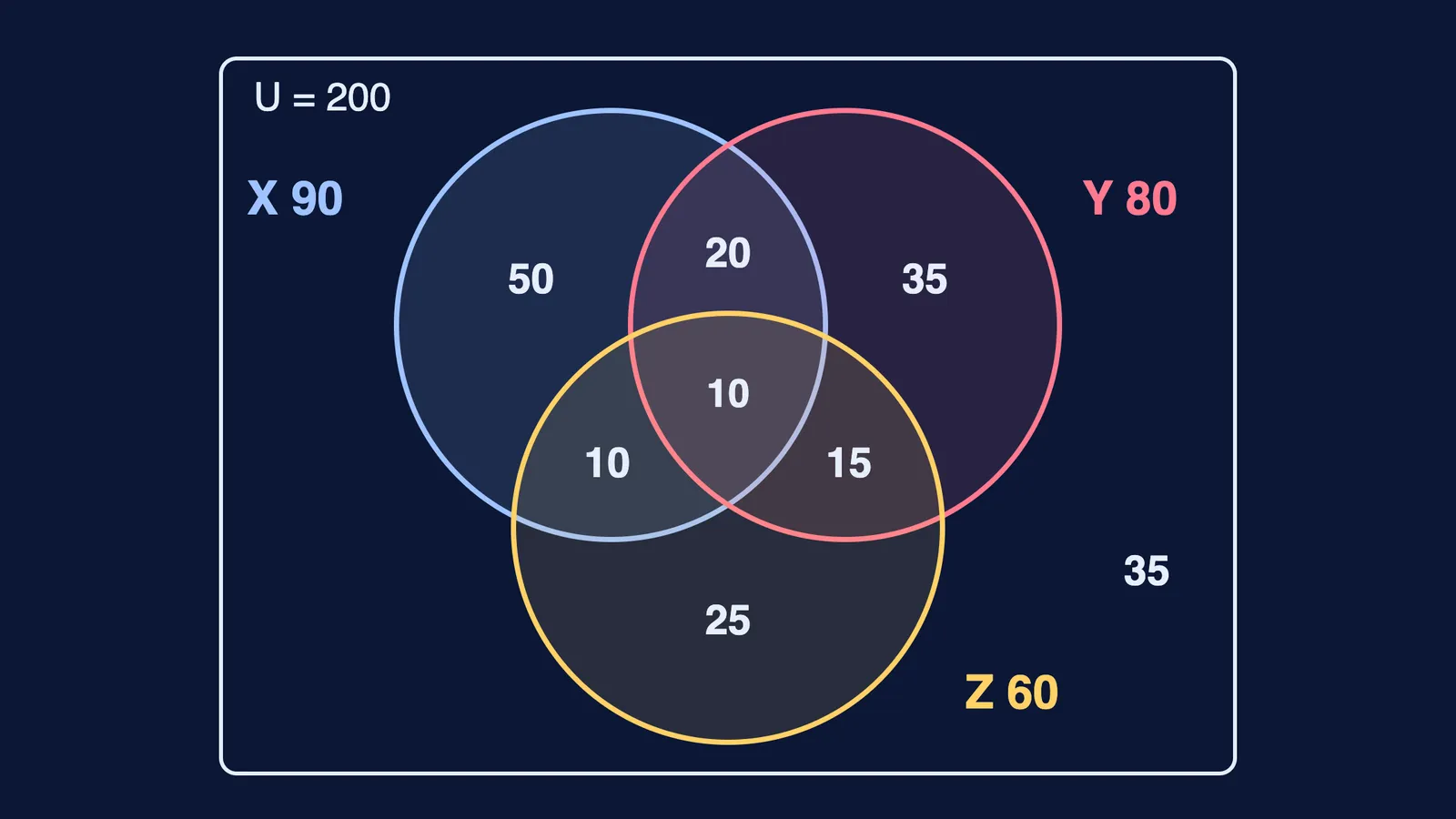
Example 3 (three sets). A survey of 200 viewers asks about streaming services X, Y and Z: n(X) = 90, n(Y) = 80, n(Z) = 60, n(X ∩ Y) = 30, n(Y ∩ Z) = 25, n(X ∩ Z) = 20, and 10 use all three.
At least one: 90 + 80 + 60 − 30 − 25 − 20 + 10 = 165, so 35 use none.
Fill from the centre out. Exactly X and Y: 30 − 10 = 20; exactly Y and Z: 15; exactly X and Z: 10.
X only: 90 − 20 − 10 − 10 = 50; Y only: 80 − 20 − 15 − 10 = 35; Z only: 60 − 15 − 10 − 10 = 25.
Exactly one service: 50 + 35 + 25 = 110. Exactly two: 20 + 15 + 10 = 45.
Check: 110 + 45 + 10 + 35 = 200.
What practice questions can you try?
The book mixes MCQs, assertion-reason items and case studies. Marks below are our suggestion, not CBSE's.
(1 mark) If n(A) = 12, n(B) = 9 and A ∩ B = φ, find n(A ∪ B).
(3 marks) In a class of 120, 75 study Economics, 60 study Accountancy and 15 study neither. How many study both, and how many study exactly one of the two?
(2 marks) A shop says that of 100 customers, 70 bought tea, 50 bought biscuits and 10 bought both. Show that this cannot be right, and find the least number who must have bought both.
(1 mark) Assertion (A): n(A ∪ B) = n(A − B) + n(B − A) + n(A ∩ B). Reason (R): A − B, B − A and A ∩ B are pairwise disjoint.
Answers: 1) 21. 2) 30 both; 75 exactly one. 3) The union would be 70 + 50 − 10 = 110 > 100; at least 70 + 50 − 100 = 20 bought both. 4) A and R are true, and R explains A.
Stuck on where to start a three-set question? The Fermi Problem Library has worked problems with a step-by-step solver that explains the reasoning rather than printing an answer.