

On this page
Binary is the first place Class 11 computer science asks you to do arithmetic the way a computer does. The CBSE Class XI Computer Science syllabus for 2025-26 lists binary, octal, decimal and hexadecimal number systems and conversion between them in Unit 1, Computer Systems and Organisation, which carries 10 of the 70 theory marks. Two methods and four addition rules cover most of it.
Why base 2 at all? NCERT's Class 11 Computer Science textbook, Chapter 2 explains that a transistor's ON and OFF states are written as 1 and 0, the two digits of the base-2 system.
How do you convert decimal to binary?
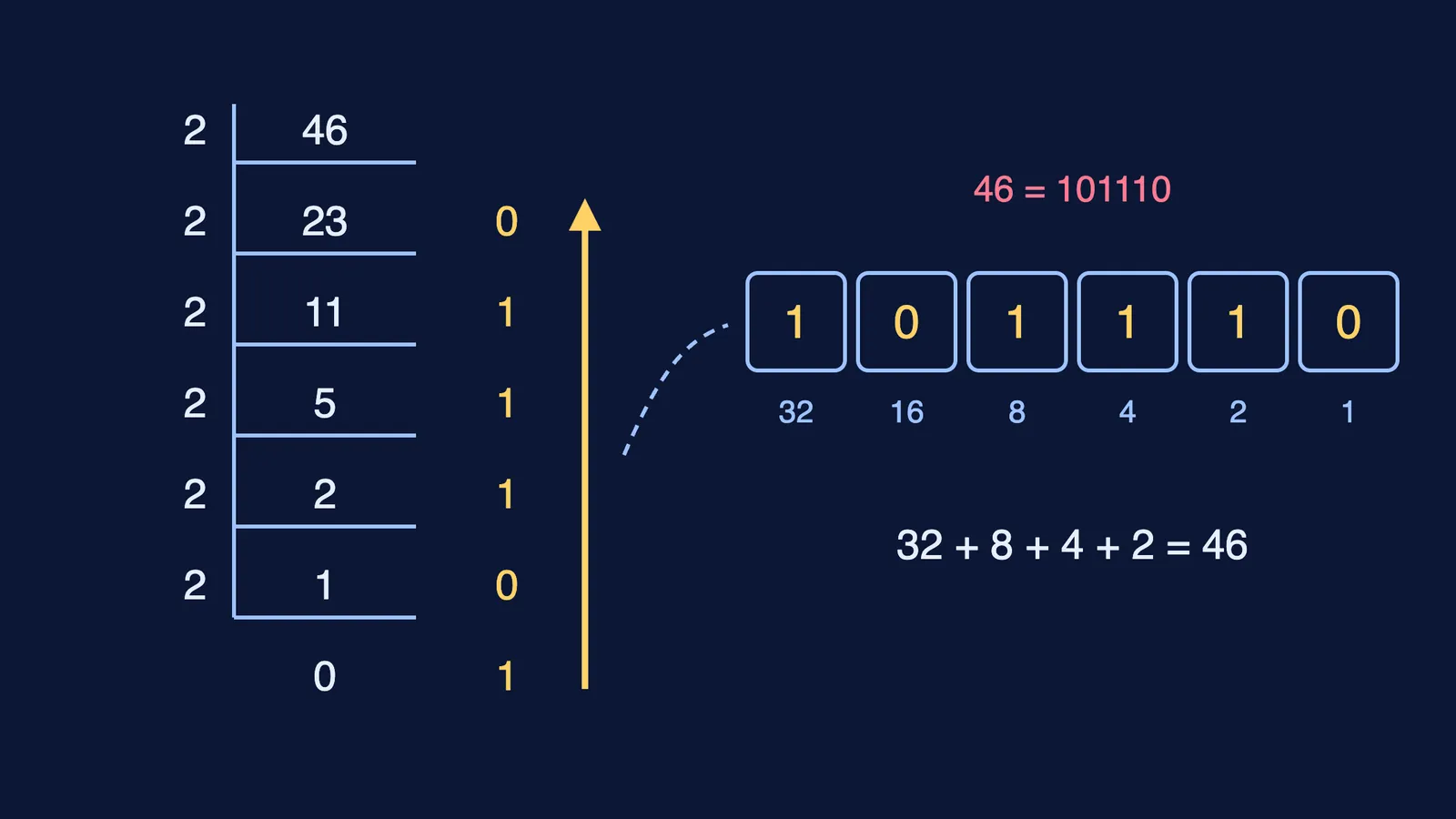
Use repeated division by 2. The NCERT chapter gives four steps: divide the number by the base, note the remainder, keep dividing each new quotient until the quotient is zero, then write the remainders in reverse order, from bottom to top.
Worked example: convert 46 to binary.
46 ÷ 2 = 23, remainder 0
23 ÷ 2 = 11, remainder 1
11 ÷ 2 = 5, remainder 1
5 ÷ 2 = 2, remainder 1
2 ÷ 2 = 1, remainder 0
1 ÷ 2 = 0, remainder 1
Read the remainders from the last one up: 101110. So 46 in decimal is 101110 in binary.
Why upward? The first remainder says whether the number is odd or even, so it is the 1s bit, on the right. The last remainder is the leftmost bit.
How do you convert binary back to decimal?
Multiply each bit by its place value and add. The NCERT chapter explains that each digit's positional value is the base raised to the digit's position, counting from 0 at the rightmost digit. In binary the place values, from the right, are 1, 2, 4, 8, 16, 32, 64 and so on.
For 101110: 1×32 + 0×16 + 1×8 + 1×4 + 1×2 + 0×1 = 46, which is where you started. That round trip is the habit worth building: convert, then convert back.
How do you add binary numbers with carries?
Line the numbers up on the right and add column by column, carrying as soon as a column reaches 2. Lecture notes on binary arithmetic from the University at Buffalo point out that there are only two carry combinations, 1 + 1 = 10 and 1 + 1 + 1 = 11, and that the rules are the same however many bits the numbers have. In full:
0 + 0 = 0
0 + 1 = 1
1 + 1 = 10: write 0, carry 1
1 + 1 + 1 = 11 (two bits plus a carry): write 1, carry 1
Worked example: add 46 and 27. 46 is 101110 and 27 is 11011, which you pad to 011011 so the columns line up. Working from the right:
0 + 1 = 1: write 1, no carry
1 + 1 = 10: write 0, carry 1
1 + 0 + carry 1 = 10: write 0, carry 1
1 + 1 + carry 1 = 11: write 1, carry 1
0 + 1 + carry 1 = 10: write 0, carry 1
1 + 0 + carry 1 = 10: write 0, carry 1
No digits left, so the final carry becomes a new leftmost 1
The sum is 1001001. Check it: 64 + 8 + 1 = 73, and 46 + 27 = 73. Two six-bit numbers gave a seven-bit answer: a final carry adds a column.
If your answer keeps disagreeing with the book and you cannot see which column went wrong, the Fermi Problem Library has worked problems with a step-by-step solver that explains the reasoning rather than printing an answer.
How do you avoid mistakes in the exam?
Use this checklist on every number-system question:
Write the place values 64, 32, 16, 8, 4, 2, 1 at the top of your rough work.
In a division ladder, read the remainders from bottom to top; the first remainder is the 1s bit.
Pad the shorter number with leading zeros so the columns line up.
Write each carry small above the next column before you add that column.
Convert your answer back to decimal and compare.
The same bits become letters through encoding schemes, which our explainer on how computers store Hindi text with Unicode and UTF-8 walks through, and the 0s and 1s become signals in the logic gate output waveforms for AND, OR, NAND and NOR. For the history, read how Leibniz described binary arithmetic in 1703.
To revise number systems alongside the rest of the syllabus, the Fermi Concept Library covers every concept in physics, chemistry, biology, mathematics and computing, each with its own lesson.


