On this page
In 1703 the Paris Académie royale des sciences printed a five-page paper by Gottfried Wilhelm Leibniz on counting with only two characters, 0 and 1 (original scan). Its title also promised to explain the ancient Chinese figures of Fohy, the line figures of the I Ching.
What did Leibniz publish in 1703?
The paper is "Explication de l'Arithmétique Binaire", on pages 85 to 89 of the academy's Mémoires for 1703; a scan of the original is in the HAL open archive. A note in its margin dates it 5 May 1703.
Instead of counting by tens, he writes, he had for several years used "the simplest progression of all, which goes by twos" (our translation). So 2 is written 10, 4 is 100, 8 is 1000 and 16 is 10000. He then prints a table of the numbers 0 to 32 written this way.
He did not recommend binary in place of ordinary decimal counting: people were used to decimal, had already learned its tables, and its numbers are shorter. But he called counting by 0 and 1 the most fundamental way for science, because patterns jump out: in his table the last column repeats 01, the next repeats 0011, the next 00001111.
How does binary with only 0 and 1 work?
Each place is worth double the place to its right: 1, 2, 4, 8, 16 and so on. A 1 means "include this value" and a 0 means "skip it". Leibniz's own example: 1101 is 13, because it is eight plus four plus one.
Now go the other way with a number of your own, say 22:
16 fits: write 1, leaving 6.
8 does not fit: write 0.
4 fits: write 1, leaving 2.
2 fits: write 1, leaving 0.
1 is not needed: write 0.
So 22 is 10110, which matches row 22 of Leibniz's table.
Sums work the same way, except you carry when a column reaches 2 instead of 10. Leibniz printed 110 + 111 = 1101 (6 + 7 = 13) and 1101 − 111 = 110 (13 − 7 = 6). His point was that nothing must be learned by heart, unlike 6 + 7 = 13 or 5 × 3 = 15 in decimal; the whole multiplication table shrinks to "once one is one". For addition, the only new fact you need is 1 + 1 = 10.
If base conversion is on your syllabus, our guide to binary, octal and hexadecimal for CBSE computer science works through the exam-style versions. If the place-value idea underneath still feels shaky, the Fermi Concept Library has a lesson for every concept in mathematics and computing, each with its place in the map.
How did Leibniz link binary to the I Ching hexagrams?
The I Ching began as a divination manual in the Western Zhou period (1000 to 750 BC), and it is built on 64 hexagrams of six stacked lines, each line broken or unbroken (I Ching overview).
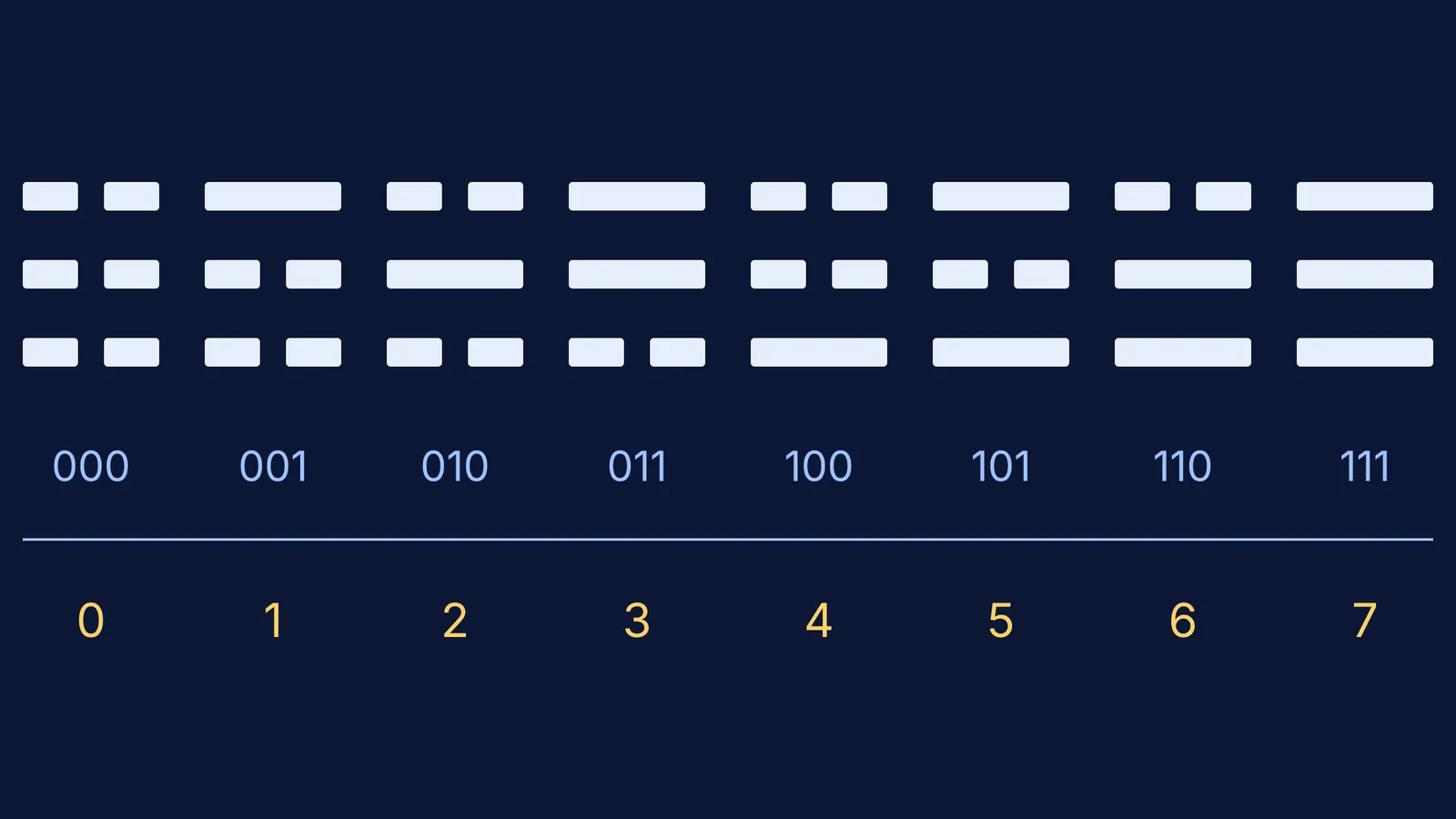
In the 1703 paper (original scan), Leibniz says he had sent his way of counting to Joachim Bouvet, a French Jesuit living in Beijing, a little over two years earlier. Bouvet replied in a letter Leibniz dates 14 November 1701, sending the "great figure" of the hexagrams that runs to 64. Leibniz's reading was simple: a whole line means 1 and a broken line means 0. Read that way, the eight three-line trigrams count 000 to 111, which is 0 to 7, as he printed on page 88 and as the diagram above shows. The 64 hexagrams count 0 to 63.
He called these figures perhaps the oldest monument of science in the world (our translation). He also claimed the Chinese had lost their meaning. Yet the binary order he found had been set out by the Song dynasty scholar Shao Yong (1011 to 1077), who arranged the hexagrams in a binary sequence, the Fu Xi ordering (Shao Yong), though he did not intend it to be used mathematically (I Ching overview).
Was Leibniz the first to use binary?
No. Thomas Harriot explored binary in England but never published it, and Juan Caramuel y Lobkowitz may have printed the first European account in 1700 (history of binary numbers). Leibniz himself wrote on the binary progression in 1679. In India, Pingala (around the 2nd century BC) described Sanskrit metres as patterns of short and long syllables, a binary-style system; we tell that story in Pingala's metres and binary-style counting.
What Leibniz's 1703 paper offered was a published arithmetic with worked examples of all four operations. For his calculating machine, see how Leibniz's stepped drum calculator mechanised multiplication.
How can you practise Leibniz's binary today?
A three-day plan:
Day 1: write 0 to 32 in binary and find the repeating pattern in each column.
Day 2: redo his sums 110 + 111 and 1101 − 111, then invent five of your own.
Day 3: draw the eight trigrams from memory and label each with its binary and decimal value.
If a sum goes wrong and you cannot see where, the Fermi Problem Library has worked problems with a step-by-step solver that explains the reasoning rather than printing an answer.
Start with 1101. Once you can see why it is thirteen, you have understood Leibniz's paper.