On this page
Before the digital age, humans dreamed of machines that could lift the burden of repetitive arithmetic. In the 17th century, early calculators like Blaise Pascal's Pascaline could add and subtract, but multiplication remained slow and manual. That changed when Gottfried Wilhelm Leibniz, a German mathematician and philosopher, designed a machine that turned multiplication into a simple turn of a crank.
His invention relied on a brilliantly simple piece of engineering: the stepped drum. This mechanism was so reliable that it powered mechanical calculators for two centuries (1).
What was the Leibniz step reckoner multiplication machine?
Conceived by Leibniz in Paris in 1672, the Step Reckoner (or *Staffelwalze*) was the first mechanical calculator capable of performing all four basic arithmetic operations: addition, subtraction, multiplication, and division (1).
Leibniz presented a wooden model of his machine to the Royal Society of London in 1673, though the first fully functional version was not completed until 1694. The final device was roughly 67 cm (26 inches) long, housed in an oak case, and built from polished brass and steel. To set up a calculation, the user entered a number using an input section that featured 8 operand dials. The result then appeared in a separate accumulator section containing 16 display windows.
If you find yourself making careless errors in long calculations today, you are not alone; Leibniz built his machine specifically to eliminate those human mistakes. Today, the Fermi Problem Library tackles this by offering worked problems with a step-by-step solver that explains the reasoning rather than printing an answer, helping you spot exactly where a method went wrong. If you want to improve your own process, check out our guide on how to solve physics problems step by step, with a worked example.
How did the stepped drum work?
The secret to the Step Reckoner's versatility was the Leibniz wheel, commonly known as a stepped drum.
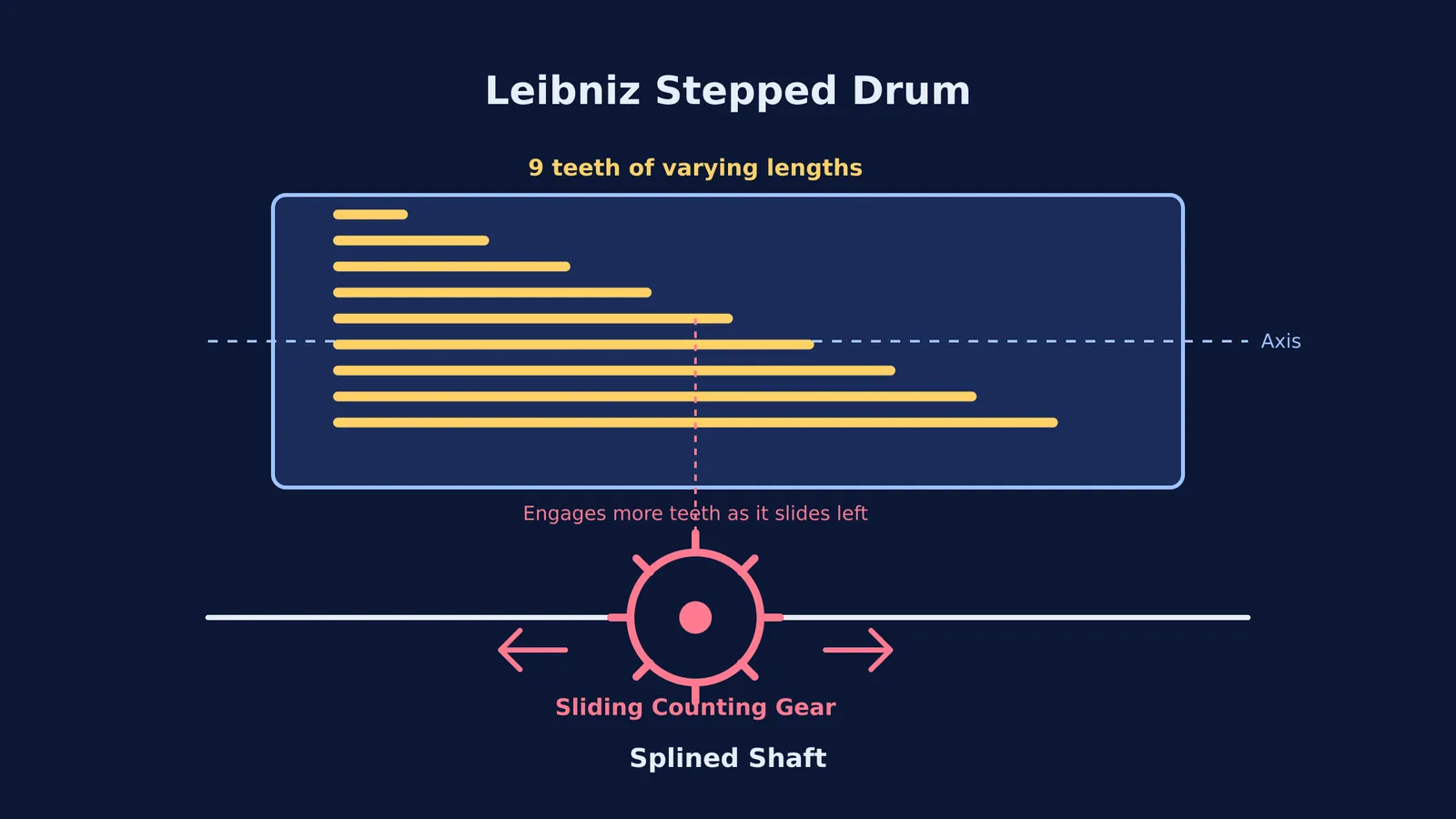
Unlike a standard gear which has teeth of equal length, the stepped drum was a cylindrical gear featuring nine teeth of varying lengths (1). These teeth were arranged in a staggered pattern, resembling a set of stairs. Next to this drum sat a smaller counting gear on a sliding shaft.
When the user slid the counting gear along its shaft, they changed its position relative to the drum. If the gear was positioned near the short end of the drum, it might only catch three of the longest teeth as the drum rotated. If slid all the way to the other end, it would catch all nine. This ingenious variable-tooth design allowed the machine to physically represent any digit from 0 to 9.
Visualising 3D mechanisms in motion is a great way to build physics intuition. For concepts that are hard to picture, the Fermi Simulation Lab offers interactive simulations for the ideas that are easier to see than to read. For more on building this intuition, read how to visualise hard physics ideas: a chooser by topic.
How did the Leibniz calculator multiply?
To understand the genius of the machine, you have to look at how it turned multiplication into a mechanical process. The Step Reckoner performed multiplication through mechanised repeated addition (1).
Here is the exact procedure a 17th-century user followed to multiply a multi-digit number:
Set the multiplicand: The user dialled the base number into the 8 input dials.
Set the multiplier: A telephone-like dial with holes numbered 0 to 9 determined how many times the drum would engage.
Turn the crank: For the units digit, turning the main crank caused the stepped drum to rotate, adding the input number to the accumulator exactly as many times as the multiplier digit required.
Shift the carriage: To multiply by the tens digit, the user turned a worm gear crank to shift the entire input section one position to the left. This perfectly mirrored the place-value shift you use when adding a zero in manual long multiplication.
Repeat: They cranked the handle again for the tens digit, and so on.
The 200-year legacy of the Leibniz wheel
While Leibniz’s original prototypes suffered from mechanical flaws—such as a design error in the tens-carry mechanism that prevented it from smoothly rolling over from 9 to 10 across multiple dials—the core concept of the stepped drum was flawless (1).
The mechanism was used in calculating machines for 200 years. It became the beating heart of the Arithmometer, the first commercially successful mechanical calculator, introduced in 1820. The fundamental design remained in active use until the 1970s, famously powering the Curta hand calculator—a compact, grenade-shaped device that engineers relied on before electronic pocket calculators arrived.
When you get stuck trying to understand the history or math behind these inventions, Fermi's AI tutor can help. Most learning tools answer questions. Fermi teaches — it holds a line of reasoning across a whole session, notices where a student is stuck, and decides whether to explain, ask, or show.
By turning abstract numbers into the physical geometry of a brass drum, Leibniz didn't just build a calculator; he proved that human reasoning could be mechanised, paving the way for the computing revolution centuries later.