On this page
A pipes and cisterns problem is a time and work problem in a plumber's uniform. The tank is the job, every inlet pipe is a worker who adds to it, and every outlet pipe or leak is a worker who undoes it. Once you see a leak as negative work, most versions of the question become one line of arithmetic.
Why do more pipes fill a tank faster?
NCERT's Class 8 mathematics textbook uses exactly this as an example of inverse proportion: if 6 pipes fill a tank in 1 hour 20 minutes, 5 pipes of the same type take 96 minutes (NCERT Class 8 Mathematics, Chapter 11). The same chapter defines two quantities x and y as being in inverse proportion when xy = k, a constant.
Here 6 × 80 = 480 pipe-minutes of work, a total that stays fixed. Only the rate changes. Now add pipes that work against you.
How do you treat an outlet pipe or a leak?
Write each pipe's rate as the fraction of the tank it handles in one hour.
An inlet that fills the tank alone in a hours adds 1/a of the tank per hour.
An outlet or leak that empties a full tank alone in b hours removes 1/b per hour, so write it as −1/b.
Net rate = (sum of inlet rates) − (sum of outlet rates).
Time to fill an empty tank = 1 ÷ net rate.
If the net rate is negative, the tank empties instead of filling.
How long does a tank take to fill with a leak?
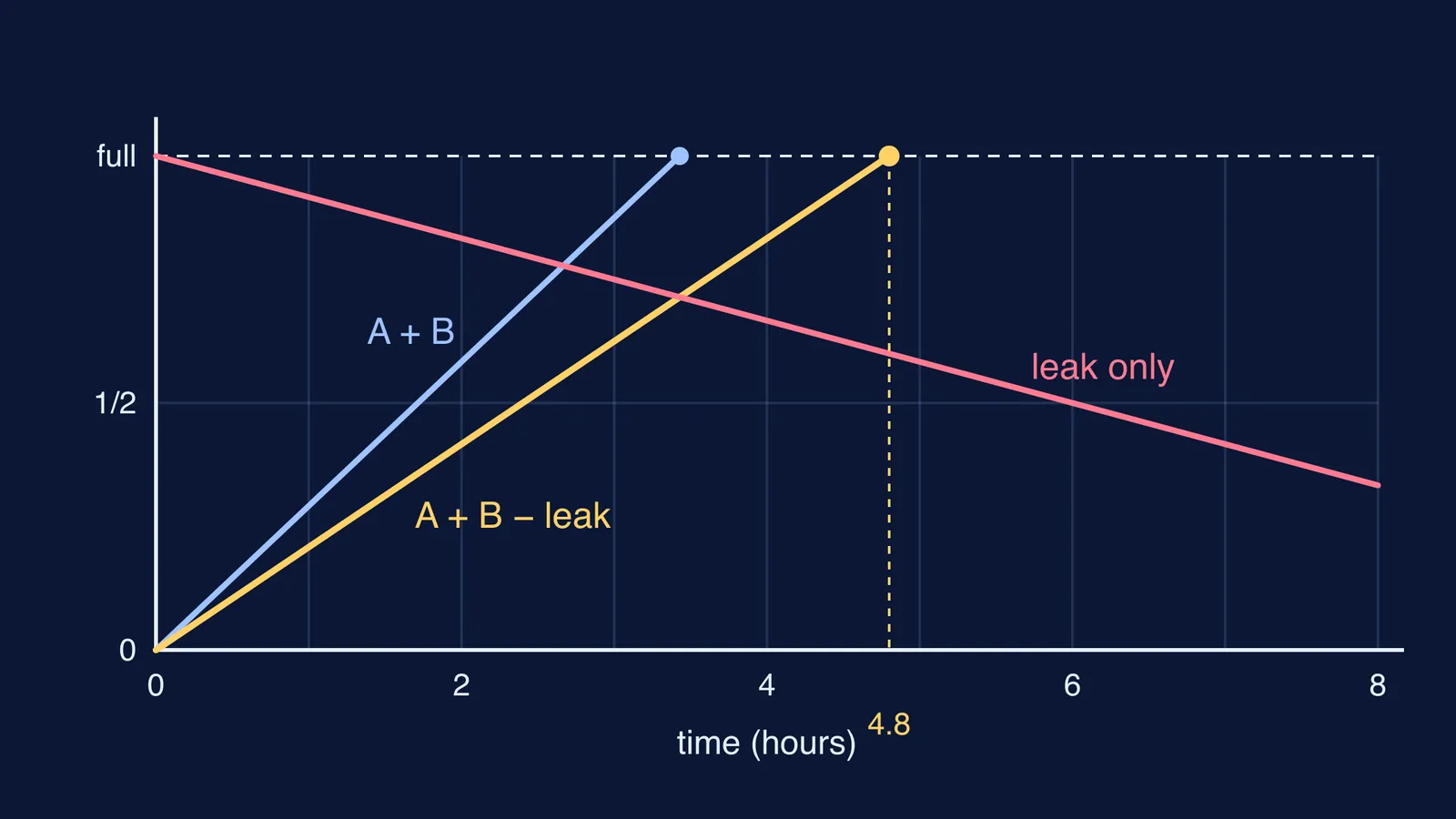
Worked example 1. Pipe A fills a tank in 6 hours, pipe B in 8 hours, and a leak empties a full tank in 12 hours. All three start together on an empty tank. When is it full?
Fraction method:
A adds 1/6 per hour, B adds 1/8, the leak removes 1/12.
Net rate = 4/24 + 3/24 − 2/24 = 5/24 of the tank per hour.
Time = 1 ÷ (5/24) = 24/5 = 4.8 hours, which is 4 hours 48 minutes.
LCM method, with no fractions: imagine the tank holds 24 units, the LCM of 6, 8 and 12. A adds 4 units an hour, B adds 3 and the leak removes 2, so the net is 5 units an hour and 24 ÷ 5 = 4.8 hours. New to this shortcut? See the LCM method for time and work problems.
Sanity check: without the leak, A and B add 7 units an hour and finish in 24 ÷ 7, about 3.4 hours. A leak can only slow things down, so 4.8 hours makes sense.
Finding the leak from the delay
Worked example 2. A pipe fills a tank in 6 hours, but because of a leak it takes 8. How long would the leak alone take to empty the full tank?
Take the tank as 24 units, the LCM of 6 and 8.
The pipe alone adds 24 ÷ 6 = 4 units an hour. With the leak, the tank gains 24 ÷ 8 = 3 units an hour.
The leak therefore removes 4 − 3 = 1 unit an hour, and empties 24 units in 24 hours.
Check with fractions: 1/6 − 1/24 = 4/24 − 1/24 = 3/24 = 1/8. That matches the 8 hours in the question.
What mistakes cost marks in pipes and cisterns?
Adding times instead of rates. Rates add; times do not.
Dropping the minus sign. Write the sign next to every rate before any arithmetic.
Ignoring a late start. If a pipe opens after 2 hours, work out what is already in the tank, then divide only the remaining fraction by the new net rate.
Not checking the direction. If the outlets match or beat the inlets, the tank never fills.
Mixing units. Convert minutes and hours to one unit before adding rates.
How should you practise these problems?
For each problem, write a rate line first: every pipe as +1/a or −1/b, nothing else.
Solve one problem by fractions and the next by LCM units, so both methods stay fresh.
Before calculating, estimate: is the answer longer or shorter than the fastest pipe alone?
Once these feel easy, try efficiency versions, such as when one worker is 50 percent more efficient than another, and LCM timing puzzles like when bells ring together again.
If your setup keeps going wrong rather than your arithmetic, the Fermi Problem Library has worked problems with a step-by-step solver that explains the reasoning rather than printing an answer, so you can see where a sign slipped. If inverse proportion itself feels shaky, the Fermi Concept Library gives each concept its own lesson.
Tonight, pick three pipes and cisterns questions and write only the rate lines first. The rest is division.