

On this page
If you are preparing for competitive exams, you will recognise this classic setup: Worker A takes 10 days to finish a job, and Worker B takes 15 days. How long will they take if they work together?
Most textbooks teach the unitary method. You calculate that A completes 1/10 of the work per day, B completes 1/15, and you add the fractions to find their combined rate. But adding fractions requires finding common denominators midway through the calculation, which costs time and invites mistakes.
Fractions are notoriously difficult for the brain to process quickly. A 2012 longitudinal study in the U.S. and U.K. found that elementary students' mastery of fractions uniquely predicted their high school mathematics achievement, even after controlling for general intelligence (Siegler et al., 2012). Adding fractions requires you to hold both numerators and denominators in your working memory. The LCM method sidesteps this intrinsic difficulty by turning the whole problem into simple integer arithmetic.
How does the LCM method work?
Instead of treating the job as one abstract whole (which leads to fractions), the LCM method scales the job up to a number that divides cleanly by everyone's time.
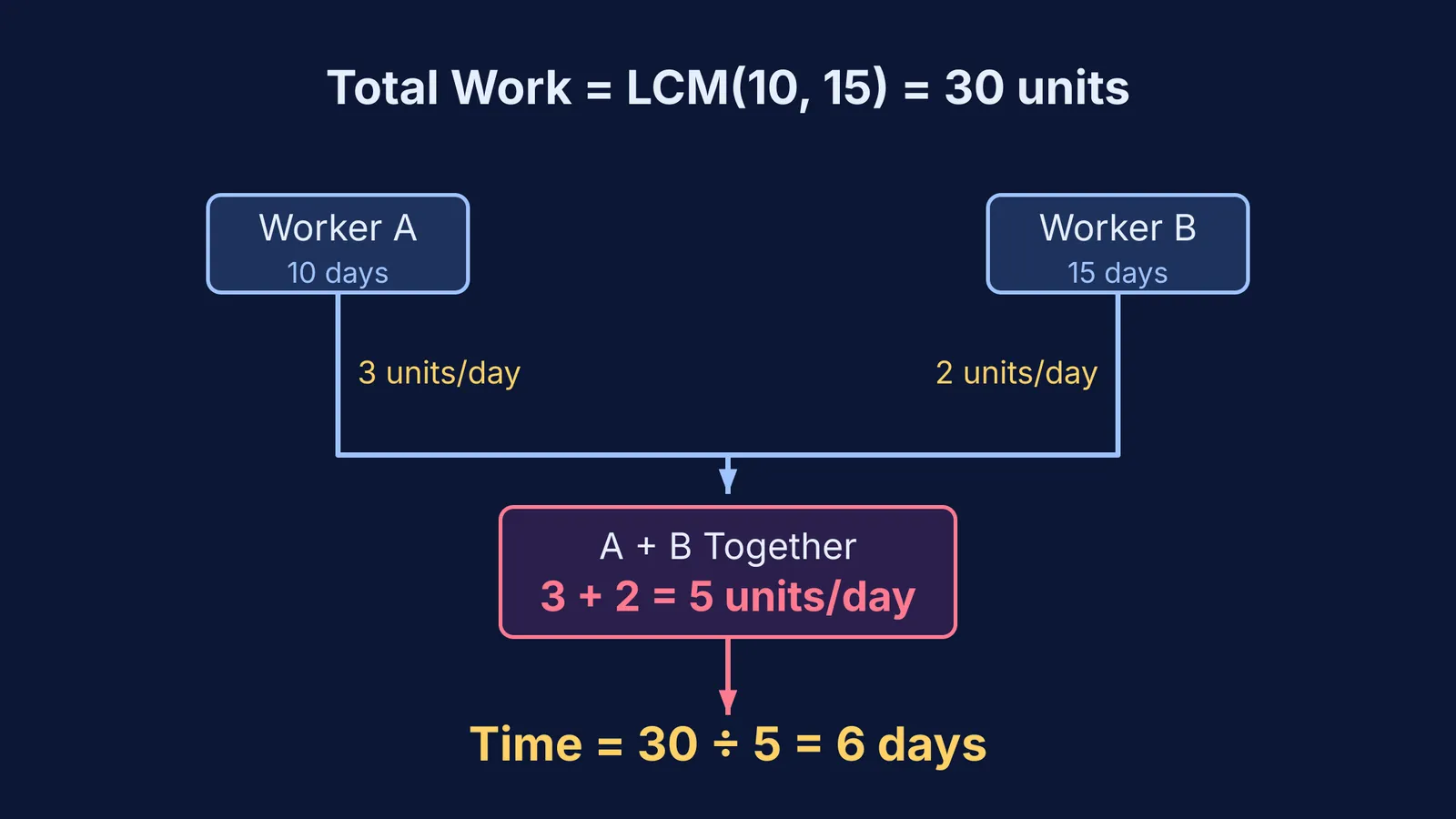
Find the total work: Take the Lowest Common Multiple (LCM) of the given times. For 10 and 15 days, the LCM is 30. Assume the job requires 30 "units" of work (imagine laying 30 bricks).
Find the daily output:
A finishes 30 units in 10 days, so A's rate is 30 ÷ 10 = 3 units a day.
B finishes 30 units in 15 days, so B's rate is 30 ÷ 15 = 2 units a day.
Combine their output: Working together, they complete 3 + 2 = 5 units a day.
Find the total time: To finish all 30 units at a pace of 5 units a day takes 30 ÷ 5 = 6 days.
What if there are three or more workers?
The unitary method becomes exponentially more tedious as you add more people because finding a common denominator for three or four fractions takes significant effort. The LCM method scales effortlessly.
Imagine A takes 10 days, B takes 12 days, and C takes 15 days.
Total work: The LCM of 10, 12, and 15 is 60 units.
A's rate: 60 ÷ 10 = 6 units a day.
B's rate: 60 ÷ 12 = 5 units a day.
C's rate: 60 ÷ 15 = 4 units a day.
Combined rate: 6 + 5 + 4 = 15 units a day.
Total time: 60 ÷ 15 = 4 days.
By dealing only with integers, you arrive at the answer in seconds without writing down a single fraction.
What if workers leave midway or work on alternate days?
The LCM method is especially useful when a problem's conditions change. Because you are tracking a pile of units rather than a fraction of a job, it is much easier to picture what is happening.
For example, what if A and B start together, but A leaves after 2 days? How long will B take to finish the rest?
Total work = 30 units.
Together they do 5 units a day. In 2 days, they complete 10 units.
Remaining work = 30 − 10 = 20 units.
B's rate is 2 units a day.
Time for B = 20 ÷ 2 = 10 days.
When a problem gets this complicated, tracing units of work is easier to follow than tracking abstract fractions. This is why the Fermi Problem Library uses the LCM method in its step-by-step solver, giving you a clear, tangible path through the reasoning.
Does the LCM method work for pipes and cisterns?
Yes. A tap filling a tank does positive work, while a leak does negative work. The logic remains exactly the same.
If Tap A fills a tank in 12 hours and Leak B empties it in 20 hours:
The LCM of 12 and 20 is 60. Let the tank hold 60 units (or litres).
Tap A adds 60 ÷ 12 = 5 units per hour.
Leak B removes 60 ÷ 20 = 3 units per hour.
Their net rate is 5 − 3 = +2 units per hour.
The time to fill the tank is 60 ÷ 2 = 30 hours.
When should you avoid the LCM method?
If the problem gives you algebraic times rather than numbers—for example, "A takes x days and B takes x + 5 days"—the LCM method will produce messy expressions like x(x + 5). In these cases, it is better to use the standard unitary equation 1/x + 1/(x + 5) = 1/t. This typically leads to quadratic word problems in Class 10, where you can solve for x using the quadratic formula.
If you find yourself stuck deciding which approach to use during practice, Fermi's AI tutor can notice where you are stuck and explain the reasoning step by step.


