

On this page
When a quantitative aptitude problem states that "A is 50% more efficient than B", it is telling you about their relative rates of work (NCERT Class 8 Mathematics). If B's efficiency is 100%, A's efficiency is 150%.
This translates to a simple ratio:
Ratio of efficiency (work rate) of A to B = 150 : 100 = 3 : 2.
This means for every 2 units of work B completes in a day, A completes 3 units. Efficiency measures how much work is done in a given unit of time. Understanding this relative rate is the key to solving time and work problems quickly without getting lost in complex fractions.
How do you turn efficiency into time ratios?
In mathematics, efficiency and time are inversely proportional: the faster you work, the less time you take (NCERT Class 8 Mathematics).
Because time is inversely proportional to efficiency, you can simply flip the efficiency ratio to find the time ratio:
Ratio of time taken by A to B = 2 : 3.
If A and B are working on the exact same task, A will take two days for every three days that B takes. A common mistake is to assume time is additive. For example, if A takes 2 days and B takes 3 days, they do not take 5 days together. Instead, their work rates are additive. Using the "unit work" method by multiplying the rate by time avoids these errors entirely.
A worked example: how do A and B finish a job together?
Let's apply this to a standard exam problem based on direct and inverse proportions (NCERT Class 8 Mathematics): *A is 50% more efficient than B. If they work together, they can finish a piece of work in 12 days. In how many days can A alone finish the work?*
Here is the step-by-step method to solve it without dealing with messy fractions:
Step 1: Set the daily work units From our efficiency ratio of 3:2, let's say:
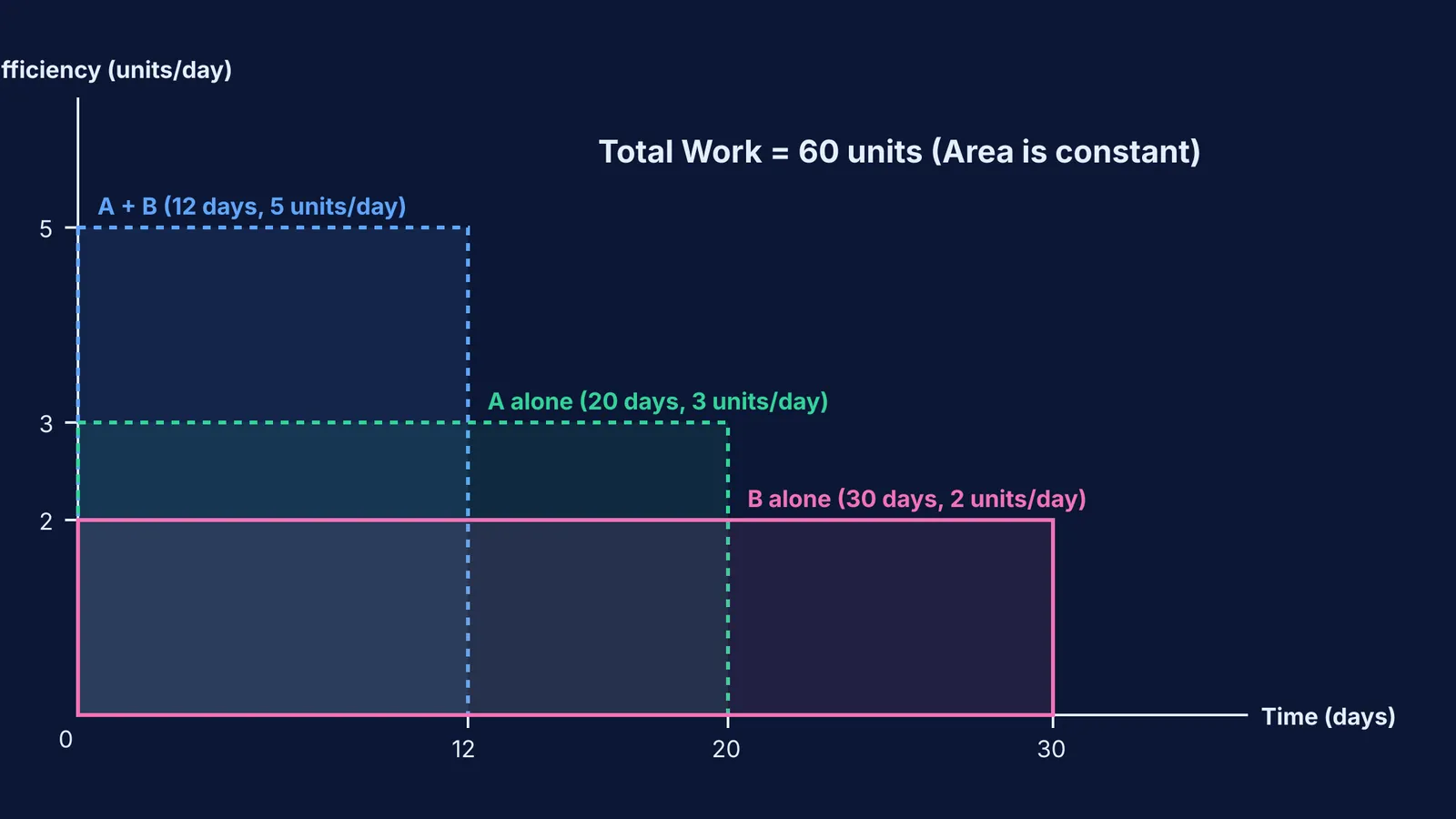
A completes 3 units of work per day.
B completes 2 units of work per day.
Together, A and B complete 5 units of work per day (3 + 2 = 5).
Step 2: Calculate the total work We know that working together, they take 12 days to finish the entire job.
Total work = Combined efficiency × Time taken
Total work = 5 units/day × 12 days = 60 units.
Step 3: Calculate the time for A alone Now that we know the total job is 60 units, we divide it by A's daily rate.
Time taken by A = Total work / A's efficiency
Time taken by A = 60 units / 3 units/day = 20 days.
If the problem asked for B, it would be 60 units divided by 2 units per day, which equals 30 days.
What happens when A is less efficient than B?
Sometimes an exam will present the reverse scenario. Suppose a problem states that "A is 20% less efficient than B" (NCERT Class 8 Mathematics).
If B's efficiency is 100%, A's efficiency is now 80%.
Ratio of efficiency of A to B = 80 : 100 = 4 : 5.
Ratio of time taken by A to B = 5 : 4.
If they work together and finish the job in 10 days, their combined daily work is 9 units (4 + 5). The total work would be 90 units (9 units/day × 10 days). A alone would take 22.5 days (90 / 4), and B alone would take 18 days (90 / 5). The same unit work logic applies perfectly, preventing you from setting up incorrect inverse equations.
How does the unit work method apply to other word problems?
The unit work approach is not just for people painting walls or building fences. It applies to any scenario involving rates. For instance, pipes filling a tank work on the exact same principle. A pipe that fills a tank 50% faster has an efficiency ratio of 3:2 compared to the standard pipe (NCERT Class 8 Mathematics).
Learning to translate statements into actionable ratios helps across many areas of mathematics. Much like setting up quadratic word problems in Class 10 or finding the distance in the nth second in kinematics, identifying the core relationship (in this case, total work = rate × time) simplifies the algebra.
Why use the Fermi approach for word problems?
When you prepare for competitive exams, getting stuck on the setup of a word problem is normal. Fermi's AI tutor can help you break down these conceptual hurdles.
If you make a mistake on a problem like this, the tutor won't just print the final answer. Instead, it works out what they already know, builds a plan for the session, and works through problems alongside the student. It might ask you to first identify the efficiency ratio before moving on to calculating the total work units.
For more practice with step-by-step guided reasoning, you can explore the Fermi Problem Library, where the tutor explains the reasoning rather than printing an answer, checking understanding as it goes. You can also brush up on foundational mathematical ideas in the Concept Library.


