

On this page
Start with a picture, not a formula. A 2x2 matrix usually turns a vector and changes its length. A few special directions are only stretched, shrunk or flipped, never turned: those are the eigenvectors, and the stretch factors are the eigenvalues.
What are eigenvalues of a 2x2 matrix?
MIT's linear algebra course puts the idea in one line: "If the product Ax points in the same direction as the vector x, we say that x is an eigenvector of A" (MIT OpenCourseWare 18.06, Lecture 21). The eigenvalue λ is the number in Ax = λx: how much that direction is stretched.
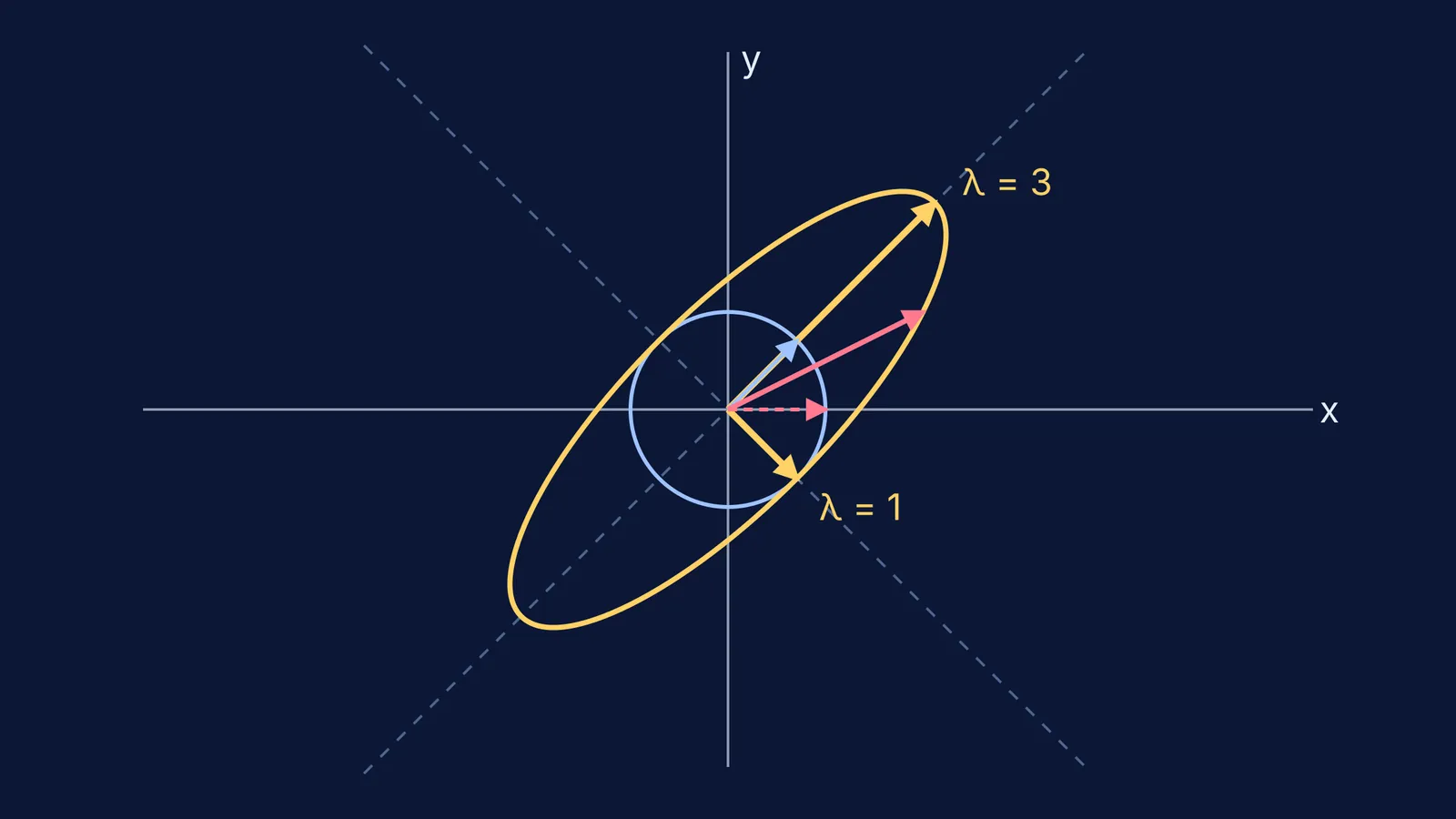
Take the matrix A with rows (2, 1) and (1, 2). Watch three vectors:
A(1, 1) = (3, 3) = 3(1, 1). Same direction, three times longer. Eigenvalue 3.
A(1, −1) = (1, −1). Same direction, same length. Eigenvalue 1.
A(1, 0) = (2, 1). The direction has turned, so (1, 0) is not an eigenvector.
In the diagram above, A turns the unit circle into an ellipse, and the eigenvectors lie along its axes.
How do you find eigenvalues with the characteristic equation?
Rewrite Ax = λx as (A − λI)x = 0. A homogeneous system has a non-zero solution only when its determinant is zero, so the eigenvalues are exactly the roots of det(A − λI) = 0, called the characteristic equation.
For A with rows (a, b) and (c, d), expand the determinant: (a − λ)(d − λ) − bc = 0, which is
λ² − (a + d)λ + (ad − bc) = 0.
The coefficient a + d is the trace (the sum of the diagonal entries) and ad − bc is the determinant. So for every 2x2 matrix the characteristic equation is λ² − (trace)λ + det = 0.
For our example, trace = 4 and det = 3, so λ² − 4λ + 3 = 0, which factorises as (λ − 1)(λ − 3) = 0. The eigenvalues are 1 and 3, matching the picture.
How are eigenvalues linked to trace and determinant?
Sum and product of roots give two rules you can use without solving anything. The trace of a square matrix equals the sum of its eigenvalues, and the determinant equals their product (Eigenvalues and eigenvectors, Wikipedia). Three quick readings follow:
If det A = 0, at least one eigenvalue is 0. The matrix squashes a whole direction flat, which is why it has no inverse.
If (trace)² − 4 det < 0, there are no real eigenvalues. The matrix turns every direction. The rotation with rows (0, −1) and (1, 0) gives λ² + 1 = 0.
A symmetric matrix with rows (a, b) and (b, d) has discriminant (a − d)² + 4b², which is never negative, so its eigenvalues are always real.
What is the Cayley-Hamilton theorem, and why does it matter for JEE?
The Cayley-Hamilton theorem says that every square matrix satisfies its own characteristic equation (Cayley-Hamilton theorem, Wikipedia). For a 2x2 matrix that means A² − (trace)A + (det)I = O. In 1858 Arthur Cayley stated the result for matrices up to 3x3 but published a proof only for the 2x2 case, according to the same article.
The JEE Advanced 2026 syllabus lists determinants, the adjoint and the inverse of matrices of order up to three; it does not name eigenvalues or Cayley-Hamilton. It is a shortcut built from parts you already study: a relation like A² = kA + mI turns an inverse or a high power into simple algebra.
Worked example with A = rows (2, 1) and (1, 2):
Cayley-Hamilton gives A² − 4A + 3I = O, so A² = 4A − 3I (both have rows (5, 4) and (4, 5)).
Inverse: since det A = 3 is not zero, multiply A² − 4A + 3I = O by A⁻¹ to get A − 4I + 3A⁻¹ = O, so A⁻¹ = (4I − A)/3, with rows (2/3, −1/3) and (−1/3, 2/3).
Cube: A³ = A·A² = 4A² − 3A = 4(4A − 3I) − 3A = 13A − 12I, with rows (14, 13) and (13, 14).
A short practice routine
Pick any 2x2 matrix and write its trace and determinant.
Write λ² − (trace)λ + det = 0 and solve it.
For each λ, solve (A − λI)x = 0; one row is enough to fix the direction.
Sketch where (1, 0), (0, 1) and the eigenvectors go, to see which turn and which only stretch.
Write the Cayley-Hamilton identity and use it to find A⁻¹ and A³.
Shaky on determinants or inverses? Revise the Class 12 matrices and determinants formulas, then plan the chapter with how to prepare matrices and determinants for JEE Advanced.
If a step stops making sense, the Fermi Concept Library gives every mathematics concept its own lesson and its place in the map, so you can go back to determinants or quadratics first. Stuck on a particular matrix question? The Fermi Problem Library has a step-by-step solver that explains the reasoning rather than printing an answer.


