On this page
This sheet covers NCERT Chapter 3, Matrices and Chapter 4, Determinants (reprint 2026-27), checked against the CBSE Mathematics curriculum for 2026-27. Not included: properties of determinants and elementary row operations (not in the syllabus), and Cramer's rule, which is in the Applied Mathematics curriculum.
A′ is the transpose, |A| the determinant, I the identity, O the zero matrix; [1 2; 3 4] lists rows separated by semicolons.
What are the types of matrices and the transpose rules?
A = [aᵢⱼ] of order m × n: m rows, n columns; aᵢⱼ is in row i, column j.
Row matrix: 1 × n. Column matrix: m × 1. Square: m = n. Diagonal: square with aᵢⱼ = 0 for i ≠ j. Scalar: diagonal, every aᵢᵢ = k. Identity I: diagonal, every aᵢᵢ = 1. Zero O: all entries 0.
A = B only if same order and aᵢⱼ = bᵢⱼ for all i, j.
Transpose: if A = [aᵢⱼ] is m × n, then A′ = [aⱼᵢ] is n × m.
(A′)′ = A; (kA)′ = kA′; (A + B)′ = A′ + B′; (AB)′ = B′A′.
Symmetric: A′ = A. Skew symmetric: A′ = −A (diagonal entries 0).
Any square A = ½(A + A′) + ½(A − A′), symmetric plus skew symmetric.
Example: A = [4 7; 1 6] splits into ½(A + A′) = [4 4; 4 6] and ½(A − A′) = [0 3; −3 0].
Watch for: (AB)′ = B′A′, not A′B′.
How do you multiply matrices, and when is AB defined?
A ± B: same order only, entry by entry. kA = [k·aᵢⱼ].
A + B = B + A; (A + B) + C = A + (B + C); k(A + B) = kA + kB; (k + l)A = kA + lA.
AB needs A m × n and B n × p (columns of A = rows of B); AB = [cᵢₖ] is m × p, cᵢₖ = Σ aᵢⱼbⱼₖ over j = 1 to n.
A(BC) = (AB)C; A(B + C) = AB + AC; (A + B)C = AC + BC; AI = IA = A for square A.
AB ≠ BA in general; AB = O is possible with A, B ≠ O (syllabus: order-2 square matrices only).
Example: A = [1 2; 3 4], B = [2 0; 1 3] give AB = [4 6; 10 12] but BA = [2 4; 10 14]. And [1 1; 1 1] × [1 −1; −1 1] = O.
Watch for: (A + B)² = A² + AB + BA + B². Above, that is [17 20; 40 57]; A² + 2AB + B² wrongly gives [19 22; 40 55].
How do you find a determinant, minors and cofactors?
Only square matrices have determinants. |[a]| = a; |a b; c d| = ad − bc.
3 × 3, along R1: |a₁ b₁ c₁; a₂ b₂ c₂; a₃ b₃ c₃| = a₁(b₂c₃ − b₃c₂) − b₁(a₂c₃ − a₃c₂) + c₁(a₂b₃ − a₃b₂).
Minor Mᵢⱼ: determinant left after deleting row i, column j. Cofactor Aᵢⱼ = (−1)^(i+j) Mᵢⱼ.
|A| = any row (or column) times its own cofactors: a₁₁A₁₁ + a₁₂A₁₂ + a₁₃A₁₃. With another row's cofactors the sum is 0.
|AB| = |A||B| (same order).
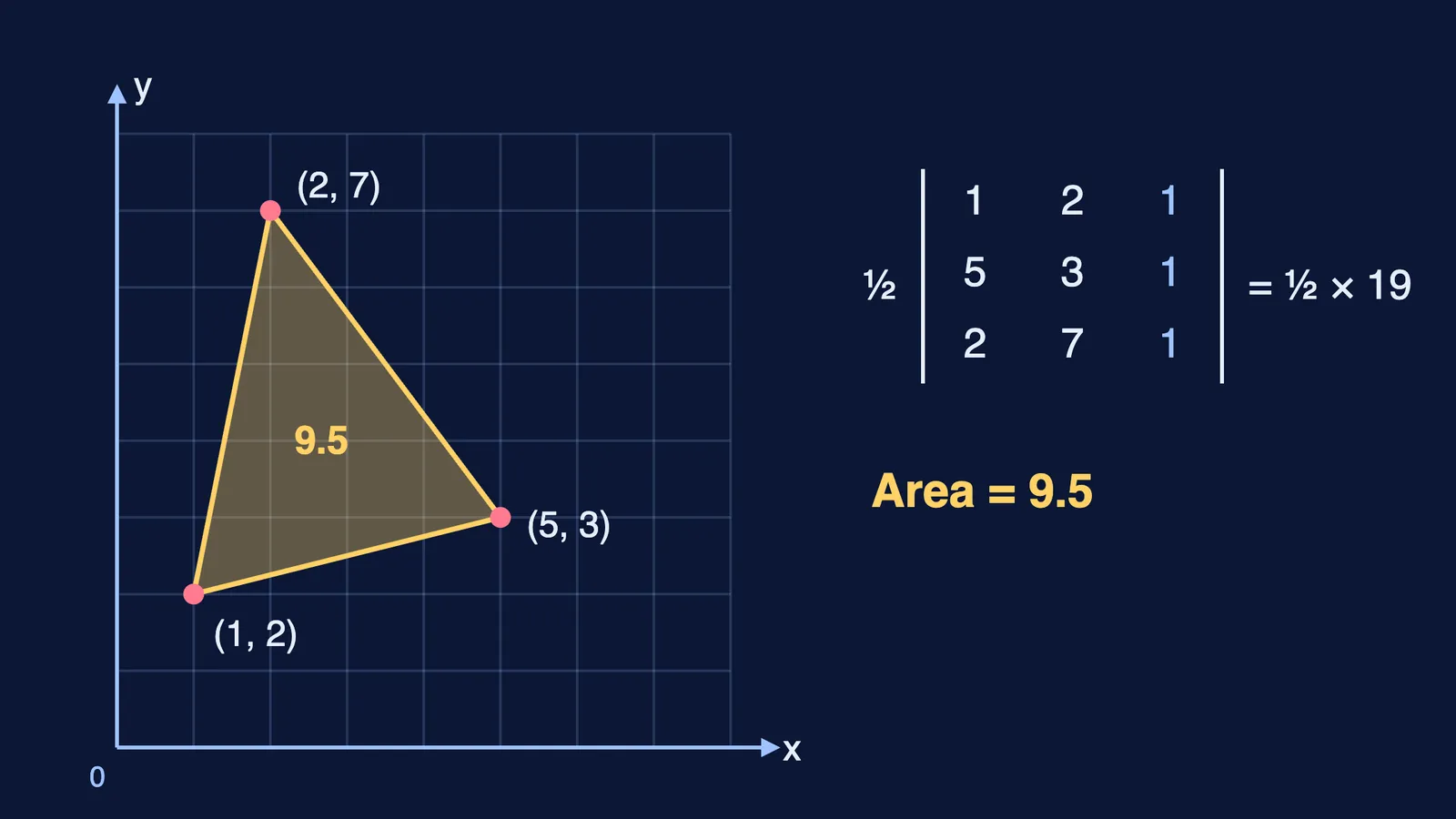
Area of a triangle with vertices (x₁, y₁), (x₂, y₂), (x₃, y₃): Δ = ½ × |det [x₁ y₁ 1; x₂ y₂ 1; x₃ y₃ 1]|. If the area is given, use both signs; collinear points give 0.
Example: expand [2 −1 3; 0 4 0; 1 5 −2] along R2 (two zeros): 4 × (2 × (−2) − 3 × 1) = −28. Triangle (1, 2), (5, 3), (2, 7): determinant 1(3 − 7) − 2(5 − 2) + 1(35 − 6) = 19, area 9.5 square units.
Watch for: cofactor signs run + − + / − + − / + − +; a minor in a − position needs its sign flipped.
How do you find the inverse of a matrix?
adj A = transpose of the cofactor matrix [Aᵢⱼ]. For 2 × 2: adj [a b; c d] = [d −b; −c a].
A(adj A) = (adj A)A = |A|I, for square A of order n.
B is the inverse of square A if AB = BA = I. Singular: |A| = 0. Non-singular: |A| ≠ 0.
A is invertible if and only if |A| ≠ 0; then A⁻¹ = (1/|A|) adj A, and it is unique.
(AB)⁻¹ = B⁻¹A⁻¹ and (A⁻¹)⁻¹ = A, for invertible A, B of the same order.
|adj A| = |A|ⁿ⁻¹ for order n; |A⁻¹| = 1/|A| when |A| ≠ 0.
Example: A = [3 5; 1 2]: |A| = 1, adj A = [2 −5; −1 3] = A⁻¹, and AA⁻¹ = I.
Watch for: the power is n − 1: a 3 × 3 matrix with |A| = 5 has |adj A| = 25.
How do you solve linear equations by the matrix method?
Write the system as AX = B (coefficient matrix, unknowns, constants). Consistent means a solution exists.
|A| ≠ 0: unique solution X = A⁻¹B.
|A| = 0 and (adj A)B ≠ O: no solution (inconsistent).
|A| = 0 and (adj A)B = O: infinitely many solutions or none.
Example: x + y + z = 6, 2x − y + 3z = 9, x + 2y − z = 2. |A| = 1(1 − 6) − 1(−2 − 3) + 1(4 + 1) = 5 and adj A = [−5 3 4; 5 −2 −1; 5 −1 −3], so X = (1/5)(5, 10, 15): x = 1, y = 2, z = 3.
Watch for: X = A⁻¹B, never BA⁻¹, which is not even defined.
How to revise this formula sheet
One card per formula, its condition on the back: same order, columns of A = rows of B, |A| ≠ 0.
Rework each example with one entry changed; check inverses by multiplying back to I.
Expand 3 × 3 determinants along the line with most zeros.
Practise the answer layout with our matrices and determinants board exam guide, then go further with the adjoint and inverse properties JEE tests.
If you cannot see where a solution went wrong, the Fermi Problem Library has worked problems with a step-by-step solver that explains the reasoning rather than printing an answer.