On this page
Eight new JEE Main-style questions, easy to hard. Each solution ends with the trap (the wrong option that looks most right) and a quick check.
What does JEE Main ask about complex numbers and quadratic equations?
The NTA's Syllabus for JEE (Main) 2027 puts Complex Numbers and Quadratic Equations in Unit 2: the a + ib form, the Argand diagram, modulus and argument, quadratics in real and complex numbers, roots and coefficients, nature of roots, and forming a quadratic from given roots.
How should you use this set?
Cover the solutions, commit to an option before reading the answer, and note the trap behind each miss.
Easy: the algebra, modulus and argument
Q1 (easy). (3 + 2i)/(1 − i) equals
(A) (1 + 5i)/2
(B) (5 + i)/2
(C) (5 + 5i)/2
(D) 1 + 5i
Answer: (A). Multiply top and bottom by 1 + i: (3 + 3i + 2i + 2i²)/2 = (1 + 5i)/2. Trap: (C) treats i² as +1. Check: (1 + 5i)(1 − i)/2 = (6 + 4i)/2 = 3 + 2i.
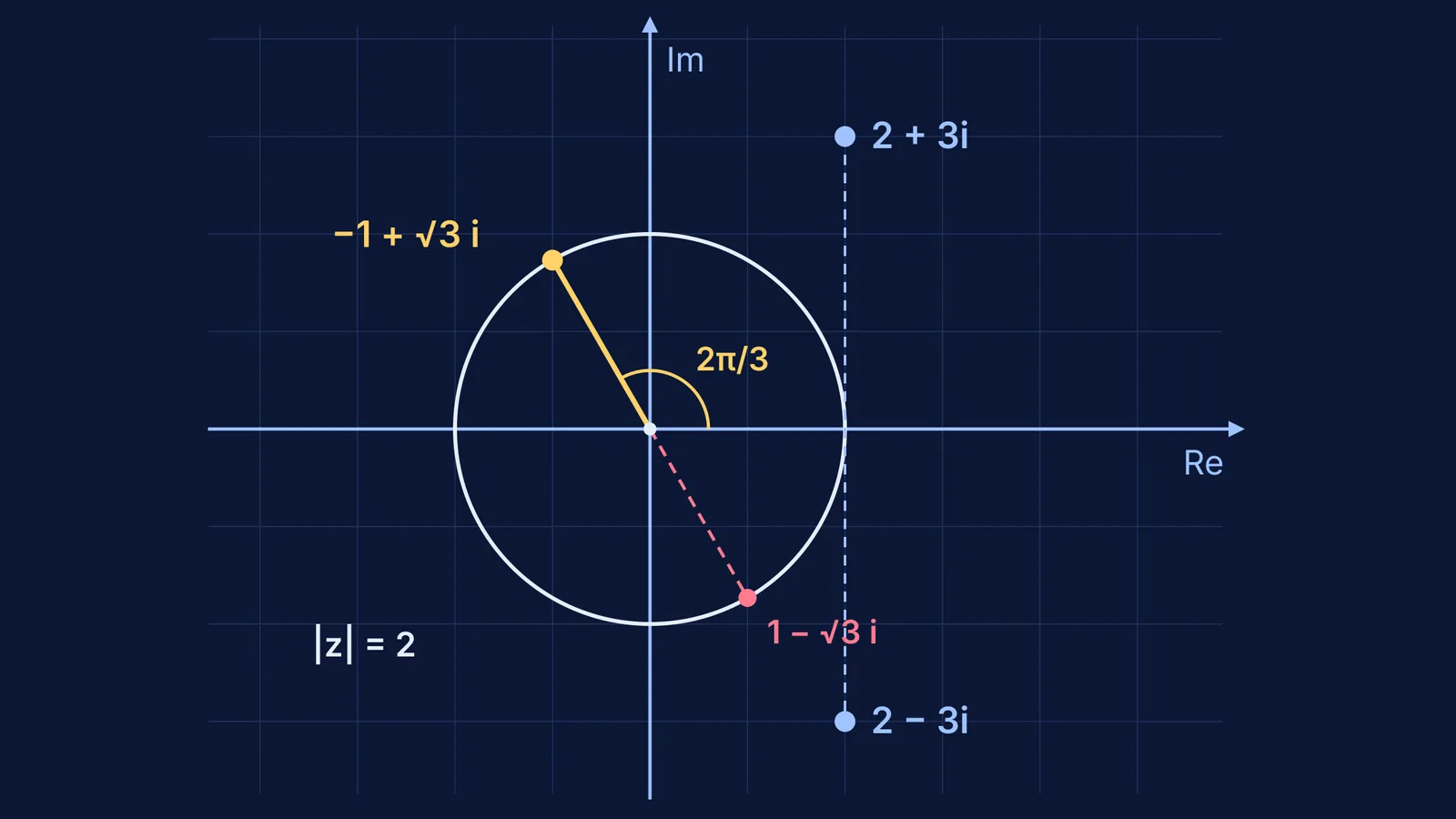
Q2 (easy). The modulus and principal argument of z = −1 + √3i are
(A) 2 and −π/3
(B) 2 and 2π/3
(C) 4 and 2π/3
(D) 2 and π/3
Answer: (B). |z| = √(1 + 3) = 2. The point (−1, √3) is in the second quadrant, so arg z = π − π/3 = 2π/3. Trap: (A) takes tan⁻¹(−√3) and ignores the quadrant; that angle points to 1 − √3i. Check: 2(cos 2π/3 + i sin 2π/3) = −1 + √3i.
Q3 (easy). The roots of x² − 4x + 13 = 0 are
(A) 2 ± 3i
(B) −2 ± 3i
(C) 4 ± 6i
(D) 2 ± 9i
Answer: (A). The discriminant is 16 − 52 = −36, so x = (4 ± 6i)/2 = 2 ± 3i. Trap: (C) forgets to divide by 2. Check: sum 4, product 4 + 9 = 13. See why complex roots mean no x-intercept.
Medium: Argand diagram, roots and coefficients
Q4 (medium). The locus of z with |z − 1| = |z + i| is
(A) the line y = x
(B) the line x + y = 0
(C) a circle through the origin
(D) the line x + y = 1
Answer: (B). z is equidistant from the points 1 and −i, so it lies on the perpendicular bisector. With z = x + iy: (x − 1)² + y² = x² + (y + 1)² gives −2x = 2y. Trap: (A) reads −i as the point (0, 1). Check: z = 1 − i gives |−i| = |1| = 1.
Q5 (medium). If α and β are the roots of 2x² − 6x + 3 = 0, then α² + β² equals
(A) 3
(B) 6
(C) 12
(D) 15/2
Answer: (B). α + β = 3 and αβ = 3/2, so α² + β² = 9 − 3 = 6. Trap: (A) takes the product as 3, forgetting to divide by 2. Check: the roots are (3 ± √3)/2, and their squares add to 24/4 = 6. A related shortcut: finding α − β without solving.
Q6 (medium). kx² + 6x + 1 = 0 has two distinct real roots exactly when
(A) k < 9
(B) k < 9 and k ≠ 0
(C) k ≤ 9
(D) k > 9
Answer: (B). Two distinct real roots need 36 − 4k > 0, so k < 9. But at k = 0 the equation is 6x + 1 = 0, with one root. Trap: (A) lets in k = 0. Check: k = 8 gives discriminant 4, two roots.
Hard: forming equations and mixing both ideas
Q7 (hard, numerical value). α and β are the roots of x² − 5x + 3 = 0. The quadratic with roots α/β and β/α is 3x² − kx + 3 = 0. Then k = ____.
Answer: 19. The new sum is (α² + β²)/αβ = (25 − 6)/3 = 19/3 and the new product is 1, so the equation is x² − (19/3)x + 1 = 0, or 3x² − 19x + 3 = 0. Trap: entering 22 means you wrote α² + β² = 25 − 3, dropping the 2 in (α + β)² − 2αβ.
Q8 (hard). The number of complex numbers z with z² + |z| = 0 is
(A) 1
(B) 2
(C) 3
(D) 4
Answer: (C). Put z = x + iy: the imaginary part gives 2xy = 0. If y = 0, x² + |x| = 0 forces x = 0. If x = 0, −y² + |y| = 0, so |y| = 0 or 1. The solutions are 0, i and −i. Trap: (B) drops z = 0. Check: i² + |i| = −1 + 1 = 0.
What should you do after this set?
Sort your misses by trap. For sign and quadrant slips (Q1, Q2, Q4), plot the point before calculating. For coefficient slips (Q5, Q7), write sum = −b/a and product = c/a first. For lost cases (Q6, Q8), check every branch, including zero. Then redo your misses later in the week. For higher powers of roots, see Newton's identities for power sums.
For the rest of the syllabus, Fermi Test Prep is our JEE Main and Advanced preparation. If one method keeps failing, the Fermi Problem Library has a step-by-step solver that explains the reasoning.