On this page
Graph y = x² − 4x + c and keep increasing c. The parabola rises, touches the x-axis once, and then lifts off completely. Once it lifts off, your textbook says the roots are complex. Here is what that means on the graph, and where the roots go.
What do complex roots mean on a graph?
The real roots of ax² + bx + c = 0 are the x-intercepts of the parabola y = ax² + bx + c. The discriminant, b² − 4ac, decides how many there are. As OpenStax College Algebra 2e puts it, "The discriminant tells us whether the solutions are real numbers or complex numbers, and how many solutions of each type to expect."
b² − 4ac > 0: two real roots; the parabola crosses the x-axis twice.
b² − 4ac = 0: one repeated real root; the vertex just touches the axis.
b² − 4ac < 0: no real roots; the parabola misses the axis, and the two roots are complex conjugates (Quadratic equation, Wikipedia).
So no x-intercept does not mean no answers. The roots exist; they are just not on the real number line.
What happens when you slide c?
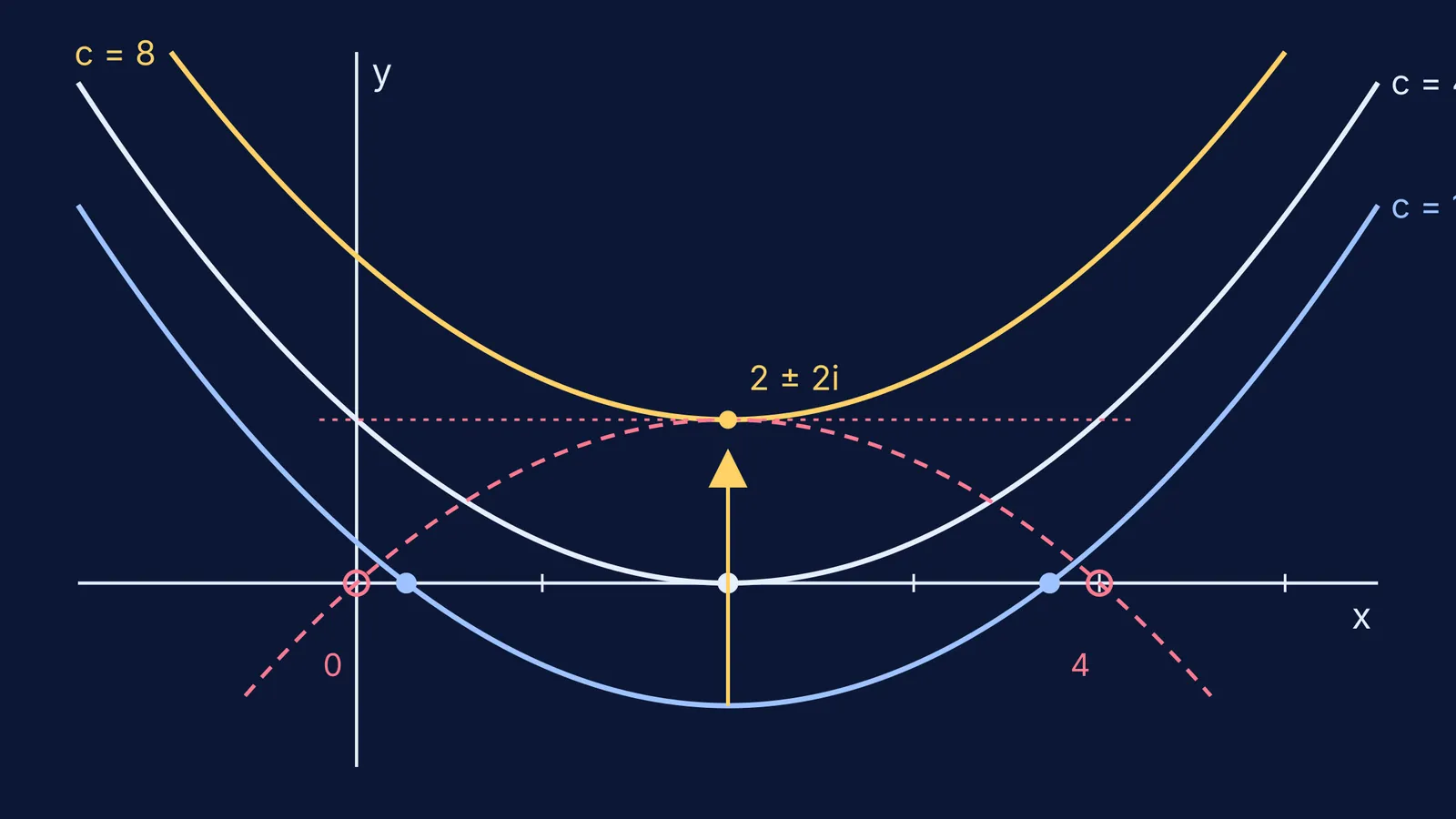
Take b = −4 and complete the square: x² − 4x + c = (x − 2)² + (c − 4). Changing c only moves the curve up or down. The vertex stays at x = 2 and sits at height c − 4. Try these:
c = 1: vertex (2, −3). Roots 2 ± √3, about 0.27 and 3.73.
c = 3: vertex (2, −1). Roots 1 and 3.
c = 4: vertex (2, 0). One repeated root, x = 2.
c = 5: vertex (2, 1). Discriminant −4. Roots 2 ± i.
c = 8: vertex (2, 4). Discriminant −16. Roots 2 ± 2i.
c = 13: vertex (2, 9). Discriminant −36. Roots 2 ± 3i.
While the vertex is below the axis, the roots sit √(4 − c) either side of x = 2. Once it rises above, the real part stays at 2 and the imaginary part grows as √(c − 4). The roots did not vanish; they turned a corner, off the real line. For the full formula working, see solving x² + x + 1 = 0 with complex roots.
For a general a, write a(x − h)² + k with h = −b/2a; when k/a is positive the roots are h ± i√(k/a), so the real part is still the vertex's x-coordinate (Quadratic equation, Wikipedia).
Where are the complex roots on the graph?
Reflect the lifted parabola in the horizontal line through its vertex. For y = (x − 2)² + 4, the mirror image is y = −(x − 2)² + 4, the dashed curve in the diagram above. It crosses the x-axis at x = 0 and x = 4, two units either side of the vertex. Those two units are the imaginary part of 2 ± 2i.
Why it works: the mirror curve meets the axis where (x − h)² = k, so x = h ± √k, the same √k that appears as the imaginary part. You can measure the complex roots with a ruler.
To plot the roots themselves, use the Argand plane: 2 + 2i and 2 − 2i sit at (2, 2) and (2, −2), mirror images across the real axis, as conjugate pairs always do. For a refresher on reading the parabola, try how to sketch a parabola from a quadratic equation.
How can you check this yourself?
A five-minute routine:
Take x² − 6x + 13 = (x − 3)² + 4. The vertex is 4 units above the axis at x = 3.
Predict the roots from the picture: 3 ± 2i.
Check with the formula: discriminant 36 − 52 = −16, so the roots are (6 ± 4i)/2 = 3 ± 2i.
Sketch the mirror parabola and confirm it crosses the axis at 1 and 5.
Slide c down to 9. The curve becomes (x − 3)², and the two roots merge at x = 3 before splitting into two real roots for any smaller c.
Step 5 is the equal-roots boundary; our guide to finding k for equal roots of a quadratic has worked examples.
A printed figure shows only one value of c; watching the curve move is what makes this click. The Fermi Simulation Lab has interactive simulations for ideas that are easier to see than to read. If a question still trips you up, the Fermi Problem Library has worked problems with a step-by-step solver that explains the reasoning rather than printing an answer.
Next time a parabola floats above the axis, find the vertex first: its x-coordinate and its height already tell you the roots.