On this page
In October 1819 a chemist who signed himself R. Porrett, Jun. published an analysis of the yellow salt we now write as K₄[Fe(CN)₆]·3H₂O. His numbers would only fit the atomic theory if the formula contained "the iron, as half an atom only". He called that a "palpable absurdity" and fixed it by halving the atomic weight of iron. He was wrong about the fix, but his analysis was honest, and the puzzle he hit is the same one you meet in Class 11 when Fe₃O₄ gives iron an oxidation number of 8/3.
Who was Porrett and what did he call ferrocyanide?
Robert Porrett had been analysing the prussiates (cyanide salts of iron) since at least 1814. He called the acid in them "chyazic" acid, a name that appears to be built from carbon, hydrogen and azote, the old name for nitrogen. Yellow prussiate of potash, today potassium hexacyanoferrate(II), was his "ferro-chyazate of potash".
His 1819 paper, "On Ferro-chyazate of Potash, and on the Atomic Weight for Iron", is in Annals of Philosophy, vol. 14, pp. 295–301. He went back to the bench after hearing that R. Phillips had found less iron in the salt than Porrett had assigned.
What did his 1819 analysis of yellow prussiate find?
He burned 25 grains of the salt with ammonium nitrate and weighed 4.5 grains of red iron oxide and 16.5 grains of potassium chloride from the residue. He then burned 1 grain with copper oxide and measured the gases: 1.79 cubic inches of carbon dioxide and 0.45 of nitrogen, "4 volumes" to "1". His final table for 100 grains:
Potash (K₂O): 41.68
Iron: 12.60
Carbon: 22.64
Azote (nitrogen): 13.32
Hydrogen: 0.80
Water: 13.00
Total: 104.04
He blamed the extra 4 grains on "the unavoidable inaccuracies" of working with small samples.
Worked example 1: how good was his analysis?
Molar mass of K₄[Fe(CN)₆]·3H₂O = 4(39.10) + 55.85 + 6(12.01 + 14.01) + 3(18.02) ≈ 422.4 g mol⁻¹.
Fe: 55.85 ÷ 422.4 = 13.22%. He found 12.60.
Water: 54.05 ÷ 422.4 = 12.80%. He found 13.00. Very close.
Potassium reported as K₂O: 2 × 94.20 ÷ 422.4 = 44.60%. He found 41.68.
His conversions hold up with modern masses. Fe in 4.5 grains of Fe₂O₃ = 4.5 × 111.7 ÷ 159.7 = 3.147, and × 4 gives 12.59. K₂O from 16.5 grains of KCl = 16.5 × 94.20 ÷ 149.10 = 10.42, and × 4 gives 41.70.
Mole ratio from his numbers. K = 41.68 × 78.20 ÷ 94.20 = 34.60 g, so 34.60 ÷ 39.10 = 0.885 mol. Fe = 12.60 ÷ 55.85 = 0.226 mol. K : Fe = 3.92 : 1.
That is 4 : 1, the right answer. His carbon and nitrogen were off (8.35 and 4.21 per iron against a true 6 and 6), and the salt has no hydrogen outside its water. Writing potassium as K₂O also inflates the total. Even the true salt adds up to 107.6% if you book it as K₂O + Fe + C + N + H₂O, because K₂O carries oxygen the salt does not contain.
Why did his numbers force "half an atom" of iron?
Porrett used a scale with oxygen = 10, on which iron was 35 and potash 60. Divide his masses by those weights: 41.68 ÷ 60 = 0.695 potash and 12.60 ÷ 35 = 0.360 iron. That is 1.93 potash per iron, so one potash for every half atom of iron. His corrected formula had 1 potash, ½ iron, 4 carbon, 1 azote, 1 hydrogen and 2 water.
He saw two ways out. He could multiply every atom by 2, or he could decide that 35 was double the true weight of iron. He rejected doubling, and wrote that he had "no hesitation" in taking iron as 17.5.
Doubling was the right choice. Iron is 55.85 on O = 16, which is 34.9 on his O = 10 scale. His rejected 35 was correct. The modern formula simply has 4 K per Fe, which is his ratio with the fraction cleared.
How did magnetite seem to support him?
His strongest support was the black oxide that Berzelius called "oxydum ferroso ferricum" and that Gay-Lussac made "by passing the vapour of water over red-hot iron":
3Fe + 4H₂O → Fe₃O₄ + 4H₂
(Check: 3 Fe, 8 H and 4 O on each side.)
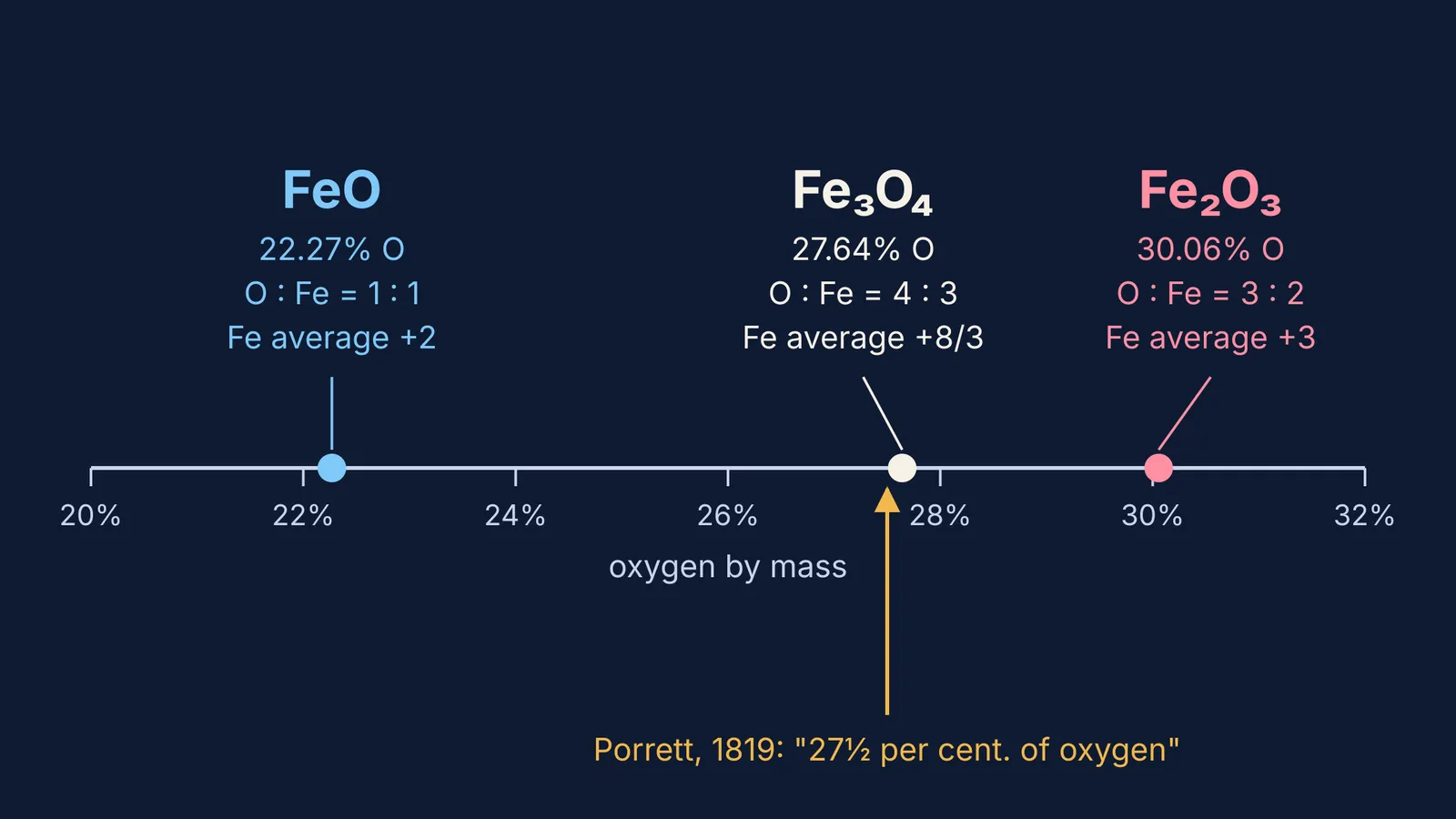
This oxide, he wrote, "contains 27½ per cent. of oxygen". With iron at 35 it needs "1⅓" atoms of oxygen per iron, and with iron at 70 it needs "2⅔". Neither is whole. With iron at 17.5 it becomes 3 iron + 2 oxygen = 72.5, which is 27.6% oxygen, all in whole atoms.
He also dismissed the idea of treating it as "one atom protoxide with two atoms peroxide", calling it one of those "ingenious expedients" that "will doubtless be abandoned".
When the paper was reprinted in French in the Annales de chimie et de physique, vol. 12 (1819), pp. 378–387, an unsigned footnote, presumably from the editors Gay-Lussac and Arago, was added at the end of that paragraph: "M. Porrett n'a pas saisi la difficulté", or "Mr Porrett has not grasped the difficulty".
Worked example 2: Fe₃O₄ and the average oxidation number
% O in Fe₃O₄ = 4(16.00) ÷ [3(55.85) + 4(16.00)] = 27.64%. Porrett's 27½ was right.
Compare FeO at 22.27% and Fe₂O₃ at 30.06%. Fe₃O₄ sits between them.
Oxidation number from the formula: 3x + 4(−2) = 0, so x = +8/3, about +2.67.
From the structure: Fe₃O₄ = FeO·Fe₂O₃, one Fe²⁺ and two Fe³⁺. Average = (2 + 3 + 3) ÷ 3 = 8/3.
The "expedient" he mocked is the NCERT answer. A fraction is fine as an average over different iron atoms. It is never fine for a single atom. For more such cases, see oxidation numbers from structure in Fe₃O₄, S₄O₆²⁻ and CrO₅.
What is the oxidation state of iron in K₄[Fe(CN)₆]?
Worked example 3
K is +1 and each cyanide is −1.
4(+1) + x + 6(−1) = 0.
x = +2. Iron is Fe(II), and the complex ion is [Fe(CN)₆]⁴⁻.
Here there is no fraction, because every iron is the same. The step-by-step method for any complex is in how to find oxidation state and coordination number in a complex. If you want to practise ratio-to-formula problems like Porrett's, try empirical and molecular formulas from percentage data, and the Fermi Problem Library has a step-by-step solver that explains the reasoning at each stage.
Where does this come up in JEE and NEET?
Class 11, Some Basic Concepts of Chemistry: percentage composition and mole ratios from mass data.
Class 11, Redox Reactions: fractional oxidation numbers, with Fe₃O₄ as the standard example.
Class 12, Coordination Compounds: oxidation state of the metal in K₄[Fe(CN)₆] and its IUPAC name.
For timed practice on these chapters, Fermi Test Prep covers JEE Main and Advanced preparation with an AI tutor.
Quick checklist
A whole-number formula comes from mole ratios. Divide by the smallest and clear any fraction by multiplying, never by changing an atomic mass.
K₄[Fe(CN)₆]·3H₂O: M ≈ 422.4, Fe 13.22%, water 12.80%, Fe is +2.
Fe₃O₄: 27.64% O, average oxidation number +8/3, made of one Fe²⁺ and two Fe³⁺.
A fractional oxidation number is an average. Atoms come whole.