On this page
In November 1819 Henri Braconnot, a chemist in Nancy, told the local Société royale académique that he had turned old hemp linen into a crystalline sugar. He expected laughter at the claim that "une livre de chiffons de linge peut être transformée en plus d'une livre de sucre" (a pound of linen rags can become more than a pound of sugar), "mais le résultat n'en sera pas moins réel" (but the result will be no less real). Three months later the same treatment turned glue into a sweet crystalline solid, sugar of gelatine. That was glycine. Both papers are in the Annales de chimie et de physique, volumes 12 (1819, pp. 172–195) and 13 (1820, pp. 113–125), scanned at the Internet Archive (volume 12, volume 13). Translations are ours.
What did Braconnot do to old linen in 1819?
Hornbeam sawdust blackened and gave off sulphur dioxide, so he switched to worn hemp cloth, which he treated as "une matière ligneuse pure" (a pure woody matter). Today we would call it nearly pure cellulose. Concentrated sulphuric acid turned it into a thick, almost colourless mucilage. Diluted and neutralised with chalk, this gave a gum. Diluted and boiled for about ten hours before neutralising, it gave a syrup that crystallised into a sugar.
With a little yeast the sugar fermented, and the liquid gave alcohol on distillation. His verdict: it was "parfaitement identique avec le sucre de raisin ou d'amidon", perfectly identical with grape sugar or starch sugar. Both are glucose.
How can a pound of rags give more than a pound of sugar?
Because hydrolysis adds water. This is the NCERT equation for breaking a polysaccharide into glucose:
(C₆H₁₀O₅)ₙ + nH₂O → nC₆H₁₂O₆
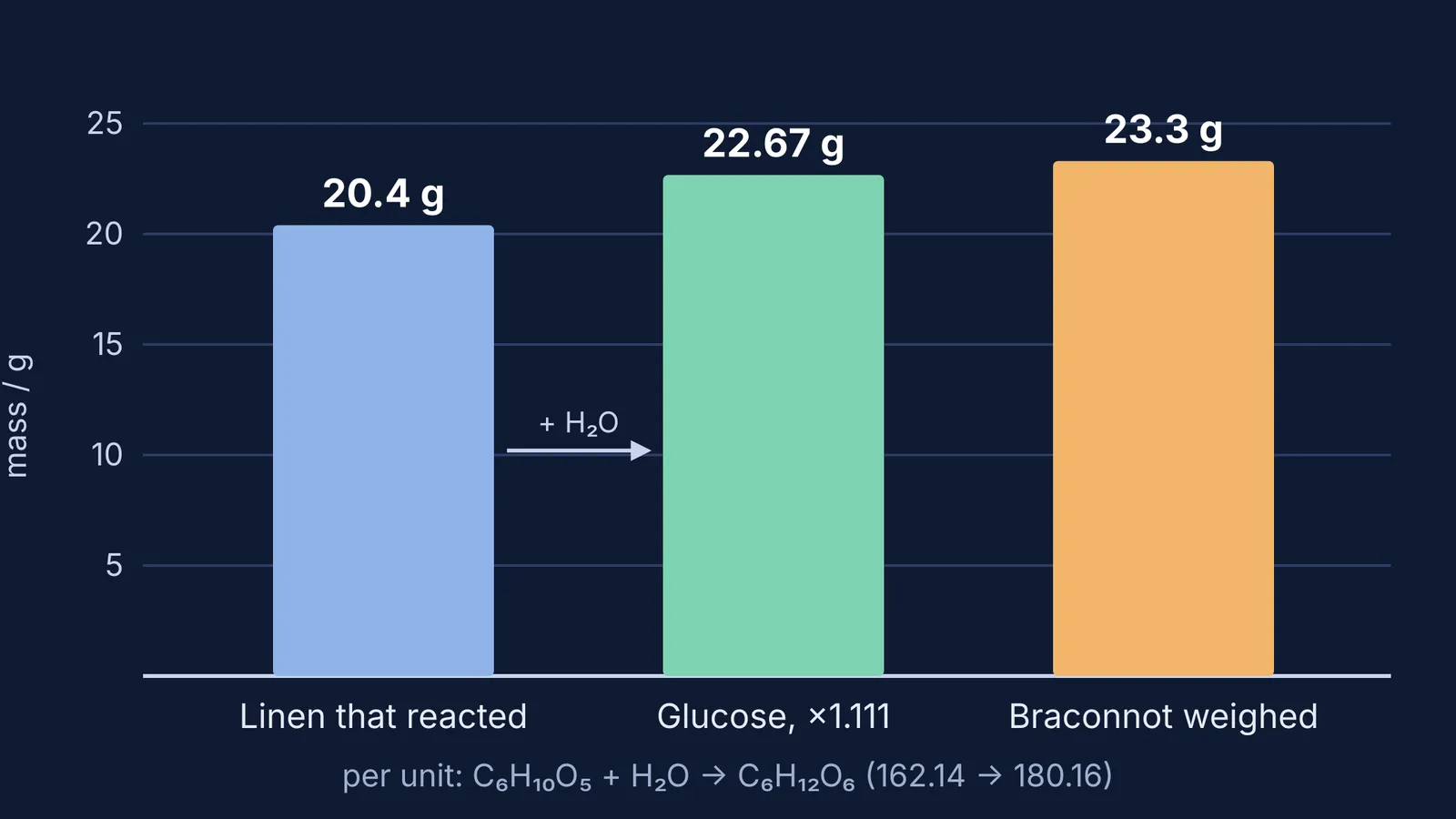
Each anhydroglucose unit, C₆H₁₀O₅ (162.14 g/mol), picks up one H₂O and becomes C₆H₁₂O₆ (180.16 g/mol). So the mass rises by a factor of 180.16 ÷ 162.14 = 1.111. A pound of pure cellulose can give up to 1.11 pounds of glucose, so his claim was right. The same factor is used in a modern setting in how much ethanol a tonne of rice straw can give.
He even guessed why. Wood, he wrote, seems to be gum or mucilage "moins de l'oxigène et de l'hydrogène dans les proportions pour faire l'eau", minus oxygen and hydrogen in the proportions that make water. That is the condensation idea behind every glycosidic bond you draw in sucrose, starch and cellulose: joining two sugar units removes one H₂O, and hydrolysis puts it back.
Worked example: did Braconnot get more sugar than theory allows?
His sugar run, from page 182:
24 g of worn linen, well dried.
3.6 g of it stayed unattacked and was weighed separately.
Dried "jusqu'au point qu'il a commencé à répandre une odeur de caramel" (until it began to smell of caramel), the sugary mass weighed 23.3 g.
Linen that reacted: 24 − 3.6 = 20.4 g.
Treat it as cellulose. Moles of C₆H₁₀O₅ units = 20.4 ÷ 162.14 = 0.1258 mol.
Theoretical glucose: 0.1258 × 180.16 = 22.67 g. The quick way is 20.4 × 1.111 = 22.67 g.
Compare: 23.3 ÷ 22.67 = 1.028. His mass is about 2.8% above theory.
Interpret. No reaction gives more than 100% of a pure product, so the 23.3 g was not pure glucose. It most likely still held calcium salts and his "acide végéto-sulfurique", an acid he found alongside the sugar. That reading is ours; he himself suspected he had lost some sugar. Either way, the result sits close to the 1.111 ceiling, which is what makes it convincing.
Then the fermentation he used as a test: C₆H₁₂O₆ → 2C₂H₅OH + 2CO₂. Check the atoms: C 6 = 4 + 2, H 12 = 12, O 6 = 2 + 4.
What did his gum balance show?
From 21.5 g of dry linen (25 g, less 1 g of moisture and 2.5 g unattacked) he got 26.2 g of gum, and analysed 5 g of it to explain the gain.
Lime: oxalic acid precipitated 0.28 g of lime (CaO). Scaled up: 0.28 × 26.2 ÷ 5 = 1.47 g.
Sulphuric acid: the residue gave 1.6 g of barium sulphate, which he said holds 0.54 g of "acide sulfurique". In modern terms that is SO₃: 1.6 × 80.06 ÷ 233.39 = 0.549 g. His 0.54 scaled to 26.2 g gives 2.83 g, the figure he printed.
Water: whatever is left. 26.20 − 21.50 − 2.83 − 1.47 = 0.40 g.
His table: woody matter 21.50 + "elements of sulphuric acid" 2.83 + "elements of water" 0.40 + combined lime 1.47 = 26.20 g. The water line is the balancing figure, not a measurement. The gum still carried sulphur and calcium.
What was the sugar of gelatine?
In February 1820 he treated commercial glue with concentrated sulphuric acid, then diluted the mixture and boiled it for hours. The syrup took about a month to crystallise. The crystals were "croquant sous la dent comme du sucre candi" (crunchy like sugar candy) and about as sweet as grape sugar. But three of his own tests show it was not a sugar:
With yeast it gave "aucun indice de fermentation", no sign of fermentation.
On distillation it gave an ammoniacal product, "d'où il résulte qu'il contient de l'azote", from which it follows that it contains nitrogen.
Nitric acid did not destroy it. It formed a crystalline "acide nitro-saccharique" that dissolved chalk with effervescence and whose potash salt detonated on hot coals like saltpetre.
Sugar of gelatine was glycine, H₂N–CH₂–COOH (C₂H₅NO₂, 75.07 g/mol): C 32.0%, H 6.71%, N 18.66%. Acid hydrolyses a protein into its amino acids, just as it hydrolyses cellulose into glucose. It is often called the first amino acid obtained from a protein; we have not checked that priority claim. His nitro-saccharic acid is often read as glycine nitrate, a salt formed by the basic –NH₂ group (see amino acids as zwitterions). We could not confirm that from a primary source; Braconnot thought it a combination of the sugar with nitric acid.
He concluded that this sugar "n'existe vraisemblablement pas dans la nature" (probably does not exist in nature). It was there all along, built into the protein. The same paper names a white substance from beef muscle fibre and wool "leucine (λευκός, blanc)", another amino acid.
Why is glycine the odd one out?
Glycine's α-carbon carries two hydrogens, so it has no stereocentre and is the only standard amino acid that is not optically active; see why glycine is not optically active. Leucine, like the rest, has four different groups on its α-carbon.
If you want more yield and percentage-composition problems worked one step at a time, the Fermi Problem Library has a step-by-step solver that explains the reasoning.
Where does this sit in your syllabus?
Class 12 Biomolecules: polysaccharide hydrolysis, fermentation, amino acids from proteins, glycine as the achiral amino acid.
Class 11 Some Basic Concepts of Chemistry: theoretical yield and percentage composition.
Quick checklist
Hydrolysis adds water: C₆H₁₀O₅ unit (162) → C₆H₁₂O₆ (180), a factor of 1.111.
Braconnot's 20.4 g of linen could give at most 22.67 g of glucose; his 23.3 g was impure, as a yield over 100% always is.
His sugar fermented to alcohol; sugar of gelatine did not, and it contained nitrogen.
Sugar of gelatine is glycine, C₂H₅NO₂: C 32.0%, N 18.66%, and no stereocentre.
For JEE Main and Advanced revision of Biomolecules, Fermi Test Prep is test prep for both exams with an AI tutor.