

On this page
Every October, after the rice harvest in Punjab and Haryana, fields are cleared by burning the leftover straw, called parali. The smoke is one of several sources behind why North India's winter smog is so bad. Indian Oil's second-generation (2G) ethanol plant at Panipat was built to turn some of that straw into fuel instead. The chemistry behind it is the carbohydrate chapter you already study, plus a yield calculation that shows why this is much harder than making ethanol from sugar.
What is 2G ethanol, and how is it different from E20 ethanol?
Most ethanol blended into Indian petrol today comes from sugarcane juice, molasses and grain, as what E20 petrol is and why ethanol is added explains. That is first-generation (1G) ethanol: the feedstock is sugar or starch that people or animals could also eat.
Second-generation ethanol uses the inedible parts of plants: straw, stalks, husks and other crop residues. The Panipat plant was dedicated on 10 August 2022. According to the Press Information Bureau release, Indian Oil built it for an estimated cost of over ₹900 crore, and it is designed to use about 2 lakh tonnes of rice straw a year to make about 3 crore litres of ethanol a year. Those are design figures; the release does not report actual output.
The government supports such plants through the Pradhan Mantri JI-VAN Yojana, first notified in March 2019. In August 2024 the Cabinet extended it to 2028-29 and widened it to advanced biofuels from agricultural and forestry residues and other feedstocks, according to the Prime Minister's Office release.
What is rice straw made of?
Rice straw is lignocellulose: three polymers locked together, plus a lot of silica-rich ash.
Cellulose: long chains of glucose joined by β-1,4 glycosidic bonds. The chains pack tightly and hydrogen-bond to each other, which makes them hard to break.
Hemicellulose: shorter, branched chains. In straw it is mostly xylan, a polymer of xylose, a five-carbon sugar (a pentose, C₅H₁₀O₅).
Lignin: a cross-linked aromatic polymer that is not a sugar at all. It wraps the other two and blocks enzymes.
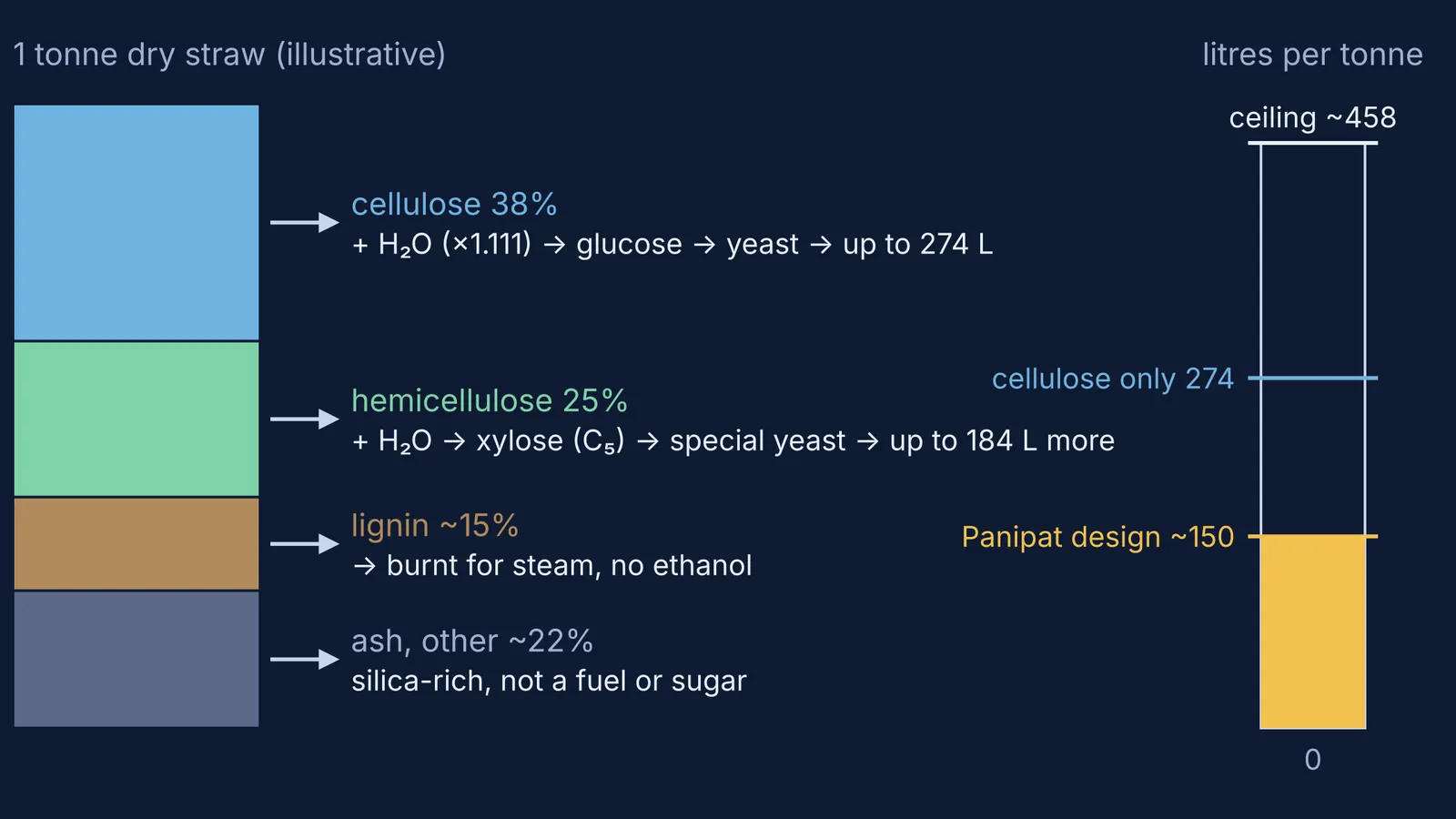
How much of each depends on variety, season and place. A 2023 review in BioResources gives cellulose 33 to 47%, hemicellulose 19 to 27% and lignin 5 to 27%, plus silica. The worked example below uses 38% cellulose and 25% xylan as an illustrative split inside those ranges, not a measured sample.
Why can't yeast ferment straw directly?
Yeast can only ferment simple sugars. Cellulose must first be hydrolysed back to glucose, the same β-1,4 bond your own body cannot break. For the difference between α and β links, see reading glycosidic links in starch and cellulose.
A 2G plant does this in two stages. A pretreatment (heat, steam, sometimes dilute acid) opens up the lignin and loosens the cellulose. Then cellulase enzymes cut the chains into glucose:
(C₆H₁₀O₅)ₙ + nH₂O → nC₆H₁₂O₆
Notice that water joins every glucose unit. Each unit in the chain weighs 162.14 g/mol, and free glucose weighs 180.16 g/mol, so 1 kg of cellulose gives 180.16 / 162.14 = 1.111 kg of glucose. Then yeast does the familiar step:
C₆H₁₂O₆ → 2C₂H₅OH + 2CO₂
The second problem is xylose. Ordinary baker's yeast (Saccharomyces cerevisiae) cannot ferment it, so unless the plant uses engineered or special strains, the hemicellulose sugar is left behind. Lignin cannot be fermented at all; plants usually burn it to raise steam.
How much ethanol can one tonne of straw give? A worked example
Take 1 tonne of dry straw with the illustrative 38% cellulose and 25% xylan. Molar masses: C₆H₁₂O₆ 180.16, C₂H₅OH 46.07, xylan unit C₅H₈O₄ 132.12, xylose 150.13 g/mol. Ethanol density 0.789 g/mL.
Part (a): cellulose only.
Cellulose: 0.38 × 1000 kg = 380 kg.
Glucose after hydrolysis: 380 × 180.16 / 162.14 = 422 kg.
Ethanol per gram of glucose: 2 × 46.07 / 180.16 = 0.511 g.
Ethanol: 422 × 0.511 = 216 kg.
Volume: 216 kg ÷ 0.789 kg/L = 274 L.
Mass check: 422 kg of glucose gives 216 kg ethanol and 206 kg CO₂, which add back to 422 kg.
Part (b): if the xylan is fermented too.
Xylan: 250 kg. Hydrolysis adds water: 250 × 150.13 / 132.12 = 284 kg of xylose.
Balanced fermentation: 3C₅H₁₀O₅ → 5C₂H₅OH + 5CO₂. Check C: 15 = 10 + 5. H: 30 = 30. O: 15 = 5 + 10.
Ethanol per gram of xylose: 5 × 46.07 / (3 × 150.13) = 0.511 g, the same as glucose.
Ethanol: 284 × 0.511 = 145 kg, or 145 ÷ 0.789 = 184 L.
Theoretical ceiling for this straw: 274 + 184 = about 458 L per tonne.
Part (c): compare with the plant's design figure.
Design: 3 crore L ÷ 2 lakh t = 30,000,000 ÷ 200,000 = 150 L per tonne.
As a fraction of the ceiling: 150 ÷ 458 = about 33%, roughly one-third.
Where does the rest of the ethanol go?
The two-thirds gap is not a mistake in the plant or in the sum. It is the difference between a theoretical yield and an actual one, and you can list the losses yourself.
Unconverted cellulose. Enzymes do not reach every chain; some stays locked in lignin.
Unfermented xylose. If the yeast cannot use pentoses, most of the 184 L in part (b) is never made.
Sugar destroyed in pretreatment. Hot acidic conditions turn some xylose into furfural and some glucose into hydroxymethylfurfural, which also slow the yeast.
Yeast growth. Yeast uses part of the sugar to make more yeast and other products, not ethanol.
Moisture and ash. A tonne of straw as delivered includes water and silica, so it holds less sugar than a tonne of dry straw.
This does not settle whether 2G ethanol solves stubble burning. Collection, storage and cost matter as much as chemistry, and whether it lowers total greenhouse emissions needs a life-cycle study, not a stoichiometry sum. The chemistry tells you the upper limit.
If converting polymer mass to monomer mass keeps tripping you up, the Fermi Problem Library has a step-by-step solver that explains the reasoning at each stage of a yield problem.
Quick checklist
2G ethanol comes from crop residues; 1G from sugar, molasses and grain.
Straw = cellulose (glucose, β-1,4) + hemicellulose (mostly xylose) + lignin + ash.
Hydrolysis adds water: × 1.111 for cellulose to glucose, × 1.136 for xylan to xylose.
Both glucose and xylose give at most 0.511 g ethanol per g sugar.
Illustrative ceiling: about 458 L per tonne; Panipat design: about 150 L per tonne.
Ordinary yeast cannot ferment xylose; lignin is burnt for steam.


