On this page
These eight questions follow Unit 7 (limit, continuity and differentiability) of the JEE Main 2027 syllabus published by NTA, which also lists derivatives of order up to two and their applications: rate of change, increasing and decreasing functions, and maxima and minima. For the topic plan, read how to prepare limits, continuity and differentiability for JEE Main.
How do you solve JEE Main limit and continuity questions?
Q1 (easy). Find lim x→0 (1 − cos 4x)/x². (a) 4 (b) 8 (c) 16 (d) 2.
Solution: 1 − cos 4x = 2 sin² 2x, so the expression is 2(sin 2x / x)², which tends to 2 × 2² = 8. Answer (b).
Trap: (c) replaces 1 − cos 4x with (4x)² and drops the half. Check: at x = 0.01 the expression is about 7.999.
Q2 (easy). Find lim x→∞ (1 + 3/x)^(2x). (a) 1 (b) e³ (c) e⁶ (d) 6.
Solution: this is the 1^∞ form, so the limit is e raised to lim 2x × (3/x) = 6. Answer (c).
Trap: (a) treats the base as exactly 1, though it only approaches 1 while the power grows. Check: at x = 1000 the value is about 400; e⁶ is about 403.
Q3 (easy). f(x) = (e^(2x) − 1)/x for x ≠ 0 and f(0) = k. If f is continuous at 0, k is: (a) 1 (b) 2 (c) 1/2 (d) 0.
Solution: k must equal the limit. Write the expression as 2 × (e^(2x) − 1)/(2x); the fraction tends to 1, so k = 2. Answer (b).
Trap: (a) uses the standard limit without the factor 2. Check: at x = 0.001 the expression is about 2.002.
How do you check differentiability at a point?
Q4 (medium). f(x) = (x − 1)|x − 1| + |x − 3|. At how many points is f not differentiable? (a) 0 (b) 1 (c) 2 (d) 3.
Solution: g(x) = (x − 1)|x − 1| is (x − 1)² for x ≥ 1 and −(x − 1)² for x < 1. Its derivative is 2|x − 1| on both sides, which is 0 at x = 1, so g is smooth there. The term |x − 3| makes a corner: the left derivative of f at 3 is 4 − 1 = 3, the right derivative is 4 + 1 = 5. Answer (b), only x = 3.
Trap: (c) assumes every modulus makes a corner. A modulus multiplied by a factor that vanishes at the same point does not. Check: compare one-sided slopes at each suspect point. For the extreme case, see Weierstrass's function, continuous everywhere but differentiable nowhere.
How do you differentiate inverse trigonometric and implicit functions?
Q5 (medium). y = tan⁻¹(2x/(1 − x²)) for |x| < 1. Find dy/dx at x = 1/2. (a) 4/5 (b) 8/5 (c) 2/5 (d) 16/5.
Solution: put x = tan θ. Then y = 2θ = 2 tan⁻¹ x on this interval, so dy/dx = 2/(1 + x²) = 2/(5/4) = 8/5. Answer (b).
Trap: (a) forgets the 2 and differentiates tan⁻¹ x. Check: the quotient rule on 2x/(1 − x²) is slower but also gives 8/5.
Q6 (medium). On x² + y² = 25, find d²y/dx² at (3, 4). (a) −1/4 (b) −25/64 (c) −3/4 (d) 25/64.
Solution: dy/dx = −x/y = −3/4. Differentiating again, d²y/dx² = −(y − x·dy/dx)/y² = −(4 + 9/4)/16 = −25/64. Answer (b).
Trap: (a) differentiates −x/y as if y were constant. Check: y = √(25 − x²) gives d²y/dx² = −25/(25 − x²)^(3/2) = −25/64.
How do you solve maxima and monotonicity questions?
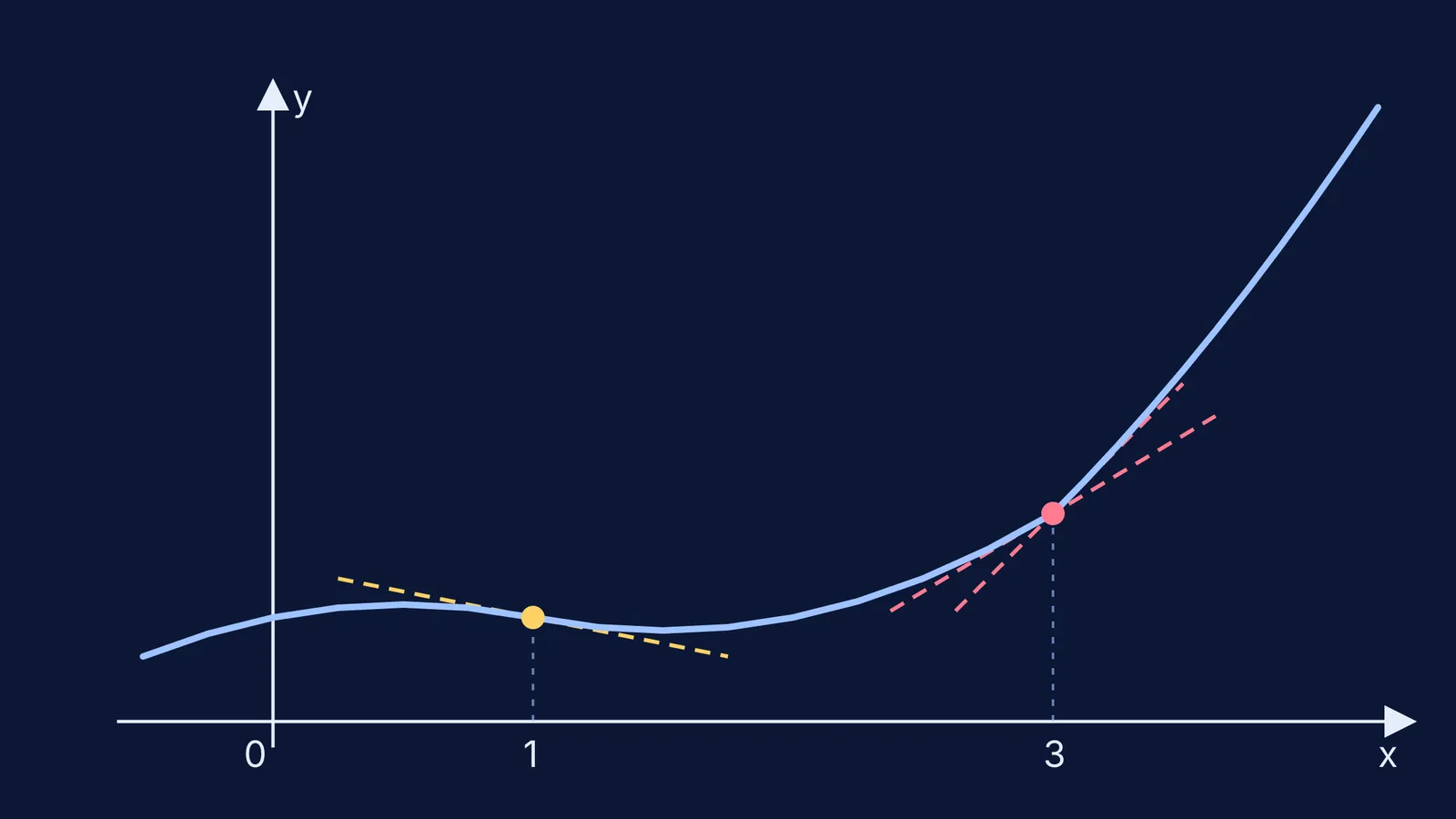
Q7 (hard). Find the absolute maximum of f(x) = x³ − 6x² + 9x + 1 on [0, 5]. (a) 5 (b) 21 (c) 1 (d) 9.
Solution: f′(x) = 3(x − 1)(x − 3). Compare critical points and endpoints: f(0) = 1, f(1) = 5, f(3) = 1, f(5) = 21. Answer (b).
Trap: (a) is only the local maximum; on a closed interval the endpoints compete too.
Q8 (hardest). For which a is f(x) = x³ + ax² + 3x + 5 increasing for all real x? (a) (−3, 3) (b) [−3, 3] (c) (−∞, −3] ∪ [3, ∞) (d) [0, 3].
Solution: we need f′(x) = 3x² + 2ax + 3 ≥ 0 for every x, so the discriminant 4a² − 36 ≤ 0, giving −3 ≤ a ≤ 3. Answer (b).
Trap: (a) demands f′ > 0 strictly and drops the endpoints. Check: at a = 3, f(x) = (x + 1)³ + 4, which is increasing even though f′(−1) = 0.
How should you use this set in revision?
Attempt all eight cold, with a timer, and note how sure you were of each answer.
Label every miss by its trap: a dropped factor (Q1, Q3, Q5), the wrong form (Q2), the wrong rule (Q4, Q6, Q8) or stopping early (Q7).
Redo the missed ones a few days later without looking at the solutions.
Add a rate-of-change question of your own; the syllabus lists it in the same unit.
If the same wrong step keeps coming back, the Fermi Problem Library has worked problems with a step-by-step solver that explains the reasoning rather than printing an answer. For an idea stronger than continuity at a point, read uniform continuity explained.
For the rest of your JEE Main and Advanced preparation, see Fermi Test Prep.