On this page
Camphor tablets bought for a puja look and smell much the same whatever their source. Yet the Indian standard for camphor, IS 3584:2007, insists that every container say whether the camphor inside is natural or synthetic. Only one test in its requirements table can tell the two apart: optical rotation. The reason is a neat piece of Class 12 stereochemistry, and it ends with a stereoisomer count where the 2ⁿ rule gives the wrong answer.
What does the BIS standard say about natural and synthetic camphor?
The full text of IS 3584:2007, Camphor: Specification is on the Internet Archive. The parts that matter:
Two grades, pure and technical. Technical camphor "shall be only the synthetic product". Pure camphor may be natural or synthetic.
Labelling. The source, natural or synthetic, and the grade "shall be marked on each container".
Where each comes from. The foreword says natural camphor is obtained from oil of camphor (from the camphor tree, Cinnamomum camphora) or from an Ocimum oil, by congealing, filtering, fractional distillation, pressing and sublimation. Synthetic camphor "is usually obtained from alpha-pinene".
Table 1 for the pure grade: melting range 174 to 179 °C, at least 96% camphor by gas chromatography (GC), and non-volatile matter at most 0.05%. The technical grade is allowed 165 to 179 °C and at least 90% camphor.
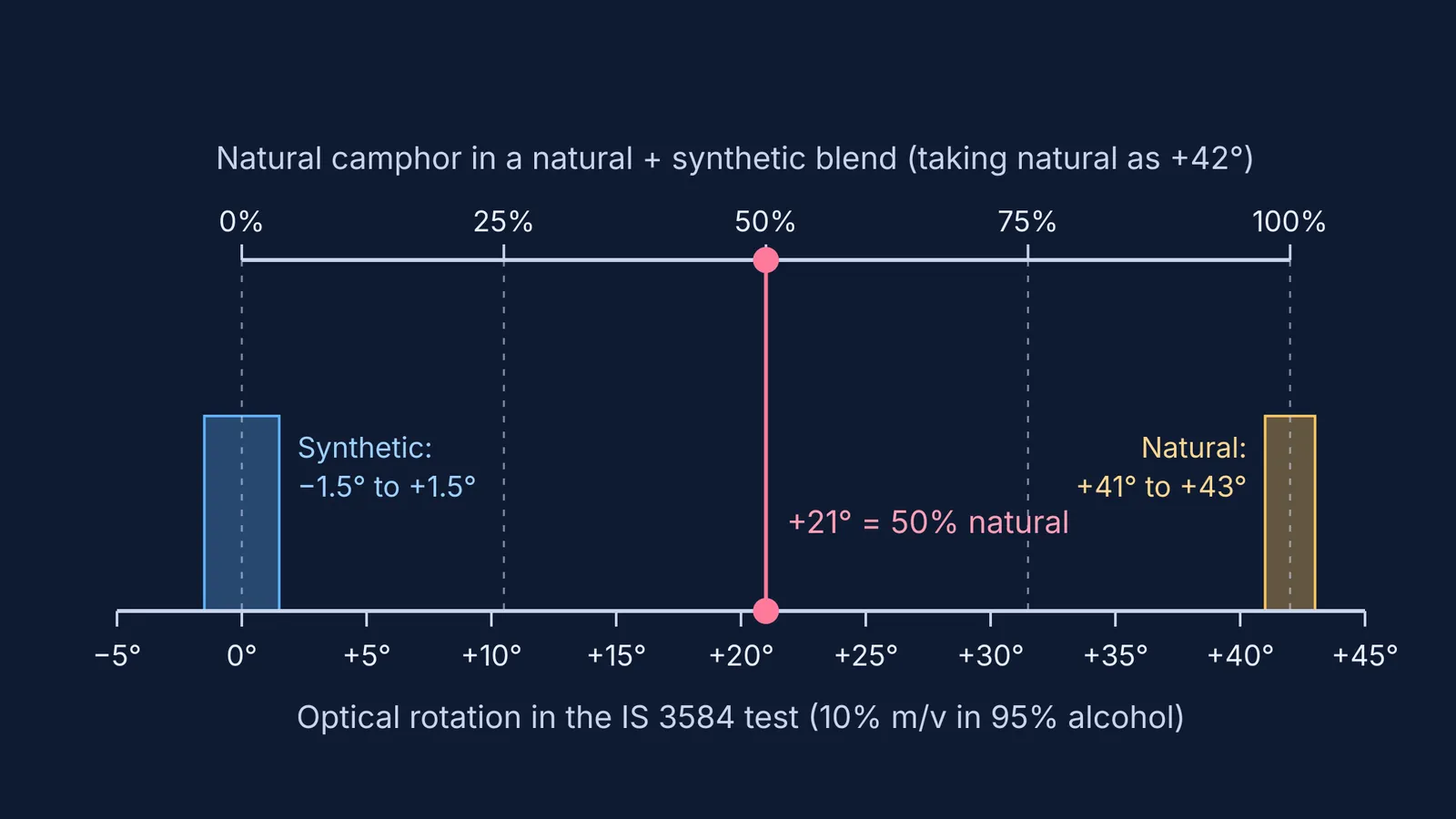
Optical rotation of a 10% (m/v) solution in 95% alcohol: natural +41° to +43°; synthetic −1.5° to +1.5°. The technical grade gets only the synthetic range.
Melting range, GC assay and non-volatile matter ask "how much camphor, and how clean?" Only rotation asks "which hand?"
Why do natural and synthetic camphor rotate light differently?
Plant enzymes are chiral, so a plant builds one enantiomer. PubChem's record for (+)-camphor gives its full name as (1R,4R)-1,7,7-trimethylbicyclo[2.2.1]heptan-2-one. That is the camphor that reads about +42° in the standard's test.
Synthetic camphor reads close to zero. A limit of ±1.5° means the product is essentially racemic: a 50 : 50 mixture of (+) and (−) camphor, whose rotations cancel. The standard does not describe the steps from α-pinene, so neither do we.
Enantiomers have identical melting points and solubilities, and an ordinary GC column like the one in the standard's annex cannot separate them. So pure camphor gets one melting range and one GC limit whatever its source. Only polarised light, which is itself chiral, sees the difference. Our post on why a racemic mixture reads zero and how it is resolved explains the cancelling in more detail.
How many stereoisomers does camphor have?
Number the skeleton the way the name does. C1 and C4 are the bridgeheads, C2 carries the C=O, C3, C5 and C6 are CH₂ groups, and C7 is the one-carbon bridge with two methyl groups. If the numbering is new to you, see [how to name bicyclo[2.2.1] compounds](https://news.fermi.ai/academic-success/bicyclo-compounds-iupac-naming).
C1 carries CH₃, C2 (the carbonyl carbon), C6 and C7. Four different groups, so C1 is a stereocentre.
C4 carries H, C3, C5 and C7. C3 leads to the C=O and C5 does not, so the groups differ. C4 is a stereocentre too.
C7 carries two identical CH₃ groups, so it is not a stereocentre. The CH₂ carbons are not either.
So 2ⁿ predicts 2² = 4 stereoisomers: (1R,4R), (1S,4S), (1R,4S) and (1S,4R). Only the first two exist.
The reason is the bridge. C1, C2, C3, C4, C5 and C6 form a six-membered ring, and C7 joins C1 to C4 across the top of it. A single carbon is far too short to start on the top face at C1 and finish on the bottom face at C4. So the bridge must sit on the same face at both ends, and once you fix C1, the configuration of C4 is decided. You cannot invert one bridgehead on its own.
So camphor has only one pair of enantiomers and no diastereomers. Natural camphor is one of them; synthetic camphor is both in equal amounts.
Check the degree of unsaturation too. Camphor is C₁₀H₁₆O, molar mass 152.24 g/mol (the standard prints 152.23). DU = (2 × 10 + 2 − 16) ÷ 2 = 3. That is two rings, because a bicyclic compound counts as two, plus one C=O.
How do you turn a rotation reading into percent natural camphor?
The rotation of a mixture is proportional to its enantiomeric excess (ee), as set out in our post on enantiomeric excess and optical purity. In a blend of natural and synthetic camphor, the synthetic part adds nothing to the rotation, so the fraction of natural camphor equals the reading divided by the reading for natural camphor.
One caution: Table 1 does not say whether +41° to +43° is a specific rotation or the instrument reading, and the method standard, IS 326 (Part 4), is not covered here. The ratio method works either way, provided both readings come from the same test.
Worked example. A pack labelled "synthetic, pure grade" is tested by the standard's method and reads +21°. Take natural camphor as +42°, the middle of its range.
Enantiomeric excess. ee = 21 ÷ 42 × 100 = 50%.
Each enantiomer. (+) = (100 + 50) ÷ 2 = 75%. (−) = (100 − 50) ÷ 2 = 25%.
Natural and synthetic. All the (−) comes from the synthetic part, which carries an equal amount of (+). So synthetic = 25% + 25% = 50%; the other 50% is natural.
Verdict. +21° is outside both ranges, so the pack fails with either label.
How much natural camphor can a "synthetic" label hide? The upper limit is +1.5°, so the most is 1.5 ÷ 42 × 100 = 3.6% natural camphor. Across the natural range of +41° to +43°, that is 3.5% to 3.7%.
What is the hexamine test in the camphor standard?
The 2007 revision added a test for adulteration with hexamine. The principle, in the standard's words, is that "Hexamine is insoluble in acetone". Camphor itself dissolves readily: the standard requires 1 g to dissolve in 1 mL of 95% alcohol.
The procedure is simple:
Put 1 g of the camphor sample in a test tube and add 5 mL of acetone.
Shake for 3 to 5 minutes at room temperature, then let the tube stand for 30 minutes.
A clear solution with every crystal dissolved means no hexamine. The standard says this method "detects hexamine in camphor as low as 1 percent".
Rotation catches racemic camphor sold as natural; the acetone test, a solubility test, catches a different white solid mixed in.
Where does this come up in your syllabus?
Class 12, Haloalkanes and Haloarenes: chirality, enantiomers, racemic mixtures and optical rotation.
JEE Main and Advanced: ee and optical purity numericals, and stereoisomer counts that break the 2ⁿ rule.
Class 11, Organic Chemistry: Some Basic Principles and Techniques: degree of unsaturation and naming bicyclic compounds.
If stereoisomer counts in bridged rings still trip you up, Fermi's AI tutor for JEE prep can work out what you already know and take you through similar structures step by step.
Quick checklist
IS 3584:2007: natural camphor reads +41° to +43°; synthetic reads −1.5° to +1.5°.
Camphor has stereocentres at C1 and C4, but the one-carbon bridge allows only (1R,4R) and (1S,4S).
Fraction natural in a blend = reading ÷ reading for natural camphor.
A "synthetic" label can hide at most about 3.6% natural camphor.
Hexamine is insoluble in acetone: 1 g camphor in 5 mL acetone must give a clear solution.