On this page
In 1886 the German chemist Albert Ladenburg made a base in the laboratory that smelled, boiled and formed salts exactly like coniine, the poisonous alkaloid of hemlock. One test failed. Natural coniine turns plane-polarised light; his did not turn it at all. Ladenburg worked out why, and then split his product into two mirror-image forms, one of which matched the natural alkaloid. The story covers three exam ideas at once: why a racemate reads zero, why it can melt differently from its enantiomers, and how a chiral acid separates them. We read the English abstracts of his two papers in the Journal of the Chemical Society, Abstracts for 1886 (vol. 50, p. 478) and Abstracts for 1887 (vol. 52, pp. 160–161), both summarising Berichte 19.
What did Ladenburg make in 1886?
Chemists already knew coniine's skeleton. A paper by J. Baum in the same 1886 volume (p. 563) found the normal propyl group next to nitrogen and confirmed "that conine is a homologue of piperidine". In modern terms coniine is 2-propylpiperidine, C₈H₁₇N: a saturated six-membered ring with one N, carrying a propyl group on the carbon beside N.
Ladenburg built that skeleton from simple pieces. From α-picoline (2-methylpyridine) and paraldehyde he obtained α-allylpyridine, C₈H₉N, a pyridine ring with a three-carbon side chain that still has a C=C. He then reduced it, "almost quantitatively", to α-propylpiperidine. This post stays with what the papers reported about structure and properties, not with how to carry the reactions out.
The match with coniine from hemlock was close. The 1887 abstract lists smell, solubility, specific gravity and physiological action, plus the platinum, gold and cadmium double salts.
Why did synthetic coniine not rotate light?
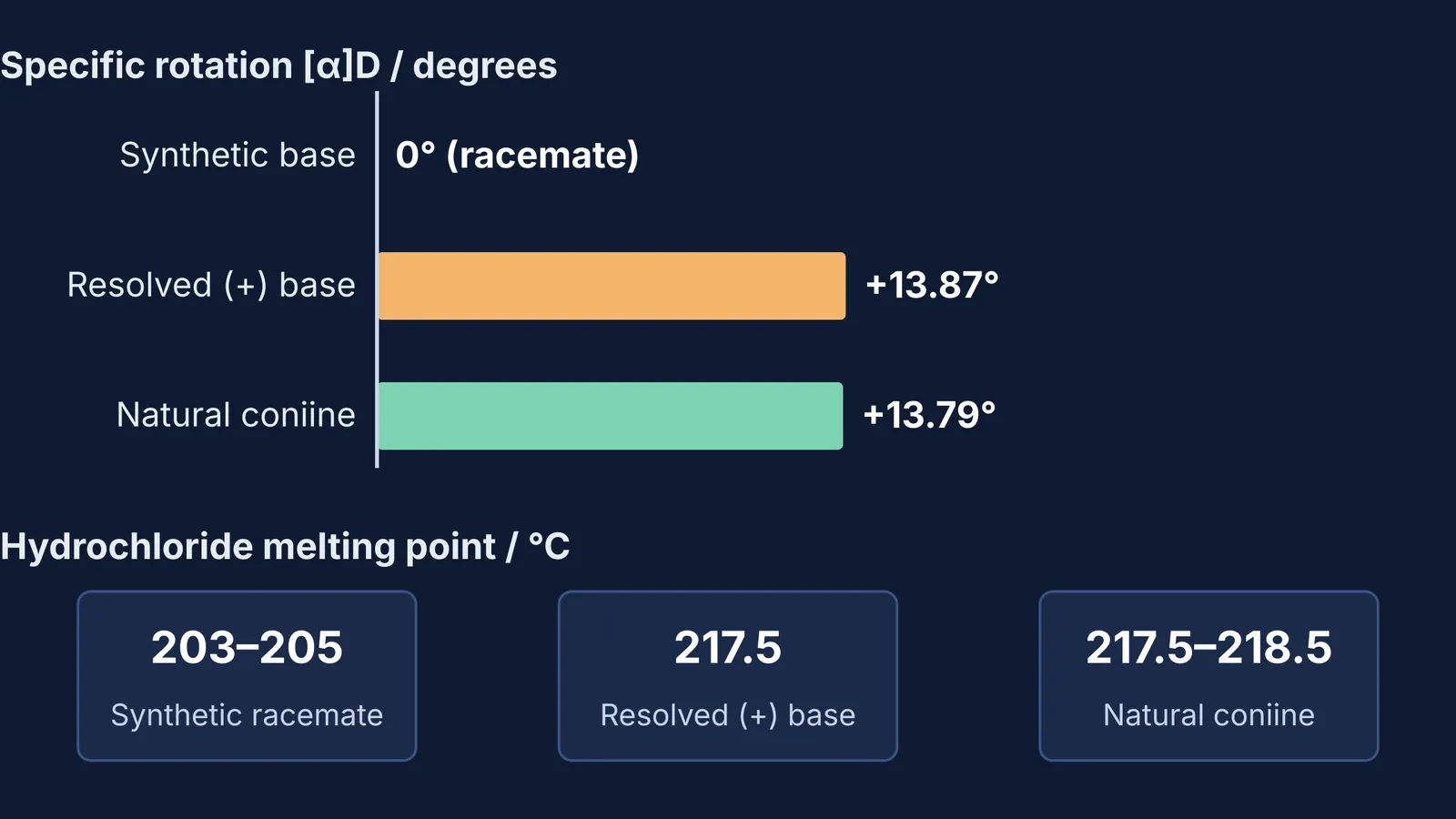
Two results did not fit. Its hydrochloride melted at 203–205 °C, while natural coniine hydrochloride melted at 217.5–218.5 °C. And α-propylpiperidine "is optically inactive, and must be regarded as a physical isomeride of conine".
Look at C2 of the ring. It carries N, the ring CH₂ on the other side, a propyl group and H: four different groups. So coniine is chiral and has two enantiomers. Ladenburg's reduction made both in equal amounts, because nothing in it was chiral. The product was a racemate. Each enantiomer rotates the plane by the same angle in opposite directions, so the mixture reads zero.
The melting points carry a second lesson. Two enantiomers have identical melting points. A racemate is a different solid, so it can melt at a different temperature. That is why his synthetic hydrochloride melted about 13 °C lower than the natural one, and why the melting point fell into line once he had a single enantiomer.
The 1886 abstract had been cautious: with the hydrochloride melting low, "the question of identity is still not quite certain". The 1887 paper settled it.
How did a seed crystal split the racemate?
Ladenburg tried two methods Louis Pasteur had introduced with tartaric acid. Pasteur's own crystal work is told in how Pasteur discovered molecular chirality with crystals.
A mould. A solution containing 0.5 per cent of the tartrate was seeded with the mould Penicillium glaucum, hoping it would consume one enantiomer. The abstract says: "without result".
A salt. He dropped a crystal into "a very concentrated solution of α-propylpiperidine hydrogen tartrate". Crystals separated slowly. The base recovered from them was dextrorotatory, with a specific rotation of 13.87°, against 13.79° for natural coniine. Its hydrochloride melted at 217.5 °C, the same as the natural salt.
Why can a salt do what plain crystallisation cannot? The abstract does not say which tartaric acid he used. If it was a single enantiomer, such as ordinary (+)-tartaric acid, the two salts are (+)-base·(+)-acid and (−)-base·(+)-acid. They are not mirror images of each other, so they are diastereomers. Diastereomers have different solubilities, so one crystallises first. Freeing the base from that salt gives a single enantiomer.
The mother liquor held the other salt. It gave a levorotatory base, still mixed with the dextro form. Ladenburg enriched it further through its cadmium iodide double salt. The abstract compares the most levorotatory fraction's rotation with natural coniine's only "under the same conditions", and the comparison is not clean enough to turn into an optical purity, so we leave it alone.
Worked example: ring count, H₂ count and optical purity
Use the degree of unsaturation, DU = (2C + 2 + N − H) ÷ 2. The method is in degree of unsaturation: rings and double bonds from a formula.
α-Allylpyridine, C₈H₉N. DU = (16 + 2 + 1 − 9) ÷ 2 = 5. The pyridine ring counts 4 (one ring plus three double bonds in the Kekulé form), and the side-chain C=C counts 1.
Coniine, C₈H₁₇N. DU = (16 + 2 + 1 − 17) ÷ 2 = 1. Only the ring is left.
Hydrogen taken up. 5 − 1 = 4, so each molecule takes up 4 H₂: C₈H₉N + 4H₂ → C₈H₁₇N. Check: C 8 = 8, N 1 = 1, H 9 + 8 = 17. Molar masses: 119.17 → 127.23 g/mol.
Optical purity of the resolved base. 13.87 ÷ 13.79 × 100 = 100.6%. A value just over 100% is measurement error. It tells you the crystals gave essentially one enantiomer.
Exercise. A partly resolved sample shows a specific rotation of +6.90° in the same conditions. Enantiomeric excess = 6.90 ÷ 13.79 = 0.500, or 50.0%. So (+) − (−) = 50% and (+) + (−) = 100%, giving 75% (+) and 25% (−). A racemate would read 0°, and pure (+) would read +13.79°.
More practice with these formulas is in enantiomeric excess and optical purity.
If resolution and ee questions keep slipping in mocks, Fermi's AI tutor for JEE prep works out where your reasoning stops and builds a plan from there.
Where does this sit in your syllabus?
Class 12 Haloalkanes and Haloarenes: chirality, enantiomers, racemic mixture, optical activity.
Class 12 Amines: amines are bases and form salts with acids.
Class 11 Organic Chemistry, Some Basic Principles: degree of unsaturation from a formula.
JEE Advanced: resolution through diastereomeric salts, enantiomeric excess.
For the underlying ideas one at a time, the Concept Library has a lesson for each concept in chemistry.
Quick checklist
Coniine is 2-propylpiperidine, C₈H₁₇N, with one stereocentre at C2.
A synthesis with no chiral input gives a racemate, which reads 0°.
Enantiomers share a melting point; a racemate may not.
A single-enantiomer acid turns a racemic base into two diastereomeric salts with different solubilities.
Ladenburg's resolved base: +13.87° against +13.79° for natural coniine.
ee = observed rotation ÷ rotation of the pure enantiomer.