

On this page
When a beam of plane-polarized light passes through a chemical sample, certain substances rotate the orientation of the light's electric field vector clockwise or anticlockwise. This property is known as optical activity, as defined by the IUPAC Gold Book on optical activity. Substances rotating the plane clockwise are dextrorotatory, marked (+), while those rotating it anticlockwise are laevorotatory, marked (-).
Whether a molecule rotates plane-polarized light depends on its three-dimensional symmetry. Under the IUPAC stereochemistry recommendations in *Pure and Applied Chemistry*, a molecule is chiral if and only if it is non-superposable on its mirror image. In organic chemistry, this condition usually arises when a carbon atom bonds to four different substituents, forming an asymmetric carbon or stereocenter.
If a molecule contains symmetry elements such as an internal plane of symmetry (σ) or a center of inversion (i), its mirror image can be aligned atom-for-atom with the original by rigid rotation in space. The IUPAC Gold Book on chirality classifies such superposable molecules as achiral. Achiral substances cannot rotate plane-polarized light because their symmetrical charge distribution cancels any net optical rotation.
Why is glycine the only achiral standard amino acid?
Every standard alpha-amino acid shares a common backbone: a central alpha carbon (Cα) bonded to an amino group (-NH2), a carboxylic acid group (-COOH), a hydrogen atom (-H), and a variable side chain (-R). As explained in our overview of the general structure of amino acids and how R groups work, the side chain determines each amino acid's identity.
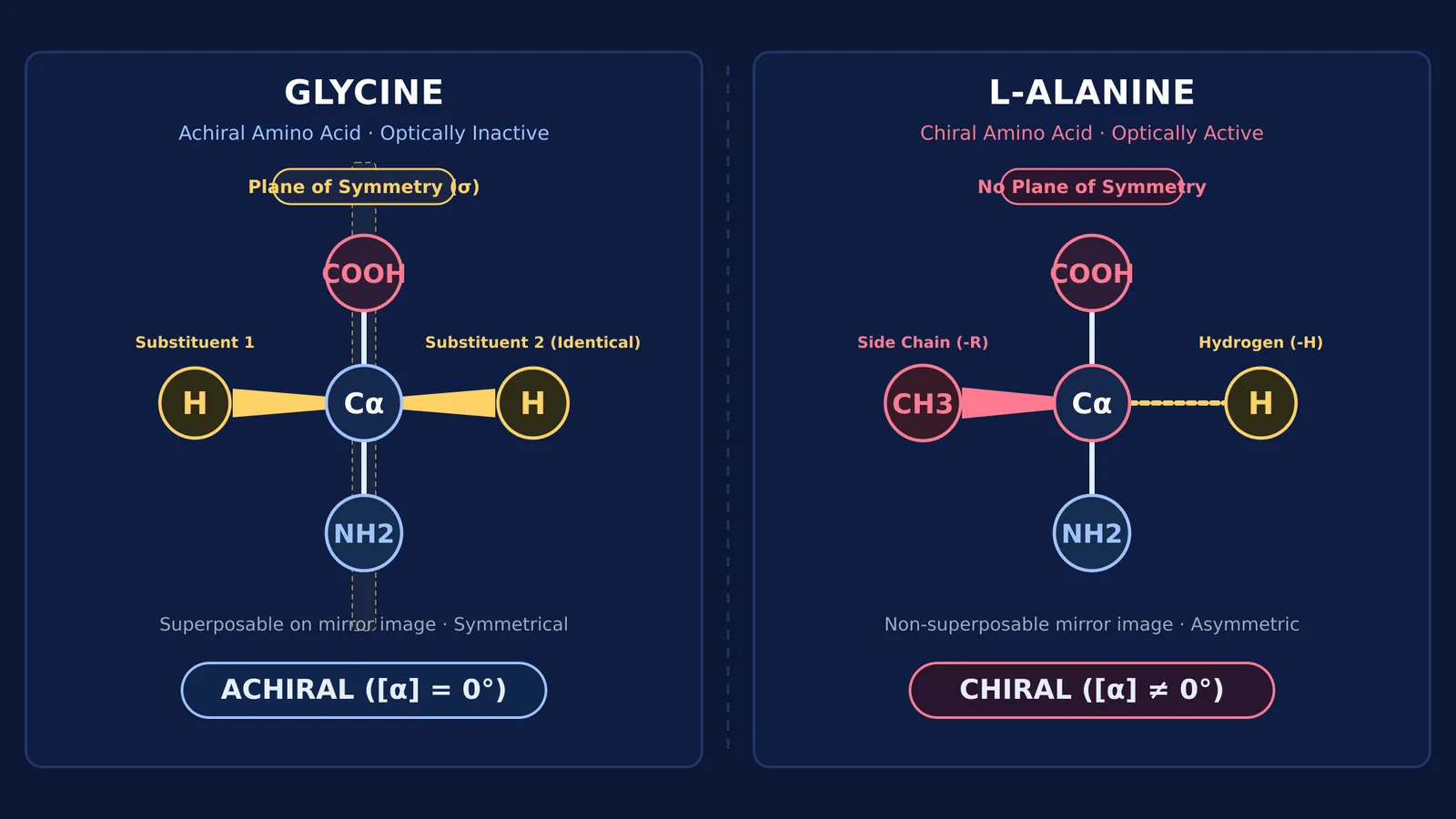
In glycine, the -R group is simply a second hydrogen atom (-H). Its molecular formula is NH2-CH2-COOH, with a molecular weight of 75.07 g/mol recorded in the NCBI PubChem database for glycine. The central alpha carbon bonds to:
One carboxylic acid group (-COOH)
One amino group (-NH2)
Two identical hydrogen atoms (-H)
Because two attached groups are identical, the alpha carbon is not asymmetric.
This pair of identical hydrogens creates an internal plane of symmetry that bisects the H-Cα-H angle and passes through the -COOH, Cα, and -NH2 atoms. Reflecting glycine across this plane yields a structure identical to the original. Because the molecule is superposable on its mirror image, pure glycine has a specific rotation [α] of 0° and is optically inactive.
How does glycine compare with the other 19 amino acids?
Human proteins are built from 20 standard amino acids. According to the NCERT Class 12 Chemistry textbook on Biomolecules, 19 of these 20 amino acids possess an asymmetric alpha carbon and are optically active. Glycine is the sole exception.
In every other standard amino acid—such as alanine (-R = -CH3) or serine (-R = -CH2OH)—the side chain differs from the amino group, the carboxyl group, and the hydrogen atom. Four distinct groups break molecular symmetry, yielding non-superposable mirror images called enantiomers. In terrestrial biology, ribosomally synthesized amino acids occur almost exclusively in the L-configuration, a phenomenon examined by Donna G. Blackmond in *Cold Spring Harbor Perspectives in Biology*.
Without a stereocenter, the designations "D-" and "L-" do not apply to glycine. In the classification of amino acids into acidic, basic, and neutral groups, glycine is grouped with neutral amino acids, yet it remains unique in stereochemistry. In our guide to identifying chiral molecules and optical isomers in 3D, its tiny side chain also provides unmatched conformational flexibility in proteins such as collagen.
If you find it challenging to picture 3D tetrahedral orientations on paper, the Fermi Simulation Lab offers interactive simulations for ideas that are easier to see than read, letting you rotate molecules and observe symmetry planes directly.
How to determine optical activity in exam questions?
In exams like NEET-UG and JEE Main, stereochemistry questions frequently test whether you can identify achiral exceptions. Use this three-step diagnostic checklist on any organic molecule:
Identify sp³-hybridized carbons: Focus on carbon atoms forming four single bonds. Planar sp² carbons in carbonyl groups (-COOH) cannot act as chiral centers.
Check for four distinct substituents: Compare all four attached groups. If any two groups match—like the twin hydrogens on glycine's alpha carbon—the carbon is achiral.
Test for internal symmetry planes: Even in molecules with multiple stereocenters, an internal plane of symmetry (σ) produces an optically inactive meso compound.
When you practice stereochemistry problems, the Fermi Problem Library offers worked problems with a step-by-step solver that explains the reasoning rather than just printing an answer. To explore related topics across science, the Fermi Concept Library covers concepts in physics, chemistry, biology, mathematics and computing, each with its own lesson.


